Blood Spatter Evidence: Science or Speculation?
The Banfield trial's key witness raises questions about a forensic discipline with a troubled history
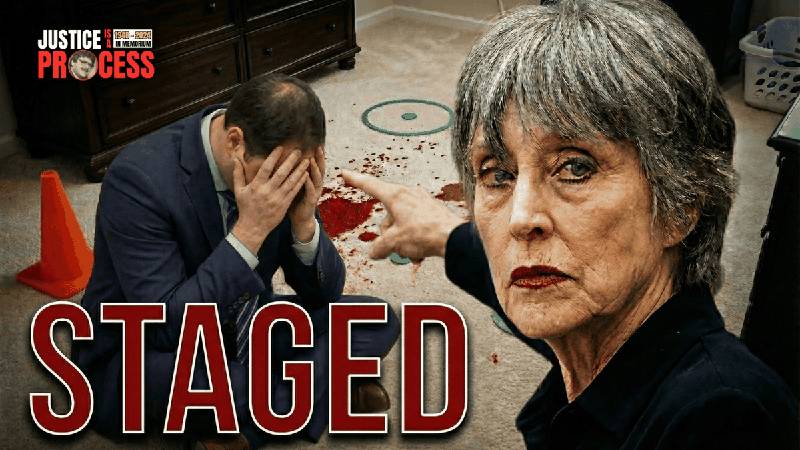
The prosecution's blood spatter expert took the stand today in the Brendan Banfield trial and delivered what sounded like a devastating blow to the defense. Joseph Ryan was moved after being shot. His head was repositioned while still bleeding. There's "a sequencing issue" with the crime scene. The scene, she suggested, was staged.
It's compelling testimony. Iris Dalley-Graff has 35 years of experience. She served two terms as president of the International Association of Bloodstain Pattern Analysis. She walked the jury through blood flows, transfer patterns, lines of demarcation, and cast-off stains with the confidence of someone who has testified in courtrooms across the country.
But here's the question nobody in that courtroom asked: How reliable is blood spatter analysis in the first place?
A "Science" Under Fire
In 2009, the National Academy of Sciences released a landmark report on forensic science in America. The findings were damning. Of all the forensic disciplines routinely used in criminal trials, the report found that most lacked scientific validation. Blood pattern analysis was singled out for criticism.
Translation: Blood spatter analysts can tell you a lot about what blood might do under certain conditions. What they can't tell you, with scientific certainty, is what actually happened in a specific crime scene.
The problem isn't that blood doesn't follow physical laws. It does. Blood in flight forms spheres. Gravity pulls blood downward. Contact transfers blood from one surface to another. These are observable, repeatable phenomena.
The problem is interpretation. When an analyst looks at a complex crime scene with dozens of blood stains, transfers, flows, and patterns, they're making judgment calls about which stain was deposited first, what position the body was in, what object caused which pattern. Those judgments are informed by training and experience, but they're not the same as scientific measurement.
What the Expert Actually Said

Let's be clear about what Dalley-Graff actually testified to. She said blood flows on Joseph Ryan's face went in multiple directions, which means his head was in different positions while bleeding. She said his hands showed contradictory blood patterns. She said there's "a sequencing issue" between where his body was found and where the blood evidence suggests he was at various points.
And then there's the detail that may matter most for the prosecution's case: Joseph Ryan had no knife slippage injuries on his hands.
Think about what the defense narrative requires. Ryan broke in. Ryan attacked Christine with a knife. Ryan was stabbing her repeatedly, violently enough that Brendan had to shoot him to stop it. But if Ryan was really gripping a knife and driving it into someone multiple times with force, you'd expect his hand to slip down the blade at some point. That's common in stabbing attacks. The expert was asked directly about this. She explained what knife slippage injuries look like. Then she confirmed: Ryan had none.
If Ryan wasn't actively wielding that knife, the entire self-defense justification falls apart. This wasn't a defense point. This was the prosecution dismantling Banfield's story piece by piece.
But here's what she couldn't say with certainty: who moved the body. When the body was moved. Why the hands ended up where they did. Whether the "staging" was intentional deception or something else entirely.
The Crime Scene Photos Tell a Story
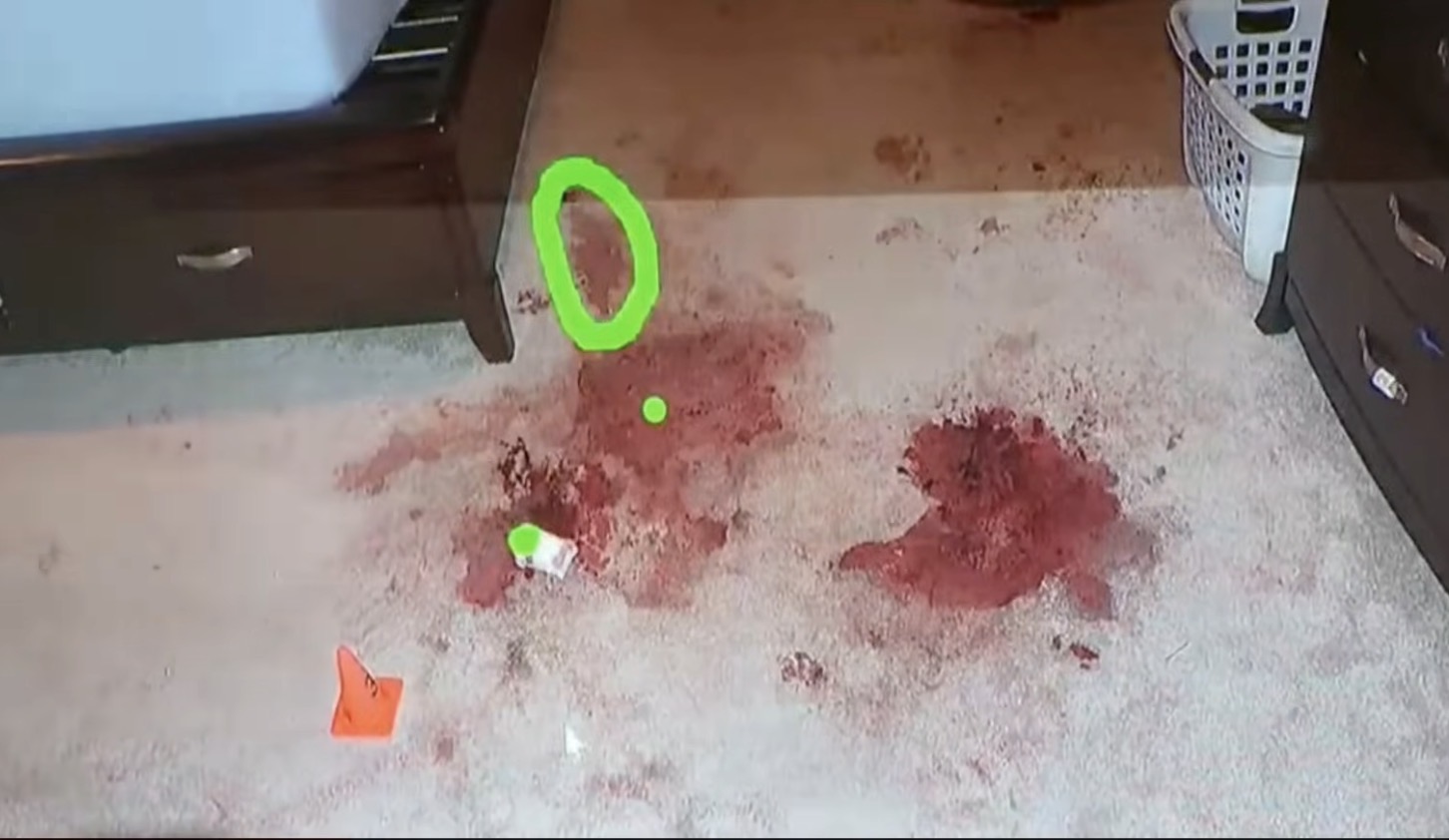
Look at the crime scene photos shown to the jury. Blood everywhere. Saturation stains. Transfer patterns. Projected patterns. Flow patterns. This wasn't a neat, contained incident. Two people died violently in this bedroom. Christine Banfield was stabbed multiple times. Joseph Ryan was shot twice. Blood from both of them ended up on Brendan Banfield's jeans, his shoes, and throughout the room.
The prosecution wants the jury to see these patterns as proof of staging, and the absence of knife injuries on Ryan as proof he wasn't really attacking. The defense will have to explain how all of this fits their narrative. That's getting harder by the day.
The Innocence Project Connection
But here's where I have to pump the brakes on accepting any of this as gospel.
This isn't academic. People have gone to prison based on blood spatter testimony. Some of them were innocent.
Joe Bryan spent 33 years in a Texas prison for the murder of his wife, convicted largely on blood spatter testimony from an analyst who claimed he could determine the shooter's position with precision. That analyst's methodology was later discredited. Bryan was released in 2020.
David Camm spent 13 years fighting convictions for killing his family. Blood spatter testimony put him away. Twice. Both convictions were overturned. He was finally acquitted in 2013 when another man's DNA was found on the victims' clothing.
The point isn't that blood pattern analysis is always wrong. The point is that it's not the objective, scientific certainty that prosecutors often present it as. When an expert takes the stand and says "the scene was staged," that sounds definitive. It's not.
What the Jury Should Consider
Dalley-Graff was asked directly: Could Ryan have placed his own hands over his chest wound after being shot? Her answer was revealing. She said it was possible for someone to fall with their hands in that position. But she said it doesn't "work together" with the other blood evidence.
That's not the same as "impossible." That's not the same as "scientifically excluded." That's an interpretation. A judgment call. An opinion dressed up in the language of forensic science.
The jury will have to decide how much weight to give that opinion. And they should know that blood pattern analysis has been seriously questioned by the scientific community, has contributed to wrongful convictions, and remains a discipline where different experts routinely reach different conclusions from the same evidence.
The Bigger Picture
I'm not saying Brendan Banfield is innocent. I'm not saying he's guilty. I'm saying the evidence should be examined critically, and "science" that isn't really science should be labeled as such.
The prosecution's theory in this case is that Banfield orchestrated an elaborate murder plot, lured Joseph Ryan to the house through a fake FetLife profile, shot him, stabbed his wife, and staged the scene to look like self-defense. Today's testimony gave them ammunition: blood evidence suggesting staging, and no knife injuries on the man supposedly attacking with a knife.
But the state still has to prove it. Beyond a reasonable doubt. And while today's testimony was damaging for the defense, "blood spatter expert says scene was staged" shouldn't be treated as dispositive evidence when the discipline itself can't meet basic scientific standards for reliability.
My father spent his career fighting a system that too often accepted junk science as gospel. Bite mark analysis. Hair microscopy. Fiber analysis. Blood spatter. One by one, these disciplines have been exposed as far less reliable than prosecutors claimed. People went to prison. Some of them died there. The ones who got out are still trying to rebuild their lives.
Watch the system. Question the "experts." Demand proof, not interpretation.
▶️ WATCH NOW Blood Patterns Don't Lie: Expert Says Scene Was STAGED | Au Pair Murder Trial Day 4Latest from the Desk
Want More?
Subscribe to Justice Is A Process on YouTube for live trial coverage, No Breaks editions, and breaking news as it happens.
🔴 Subscribe on YouTube111,000+ subscribers watching the system with us
Watch the system. Question everything.
— Justice
Comments
Comments are moderated and will appear after approval.