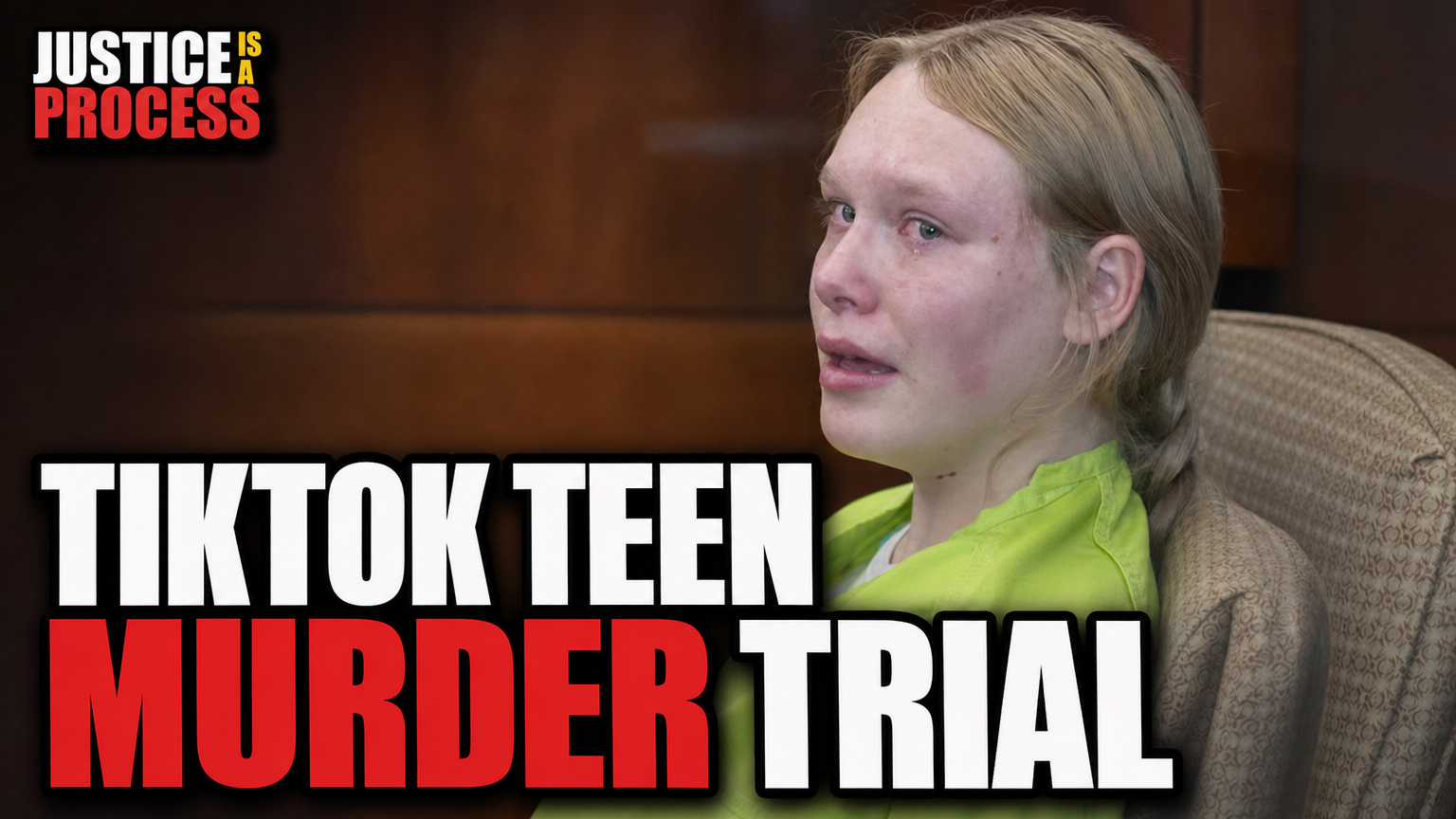
A 16-year-old called 911 to report her parents shot dead in their bed. Five months later, she was arrested for their murder.
July 2026 | Justice Is A Process
On the night of February 20th, 2025, a 911 dispatcher in Carroll County, Georgia picked up a call from a 16-year-old girl. Her mother and stepfather, she said, had been shot. Her five-year-old half-sister had found them first, in their bed, and had come to tell her.
Deputies arrived at a home in the 1500 block of Tyus Carrollton Road outside Carrollton and found exactly what the caller described. Kristin Brock, 41, and James Brock, 45, were dead in their bedroom, killed by gunfire. Their younger daughter, barely old enough for kindergarten, had been the one to walk in on it. Their older daughter, Sarah Grace Patrick, was the one who dialed 911.
For five months, nothing happened publicly. No arrest. No named suspect. A community grieved a young couple gunned down in their own home, and a teenage girl grieved online, in the place teenagers now grieve everything: TikTok. She posted tributes. She posted tears. She reached out to true-crime influencers and asked them to cover her parents' case, telling at least one of them it would be a "really big hit." She captioned one video "should prob delete later." She did not delete it.
Then, on July 8th, 2025, Sarah Grace Patrick turned herself in. The Carroll County Sheriff's Office announced at a press conference that the same girl who had called 911 that February night, the same girl posting grief content to hundreds of thousands of TikTok followers, was now charged with killing the two people she'd claimed to be mourning.
She was sixteen years old when Kristin and James Brock were shot to death. Under Georgia law, that does not matter. Murder is one of a short list of charges that sends a minor straight into Superior Court to be tried as an adult, no juvenile proceeding, no separate track. Sarah Grace Patrick has been sitting in an adult jail cell since the day she walked into the sheriff's office, and on August 3rd, 2026, she is scheduled to sit at the defense table in an adult courtroom while a jury decides whether she killed her mother and stepfather.
This is not a case where the facts are complicated to state. A woman and her husband were shot dead in their own bed. Their teenage daughter says she found out about it from a five-year-old. The daughter is now charged with doing it. What is complicated, and what this case will spend weeks litigating, is everything underneath that: what the evidence actually shows, what a forensic neuropsychologist found when he evaluated Sarah Grace Patrick for months before anyone charged her with anything, why her own mother's side of the family has lined up behind her while her stepfather's family has not, and why, after both sides told the court in July they were ready for trial, the defense turned around at the last possible moment and asked for more time.
We are not here to tell you she did it. We are not here to tell you she didn't. We are here to watch the State of Georgia try to prove, beyond a reasonable doubt, that a girl who called for help is the same girl who created the reason to call for it. That is the entire case. Let's begin.
According to the Carroll County Sheriff's Office, deputies were dispatched to a residence in the 1500 block of Tyus Carrollton Road on the evening of February 20th, 2025. What they found inside was a double homicide: Kristin Brock, 41, and her husband James Brock, 45, shot to death in their bedroom. Prosecutors allege the couple was killed in their bed.
The 911 call came from Sarah Grace Patrick, then 16, Kristin's daughter from a prior relationship and James's stepdaughter. According to reporting on the case, Patrick told the dispatcher that the couple's five-year-old daughter, her own half-sister, had discovered the bodies and alerted her. Patrick made the call that brought deputies to the house.
For the public, that is where the story started and, for five months, where it stayed. There was no announced suspect. There was no arrest. A young couple was dead, a small child had found them, and a case that should have generated instant answers instead generated a long, unsettling silence.
Prosecutors have said publicly, more than once, that investigators built a case using "mountains of physical and digital evidence," assembled with assistance from both the Georgia Bureau of Investigation and the FBI. What exactly that evidence consists of has not been laid out in detail in open court as of this writing. The defense, for its part, has said that full discovery remained outstanding heading into the scheduled trial date, and reporting on the case has consistently noted one specific, striking gap: as of the most recent hearings, no murder weapon has been recovered, and no physical evidence directly tying Sarah Grace Patrick to the shootings has been made public.
That gap matters, and it will matter more as this trial unfolds. A case built on "mountains of evidence" that has not yet publicly produced the gun that killed two people is a case the State will eventually have to explain to a jury. Maybe that explanation is straightforward: forensic and digital evidence, cell data, timeline reconstruction, statements, motive. Maybe the missing weapon becomes the hinge the defense pushes on hardest. We don't know yet. We are naming it now because it is the kind of fact that gets buried under five months of speculation and TikTok commentary, and it should not be.
The five-month gap between the killings and the arrest is itself worth sitting with. It is not, on its own, unusual for a homicide investigation, particularly one this evidence-heavy, to take months to build before charges are filed. Investigators do not have to arrest on a hunch, and a careful, methodical case built over five months can be a stronger case than one filed the same week as the crime. But that same gap is also exactly the kind of runway that lets public narrative outrun the courtroom. By the time Sarah Grace Patrick was arrested in July 2025, she had already spent five months as a very online, very visible teenager grieving in public, and a true-crime audience had already started forming opinions about her before a single piece of evidence had been tested in front of a judge. That imbalance, between how long the public has had to form a verdict and how little of the actual evidence the public has actually seen, is one of the central tensions this channel exists to correct.
On July 8th, 2025, the Carroll County Sheriff's Office announced that Sarah Grace Patrick had turned herself in and was being charged in connection with her mother and stepfather's deaths. She was initially booked on two counts of murder and two counts of aggravated assault. A Carroll County grand jury later returned a formal indictment the following month, in August 2025, expanding the case to eight counts: two counts of malice murder, two counts of felony murder, two counts of aggravated assault, and two counts of possession of a firearm during the commission of a felony, one set of charges for each victim.
Patrick has pleaded not guilty to every count. She has been held without bond since her arrest, and according to reporting on her custody status, has spent that time in solitary confinement, a detail her supporters have pointed to and that will likely surface again as the case moves toward trial.
The five months between the killings and the arrest were not silent online, even if they were silent in the courthouse. In the weeks after her mother and stepfather died, Sarah Grace Patrick posted a stream of content to TikTok processing her grief in public: tribute videos, emotional slideshows, and direct outreach to true-crime content creators asking them to look into her parents' case. According to reporting that has reviewed her posts, she told at least one influencer that coverage of the case would be a "really big hit," and captioned one of her own videos "should prob delete later."
None of that is a crime. Grieving publicly, even grieving in a way that reads as tone-deaf or self-promotional to outside observers, is not evidence of murder. But it is the reason this case has a nickname before it has a verdict. Every outlet covering it, from Court TV to true-crime podcasts, refers to Sarah Grace Patrick as some version of "the TikTok teen." That framing did not come from prosecutors. It came from her own public footprint, and once she was charged, prosecutors read that same footprint very differently: not as a grieving teenager reaching for connection, but, in the language they later used in a bond hearing, as part of a "pattern of intimidation towards family members and others with knowledge of the crime."
Both readings of the same set of TikTok posts can be argued in front of a jury. Neither one is proof of anything on its own. That tension, between the girl who publicly begged the internet to help solve her parents' murder and the girl the State now says pulled the trigger, is baked into every piece of coverage this case will generate.
Kristin Brock was 41 years old. James Brock was 45. They were a married couple living in Carrollton, Georgia, raising a young daughter together, in a household that also included Kristin's older daughter from a previous relationship, Sarah Grace Patrick. On February 20th, 2025, they were killed in their own bedroom, in their own bed, in the home where they were raising their family.
Public reporting on this case has, understandably, spent far more time on the defendant than on the people she is accused of killing. That is a pattern worth naming and resisting where we can. Kristin and James Brock were not a headline. They were two parents who did not come home to their five-year-old the next morning, because they never left. Whatever this trial ultimately proves or fails to prove, that fact does not change: two people are dead, and a small child found them.
One detail from the case has drawn particular attention and deserves to be handled with care rather than sensationalized: the couple's younger daughter, reported in various accounts as either five or six years old at the time, is the one who discovered her parents' bodies. She is, by the State's own account in pretrial hearings, considered a key witness in the case, and prosecutors have specifically raised concern about her safety and about the possibility of intimidation directed at her. We will not speculate about what she saw, what she remembers, or what role she may play at trial. We will say only that she is a child who lived through the worst morning of her life, and every surface of this coverage will treat her as exactly that, not as a plot device.
Sarah Grace Patrick was sixteen years old on February 20th, 2025, when her mother and stepfather were killed. She is Kristin Brock's daughter and James Brock's stepdaughter. Under Georgia law, because she is charged with murder, she is prosecuted as an adult regardless of her age at the time of the offense, a legal reality we will unpack further in the sections below.
Patrick was not arrested in the immediate aftermath of the killings. She lived through five months of public uncertainty about who, if anyone, would be charged, all while her online presence, particularly her TikTok activity, drew growing attention. She turned herself in on July 8th, 2025, and has been held without bond since, most recently denied bond again on January 28th, 2026, when Judge Dustin Hightower ruled that nothing had changed to justify her release.
That January bond ruling surfaced two details worth understanding before the trial starts. First, Patrick's maternal grandparents and her biological father had signed agreements with a production company to participate in a documentary about the case, reportedly worth a combined $100,000 to them, though not to Patrick herself. The judge cited that arrangement, and the "media frenzy" around it, as a factor weighing against her release, reasoning that a documentary deal could create pressure to generate content rather than lie low pending trial. Second, Patrick's release plan, according to the hearing, involved living out of state in Alabama with a friend rather than with any family member, a plan the judge treated as elevating her flight risk rather than reducing it.
Underneath the procedural detail sits a family split that will likely surface again and again as this trial proceeds. Kristin Brock's side of the family, Patrick's maternal relatives, have largely stood behind her and, according to reporting, have declined to cooperate with investigators. James Brock's family has taken the opposite position, actively pushing for the case to move forward and for justice to be done on his behalf. At Patrick's bond hearings, supporters have shown up wearing "I Stand With Sarah" shirts, seated in the same room as members of the family asking the court to keep her locked up. This is, in the most literal sense, a family divided over whether one of its own killed two of its own, and that division is not going away before the verdict does.
The defendant is presumed innocent. Nothing in her public grief, her TikTok activity, her family's fractured loyalties, or the length of time between the killings and her arrest is evidence of guilt. It may all be background a jury weighs, but it is background, not proof. The State has to prove she pulled the trigger, or was a party to someone else pulling it, beyond a reasonable doubt. That burden never moves to her.
The Judge: Dustin Hightower presides over the case as a Superior Court judge in Georgia's Coweta Judicial Circuit, which covers Carroll County along with Coweta, Heard, Meriwether, and Troup counties. Judge Hightower has denied bond for Patrick at multiple hearings and has managed the case through two trial-date resets, from an original January 5th, 2026 setting to the current August 3rd, 2026 date, while telling both sides at a July 2026 calendar call that a year and a half from indictment to trial is fast for a murder case and that further delay would need to clear a high bar.
The Prosecution: The case is being prosecuted out of the Coweta Judicial Circuit District Attorney's Office, led by District Attorney Herb Cranford. We have not independently confirmed the name of the specific assistant district attorney or attorneys handling day-to-day prosecution in the courtroom, and we will update this report and our coverage once that is confirmed on the record rather than guess.
The Defense: Sarah Grace Patrick's lead defense counsel is Shawn Hoover, a public defender who took over as lead on the case earlier in 2026 after her previous public defender left that office. Hoover has told the court he had to assemble an entirely new defense team, including new experts, after stepping in, which became a central part of his argument for more preparation time ahead of the August trial date. The defense retained a forensic neuropsychologist, Dr. Robert Schaefer, in August 2025, shortly after Patrick's arrest, to evaluate her. Dr. Schaefer's evaluation and eventual written report became the reason the original January 2026 trial date was pushed back in the first place, as prosecutors said they needed time to review his findings and potentially retain a rebuttal expert of their own.
Sarah Grace Patrick faces an eight-count indictment out of Carroll County: two counts of malice murder, two counts of felony murder, two counts of aggravated assault, and two counts of possession of a firearm during the commission of a felony, essentially a mirrored set of charges for each victim, Kristin Brock and James Brock. Here is what each of those charges actually requires the State to prove, in plain language.
What it means: Under Georgia law, malice murder is the intentional killing of another person with malice aforethought, meaning either a deliberate intent to kill or a wanton, depraved disregard for human life so extreme that intent to kill can be inferred from it. This is the most serious homicide charge under Georgia's criminal code and does not require proof of premeditation over any specific length of time; the malice can form in an instant.
What the State must prove: That Kristin Brock and James Brock are dead, that Sarah Grace Patrick caused their deaths, and that she did so with malice, either expressed intent or the kind of conduct a jury can look at and conclude intent must have been present.
Potential sentence: In Georgia, malice murder carries a mandatory sentence of life imprisonment, life without parole, or, in cases where the State seeks it and a jury imposes it, the death penalty. As of this writing, we are not aware of public confirmation that prosecutors have filed formal notice of intent to seek death in this case, and we will not speculate on charging strategy the State has not announced.
What it means: Felony murder is a killing that occurs during the commission of another dangerous felony, in this case charged alongside the aggravated assault and firearm counts. It does not require the State to prove malice or intent to kill at all. If a death occurs during the commission of a qualifying felony, the felony murder statute treats the killing itself as murder regardless of the defendant's state of mind toward the death specifically.
What the State must prove: That Patrick committed or attempted to commit an underlying felony (here, aggravated assault with a firearm), and that Kristin Brock and James Brock died as a direct result of that felony.
Potential sentence: Felony murder in Georgia carries the same sentencing range as malice murder, life imprisonment or life without parole. As a legal matter, felony murder and malice murder convictions on the same death typically merge at sentencing, meaning a defendant is not punished twice for one death even if convicted on both theories.
What it means: Aggravated assault under Georgia law is an assault committed with a deadly weapon or in a way likely to cause serious bodily injury. Here, it is charged as the underlying felony that supports the felony murder counts, alongside standing as its own charge.
What the State must prove: That Patrick assaulted Kristin Brock and James Brock with a firearm, in a manner that placed them in reasonable fear of immediately receiving a violent injury or that resulted in such injury.
Potential sentence: Aggravated assault in Georgia can carry a sentence of one to twenty years, though in this case it is charged in connection with a homicide and would be evaluated by the court alongside the murder counts, and may merge into them depending on how the jury's verdict is structured.
What it means: Georgia law separately criminalizes having a firearm on or near your person while committing certain felonies, layered on top of whatever the underlying felony charge already is.
What the State must prove: That Patrick had actual possession of a firearm while committing the underlying felonies charged against her.
Potential sentence: A conviction on firearm possession during a felony in Georgia carries a mandatory minimum five-year sentence that runs consecutively, on top of and after, any sentence imposed for the underlying felony.
The burden of proof on every one of these eight counts sits entirely with the State. Sarah Grace Patrick does not have to prove her innocence, does not have to explain where she was, does not have to produce an alternate suspect, and does not have to testify. If the State cannot prove each element of each charge beyond a reasonable doubt, the law requires an acquittal on that count, full stop. That is not a technicality. That is the entire point of the system this channel exists to watch.
Strip away the TikTok headlines and the true-crime podcast titles, and this case is going to trial for one specific reason: the State says it has overwhelming physical and digital evidence connecting Sarah Grace Patrick to her parents' murders, and as of the most recent public hearings, none of that evidence has included the murder weapon or any publicly disclosed physical link placing the gun in her hand. A five-month gap between the killings and any arrest, followed by an indictment built on evidence the defense says remains incompletely disclosed even as trial approaches, is exactly the kind of gap that puts a case in front of twelve strangers instead of resolving with a plea.
Layered on top of that evidentiary question is a second, entirely different fight: what a forensic neuropsychologist found when he spent months evaluating a sixteen-year-old accused of killing her parents. The defense retained Dr. Robert Schaefer within weeks of Patrick's arrest in August 2025. He met with her multiple times. His eventual report was significant enough that it pushed the original trial date from January to August 2026, because prosecutors said they needed time to review it and potentially bring in their own expert to respond. We do not know what that report says. Nobody covering this case publicly does, as of this writing. But the defense's own conduct, retaining a forensic neuropsychologist this early and this deliberately, is a strong signal that some version of a mental-state defense, whether that ultimately takes the shape of diminished capacity, an insanity-related defense, or mitigation aimed at sentencing rather than guilt, is coming. Georgia's insanity standard is narrow and specific (it asks whether a defendant, because of mental illness, either did not know the difference between right and wrong at the time of the act or acted under a delusional compulsion she could not resist), and it is a much higher bar to clear than popular culture assumes. We are not going to assume which version of this defense the evidence supports until the defense actually puts it in front of a jury. What we can say is that the neuropsychological evaluation is one of the two central pillars this trial will be built on, alongside the missing murder weapon.
Name it plainly: this case is at trial because the State believes it can prove, without the gun, that a teenager killed her own mother and stepfather, and the defense believes that between an incomplete evidence picture and a forensic evaluation of her mental state, there is real room for a jury to have doubt, whether doubt about what happened, doubt about who did it, or doubt about whether she can be held to full criminal responsibility for it.
Publicly, prosecutors have described the evidence against Patrick as extensive: "mountains of physical and digital evidence" developed with the assistance of the GBI and FBI. At bond hearings, they have argued she poses a danger if released and pointed to what they characterized as a pattern of intimidation directed at family members and others connected to the case, including specific concern about her young half-sister, described as a key witness. Their theory of the case, in broad strokes, is that Patrick is responsible for killing her mother and stepfather and that her public behavior afterward, from the TikTok outreach to the alleged intimidation, reflects consciousness of guilt rather than simple grief.
The defense, under new lead counsel Shawn Hoover, has signaled several distinct lines of attack heading into trial. First, the forensic neuropsychological evaluation, which points toward some form of mental-state defense or mitigation. Second, a challenge to the investigation itself: at the July 2026 calendar call, the defense pointed to a supplemental report filed by a police officer on the State's own witness list, who told the DA's office he had a "hunch" that the murder weapon might have been pawned. That hunch led investigators to a second individual and a firearm, which was tested, though prosecutors say GBI testing determined that weapon was not the murder weapon. The defense has used this episode to argue that the investigation has been less buttoned-up than prosecutors claim and that late-breaking developments like this justify more time to prepare. Third, the defense has raised new evidence it says was not available to Patrick's previous legal team, specifically ten years of DFACS (Georgia's child welfare agency) records, which the new defense team is still reviewing. And separately from the trial-date fight, the defense has previously filed motions for a change of venue, citing the intense local and national pretrial publicity this case has generated.
None of these threads, on their own, tell us what happened inside that house on February 20th, 2025. Together, they tell us this will not be a short or simple trial, and that both the forensic and investigative pictures remain genuinely contested heading into jury selection.
The "rogue officer" episode deserves a closer look, because it is a small story that says something bigger about how this case has been built. According to the defense, an officer on the prosecution's own witness list, someone who had never before filed a report specific to this investigation, went to the District Attorney's office and disclosed that he had a hunch the murder weapon might have been pawned. That hunch led him to a second person who allegedly had a gun matching the description, and that firearm was recovered and tested. The Georgia Bureau of Investigation's own testing determined it was not the weapon used to kill Kristin and James Brock. On its face, that sounds like a dead end, and prosecutors have treated it that way, arguing it changes nothing about their case. But the defense is using it for a different purpose: not to claim they've found the real gun, but to argue that an officer inside this investigation felt compelled, this late, to go around normal channels on his own instinct, and that if one loose thread like that exists, the defense is entitled to time to find out whether there are others. Whether Judge Hightower agrees that this justifies delaying a trial date he already called firm is a live question as of this writing.
This case has already been through one full trial-date collapse and, as of this writing, is fighting through a second attempt to delay it. Jury selection was originally set for January 5th, 2026. That date fell apart when prosecutors told the court they needed time to review Dr. Schaefer's neuropsychological evaluation and consider retaining their own rebuttal expert. Judge Hightower reset the trial to August 3rd, 2026, and, according to pretrial hearing records, told both sides at the time that he was setting a firm date and would not grant further continuances absent what he called a true, just legal issue.
Bond has been denied at least twice: an initial hearing after her arrest, and again on January 28th, 2026, when Judge Hightower found no material change in circumstances and cited both flight risk (an out-of-state release plan and the pending documentary deal) and the intimidation concerns prosecutors raised.
Then, in July 2026, with both the defense and the prosecution having previously told the court they were ready for the August 3rd date, Shawn Hoover reversed course at a calendar call and asked for a continuance. His stated reasons were the ones described above: a brand-new legal team assembled after he took over the case, ten years of DFACS records the defense says it has not had adequate time to review, and the supplemental officer report about the possibly-pawned, ultimately-excluded firearm. Prosecutors opposed the delay, arguing the material Hoover cited was either not genuinely new or not unusual for a case at this stage. Judge Hightower did not rule from the bench; he indicated he would issue a written order on whether the August 3rd date holds. As of our most recent reporting check, family members close to the case have told local outlets they expect the trial to proceed as scheduled, and no outlet has reported a new, official trial date beyond August 3rd. We are treating August 3rd, 2026 as the operative date for our coverage plan while acknowledging directly that this is the second time in this case's history that a "firm" trial date has faced a serious last-minute challenge, and we will update our audience immediately if that changes.
Every case this channel covers gets the same lens: not "is the defendant guilty," which is the jury's question and nobody else's, but "is the system doing what it's supposed to do." In a case like this one, involving a minor charged as an adult, a mental-health-driven defense theory, and intense pretrial media attention including a paid documentary deal involving the defendant's own family, that lens has several specific things to watch for.
Georgia is one of a number of states where certain serious violent felonies, murder chief among them, automatically place a minor's case in Superior Court to be tried as an adult, with no juvenile-court option and no judicial discretion to route it elsewhere at the outset. The specific statute is O.C.G.A. § 15-11-560, sometimes called Georgia's "Seven Deadly Sins" law, which gives Superior Court exclusive original jurisdiction over children age thirteen to seventeen charged with one of seven offenses: murder, voluntary manslaughter, rape, aggravated sodomy, aggravated child molestation, aggravated sexual battery, and certain armed robberies. Once a child is indicted under this statute, Georgia law allows the case to be sent back down to juvenile court only for what the statute calls "extraordinary cause," a high bar that is rarely met.
Sarah Grace Patrick was sixteen years old when the crime she's accused of occurred. She has never had, and under this statute will not have, a juvenile proceeding. Whatever you believe about whether that's the right policy, it is worth sitting with directly: a girl who could not vote, could not sign a legal contract, and could not buy a drink is being tried in the same courtroom, under the same rules, facing the same potential sentence, as an adult defendant would. That is not a loophole or an error. It is exactly how Georgia law is written for this charge, and it has been since SB 440 passed decades ago. We will watch how the defense uses her age and developmental history, including whatever the DFACS records and the neuropsychological evaluation ultimately show, and whether it becomes relevant to guilt, to a diminished-capacity or insanity-adjacent defense, or is held in reserve for sentencing if it comes to that. It is also worth noting plainly what Georgia's insanity defense actually requires, because popular culture routinely gets this wrong: a defendant must show that, because of mental illness, she either did not know right from wrong at the time of the act, or acted under a delusional compulsion she was powerless to resist. It is a narrow, difficult standard to meet, not a general "she was troubled" argument, and if the defense is heading in that direction, it will have to clear that specific bar in front of this jury.
We said it above and we'll say it again because it is the single fact most likely to decide this case: as of the most recent public reporting, no murder weapon has been recovered and produced as evidence tying Sarah Grace Patrick to the shootings. Prosecutors say the case does not depend on the weapon, that "mountains" of other physical and digital evidence exist. We will watch closely for what that other evidence actually is when it is presented in open court, because a jury asked to convict on two counts of malice murder without a recovered weapon is a jury that will need to be walked, carefully and specifically, through exactly how the State says it knows what it says it knows.
It is unusual, and worth flagging directly, for a defendant's own family members to sign a paid documentary deal about her pending murder case before that case has even gone to trial. Judge Hightower treated the arrangement as a factor cutting against Patrick's release on bond, reasoning that it created pressure toward media engagement rather than away from it. We will watch whether that arrangement, and the broader wave of true-crime podcast and social-media attention this case has already generated, creates problems for a fair trial: tainted jury pools, witnesses whose accounts have been shaped by months of public commentary, or a courtroom atmosphere that starts to feel more like content than adjudication. The defense has already moved for a change of venue over pretrial publicity concerns. Whether that motion succeeds or fails, the concern behind it is legitimate and belongs in this coverage.
By the time jury selection begins, this case will already have generated multiple dedicated podcast series following it in real time, along with recurring coverage from national outlets like Court TV and Law & Crime, true-crime YouTube channels, and the paid documentary project involving Patrick's own extended family. That level of pre-verdict media saturation is unusual even by true-crime standards, and it did not happen by accident: it happened because a teenager's own social media activity turned a regional double homicide into a national story before anyone was charged. We are, by publishing this report and covering this trial ourselves, part of that same ecosystem, and we are not going to pretend otherwise. What we can do is be transparent about it, hold ourselves to the presumption of innocence in our own coverage, and watch for the specific harms heavy pretrial publicity can cause: witnesses whose memories get reshaped by months of public commentary, jurors who arrive with opinions already formed, and a defendant, whatever she did or didn't do, tried in an atmosphere closer to a media event than a courtroom. That is exactly the concern behind the defense's change-of-venue motion, and it is a legitimate one regardless of what you think about the underlying charges.
Kristin Brock's relatives, by most public accounts, believe in Sarah Grace Patrick's innocence and have declined to cooperate with the investigation against her. James Brock's relatives want the case prosecuted fully. That is not a detail we're including for drama. It reflects something real about how uncertain even the people closest to this family are about what actually happened in that house. We will not treat either side of that family divide as more credible than the other by default. We will watch what each side says on the record, under oath, and weigh it the same way the jury has to.
Whatever the TikTok videos show, whatever the documentary deal implies, whatever the family divide suggests about who believes what, none of it is evidence of guilt. The presumption of innocence is not a phrase we say out of habit. It means the State of Georgia has to prove, count by count, element by element, beyond a reasonable doubt, that Sarah Grace Patrick is responsible for the deaths of Kristin Brock and James Brock. She does not have to prove she isn't. If the State's evidence, missing weapon and all, does not clear that bar, the law requires a not-guilty verdict regardless of what public opinion, TikTok commentary, or a documentary crew might prefer.
Every trial this channel covers is, underneath the specific facts, a test of whether the system built to handle exactly this kind of case actually works the way it's supposed to. This one tests several parts of that system at once. It tests whether Georgia's automatic adult-court statute for juveniles, written to handle the worst violent crimes without carving out exceptions for age, can still deliver a fair trial when the defendant was sixteen at the time of the offense and the defense is actively building a case around her mental and developmental history. It tests whether a five-month, evidence-heavy investigation followed by a "mountains of evidence" indictment can hold up when the single most obvious piece of physical evidence, the murder weapon, has not been publicly produced. It tests whether a courtroom can function normally when a documentary crew, a half dozen podcasts, and a national cable network are all already invested in the outcome before a single juror has been sworn in. And it tests whether a judge who has now faced two separate, serious attempts to push back a "firm" trial date can hold the line without shortchanging either side's right to actually prepare. None of those are questions about whether Sarah Grace Patrick is guilty. All of them are questions about whether the system gets a fair, careful answer to that question, and that is what we are going to be watching for, every single day.
Starting with jury selection, we will be in that courtroom, or watching the feed of it, every single day this trial is in session.
You'll get LIVE BROADCASTS as the day unfolds, NO BREAKS EDITIONS for anyone who wants the full day without the recesses, JUSTICE BREAKDOWNS with real analysis after testimony wraps, and KEY MOMENTS clips pulled from the heaviest parts of each day so nothing important gets buried.
This is not a case we are covering because a teenager has a TikTok following. We are covering it because the State of Georgia is asking a jury to convict a girl who was sixteen years old of killing her own mother and stepfather, without, as of this writing, a recovered weapon, while her own defense team has spent a year building a forensic case around her mental state. That is a real trial, with real stakes, for a real family torn in half by what happened in that house. We are going to watch it the way we watch every trial: closely, skeptically, and without deciding anything before the jury does.
The defendant is presumed innocent until proven guilty beyond a reasonable doubt. That is not a technicality. That is the foundation of everything we do here.
Let's watch the system together.
Subscribe to Justice Is A Process on YouTube for live trial coverage, No Breaks editions, and breaking news as it happens.
🔴 Subscribe on YouTube86,000+ subscribers watching the system with us
Discussion