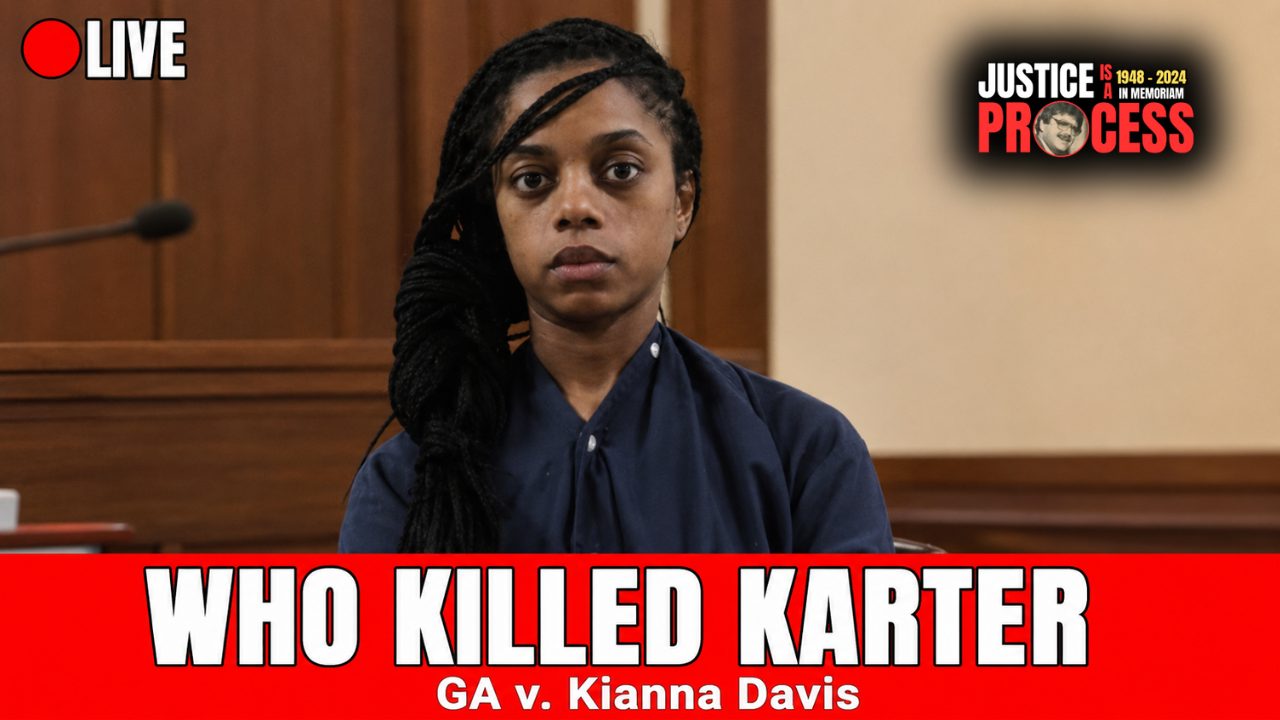
A mother, her friend, and the 48 hours that ended a 2-year-old's life
July 2026 | Justice Is A Process
Sometime between the fifteenth and the seventeenth of November, 2020, a 2-year-old boy named Karter Ambrose was struck hard enough that his liver tore.
Not a fall. Not an accident on the playground. According to the State of Georgia, someone hit this child with an object, and the blow was severe enough to lacerate one of the largest organs in his small body. A lacerated liver bleeds. It bleeds slowly, and then it bleeds fast, and a toddler cannot tell you what is wrong. He can only cry, and then grow quiet, and then stop.
Karter did not survive that weekend.
For nearly three years after he died, no one was charged. The autopsy existed. The injury existed. The people who had been in the room with Karter existed. And still, the calendar turned over once, twice, almost a third time before a Houston County grand jury handed up an indictment in October 2023 naming two people: Karter's mother, Kianna Davis, and a friend of hers, Kiyon Devoy Benton.
Today, that indictment finally reaches a jury. Kianna Davis goes on trial in Houston County, Georgia, facing malice murder and a stack of felony charges that could put her in prison for the rest of her life. Kiyon Benton, charged with the same crimes, will be tried separately at a later date.
We are not here to tell you Kianna Davis killed her son. We are not here to tell you she did not. We are here to do what we always do at Justice Is A Process: sit in that courtroom, watch the State try to carry a burden the Constitution places entirely on its shoulders, and ask out loud whether it does. Because two adults were with this child in the days he was fatally injured. The law is going to ask a jury to decide, beyond a reasonable doubt, that it was this defendant, this one, who is guilty. That is a heavy thing to prove. It should be. That is the whole point.
The defendant is presumed innocent. That is not a slogan we recite to be polite. It is the load-bearing wall of everything that happens over the next several weeks. Let's begin.
Let's start with what the State claims, and let's be precise about the words, because in a case like this the words carry everything.
Prosecutors allege that between November 15 and November 17, 2020, Kianna Davis and Kiyon Benton caused the death of 2-year-old Karter Ambrose by, in the language of the indictment, beating the child with an object, "the exact nature of which is unknown." The medical finding at the center of the State's case is a lacerated liver. In plain terms, the prosecution says Karter was hit hard enough in the abdomen to tear the organ, and that he died as a result.
Read that phrase again, because the defense certainly will: "an object, the exact nature of which is unknown." The State is telling you, in its own charging document, that it does not know what struck this child. That is not necessarily fatal to a murder case. Prosecutors do not have to produce the weapon to prove a homicide. But it is a detail worth holding onto, because it tells you something about the shape of the evidence. This is a case built on a body, a medical examiner's conclusions, and the circumstances of who was present, not on a recovered weapon or a confession the public knows about.
Notice that the State charges a range of dates, not a single moment. That two-day window matters. When prosecutors cannot pin the fatal act to a precise hour, they charge the span in which they believe it happened. It gives the State flexibility. It also gives the defense an opening, because a window that wide invites the question the entire trial may turn on: if the injury could have been inflicted at any point across those forty-eight hours, and more than one adult had access to Karter during that time, how does the State prove which adult, and which moment?
That is not us arguing for the defense. That is simply the arithmetic of the charge. When you indict two people for one child's fatal injury and you describe a two-day window, you have created a case where the central factual question is not only what happened, but who did it, and how the jury can be sure.
There is a second layer to the allegations, and it is arguably the more revealing one. Among the charges Davis faces is second-degree murder, and the State's theory for that count is not that she struck Karter. It is that she failed to seek immediate medical attention for him after he was hurt.
This is a crucial fork in the State's own case. Prosecutors are advancing two different stories at once. In one story, Davis intentionally and with malice beat her son to death. In the other, Davis is criminally responsible because, whatever caused the injury, she did not get Karter the care that might have saved him in time. A lacerated liver is not always instantly fatal. With prompt surgical intervention, such injuries can be survivable. The State's second-degree murder count is built on the theory that the clock ran out on Karter while the adults responsible for him did nothing.
To understand the fight ahead, you have to understand the injury, because it is the one piece of physical evidence everything else orbits. The liver sits in the upper right of the abdomen. In an adult it is partly shielded by the rib cage, but in a small child the abdominal wall is thin and the organ is relatively large and vulnerable. It takes significant blunt force to lacerate it. This is not the kind of injury a toddler gives himself falling off a couch. Medical experts who work in child abuse cases will tell you that fatal abdominal trauma in young children is, after head injury, one of the leading patterns of inflicted harm, precisely because it can be inflicted by a single hard blow and can be missed by an adult who is not looking for it. The bleeding is internal. On the outside, there may be little to see.
That is the double edge of the medical evidence in this case. On one side, a lacerated liver strongly supports the State's argument that Karter's death was a homicide and not an accident, that real force was used against a defenseless child. On the other side, the injury itself is silent about who delivered the blow. A torn liver does not carry a fingerprint. It tells you what happened to the body. It does not tell you whose hand did it, or in which of the hours across that two-day window. The medical examiner can testify to the mechanism and, within limits, to timing. The medical examiner cannot testify to identity. Holding those two truths at once, the injury is powerful proof of a crime and no proof at all of which suspect committed it, is the discipline this case demands.
The investigation was handled by the Warner Robins Police Department together with the Houston County Sheriff's Office, and later carried by the Houston County District Attorney's Office to a grand jury. Officials have described it as a thorough investigation, and the length of it, nearly three years, is consistent with that description in at least one reading. Child death investigations are among the most difficult cases in law enforcement. The victim cannot speak. The witnesses, if there were any beyond the adults in the home, are often other small children. The physical evidence degrades or was never documented in a way that isolates a single actor. And when more than one adult had access to the child, investigators face the exact problem the trial now faces: proving not just that abuse occurred, but which person is responsible.
So the silence between 2020 and 2023 can be read two ways, and honest coverage has to hold both. Read charitably to the State, the delay reflects careful work, waiting on forensic review, building a case solid enough to charge, and ultimately deciding the evidence supported charging both adults who had access. Read charitably to the defense, the delay reflects a case that was never strong enough to charge with confidence, one that moved only when prosecutors resolved the who-did-it problem by indicting everyone and leaving it to juries. The trial is where those two readings get tested against actual evidence, and we will be watching which one the record supports.
Karter died in 2020, but for most of the public this case did not exist until November 2023, when Davis was arrested. And the reason it made statewide news then had almost nothing to do with Houston County. By 2023, Kianna Davis was a high school teacher in Buford, in Gwinnett County, on the other side of the state from where Karter died. The headlines that traveled across Georgia were not about a Warner Robins toddler. They were about a schoolteacher, standing in front of classrooms full of teenagers, who was suddenly arrested and charged with beating a 2-year-old to death three years earlier.
That framing, teacher arrested, is how many people first encountered this case. It is worth naming plainly, because it can distort how the facts land. Kianna Davis's job in 2023 is not evidence of what happened in a home in 2020. The State has to prove what happened in November 2020, in Houston County, to a 2-year-old boy. Her later employment is context for the public reaction. It is not proof of anything, and a fair look at this case has to keep those two things separate.
There is a geography to this case that will shape how it is felt. Karter died in Houston County, in the Warner Robins area of middle Georgia, and that is where the trial is being held and where the community carried the loss. But the arrest three years later reverberated more than a hundred miles north, in Gwinnett County, where parents suddenly learned that the person standing at the front of their teenagers' classroom had been charged in a toddler's death. Two communities, two different shocks, one case. We mention this because the jury will come from Houston County, from the place where Karter lived and died, and the pressure of a grieving community is part of the environment any trial like this unfolds inside. A fair process has to hold up under exactly that pressure, or it is not worth much.
Before he was a case number, before he was a name in an indictment, Karter Ambrose was 2 years old. That is the entire span of his life. He never started school. He never learned to read. Whatever he was going to become, the person he would have grown into, none of it happened. A 2-year-old is barely out of babyhood, still learning words, still reaching up to be carried. That is who the State says was beaten badly enough to die.
Karter's father is Kadeem Ambrose, a firefighter who has served the Warner Robins Fire Department. He is not a defendant in this case, and the record gives no indication he was present for or involved in what happened to his son. He is, in every sense the trial will show, a father who lost a child. Whatever else this trial surfaces, that loss is real and it belongs to him. We will keep Karter a person throughout our coverage, not a prop in a legal argument, because the moment we forget that a real child died, we have lost the plot of why any of this matters.
Kianna Davis was 32 years old when she was arrested in November 2023. She is Karter's mother. By the time of her arrest she was working as a teacher at Seckinger High School in Buford, Georgia, a position she held far from where Karter died. She was taken into custody without incident by a combination of the Warner Robins Police Department, the Houston County Sheriff's Office, the District Attorney's Office, and a U.S. Marshals fugitive task force.
After her arrest, Davis was granted bond, set at $15,000. That number is worth pausing on. Bond in a malice murder case is not automatic in Georgia, and it is often denied outright for the most serious charges. A judge's decision to grant bond, and to set it at a relatively modest figure, reflects a judgment about flight risk and danger to the community. It is not a comment on guilt or innocence. But it does tell you that, whatever the charges say on paper, the court did not treat Davis as someone who had to be held without any possibility of release.
We say this next part every time, and we mean it every time: Kianna Davis is presumed innocent. She has pleaded not guilty. The burden of proving otherwise rests entirely on the State of Georgia, and she is not required to prove anything at all. She does not have to testify. She does not have to call a single witness. If the State cannot convince twelve jurors beyond a reasonable doubt, the correct verdict is not guilty, no matter how painful the underlying facts.
This is the figure who makes Georgia v. Davis different from the ordinary child-homicide case, and understanding him is essential to understanding the whole trial.
Kiyon Devoy Benton was indicted alongside Davis. He faces the same charges she does: malice murder, felony murder, cruelty to children, and the rest. He is described in the reporting as a friend of Davis, not as Karter's father and not, on the public record, as a relative of the child at all. Crucially, Benton is being tried separately. No trial date has been set for him as Davis's trial begins.
Stop and sit with what that means. The State has told a grand jury, under oath, that it has probable cause to believe two different people committed the same murder of the same child. Both indictments allege that Davis and Benton, together, beat Karter. But a jury in Davis's trial will be asked to decide her guilt, and only hers, on the evidence in her courtroom. And her defense is free to point at the empty chair where Benton is not sitting.
The prosecution comes out of the Houston County District Attorney's Office, the office that took this case to a grand jury in the fall of 2023. The investigation was led by the Warner Robins Police Department with the Houston County Sheriff's Office. The trial judge and the specific attorneys who will try the case in the courtroom are details that will come into focus as proceedings begin, and we will identify them for you as they do. As of the start of trial, the defense's public theory has not been laid out in detail, which is itself normal. Defendants are under no obligation to preview their case, and much of what the defense is fighting about becomes visible only once the evidence starts coming in.
Kianna Davis faces seven counts. They range from the most serious homicide charge Georgia law provides down to a form of criminal negligence. Let's take them in plain English, one at a time, and be clear about exactly what the State has to prove for each. Remember the through-line: for every one of these, the burden is entirely on the prosecution, and the standard is beyond a reasonable doubt.
What it means: Under Georgia law, malice murder is the unlawful killing of another person with "malice aforethought." Malice can be express, an actual intent to kill, or implied, where the killing shows an abandoned and malignant heart with no real justification. This is the count that says Davis meant to cause Karter's death, or acted with such disregard for his life that the law treats it the same way.
What the State must prove: That Karter is dead; that Davis caused his death; and that she did so with malice. This is the hardest count for the prosecution to carry, because it requires proving intent, the state of mind behind the act.
Potential sentence: In Georgia, malice murder carries life in prison, either with or without the possibility of parole. Death is a theoretical maximum but is not indicated on this record.
What it means: Felony murder is one of the most important and least understood charges in American law. It says that if a person causes a death while committing another felony, they can be convicted of murder even if they never intended for anyone to die. Here, the underlying felonies are the child-cruelty and aggravated-assault charges. The State does not have to prove Davis wanted Karter dead. It only has to prove she committed the underlying felony and that Karter died because of it.
What the State must prove: That Davis committed the underlying felony (for example, cruelty to children), and that Karter's death was caused during and because of that felony. Intent to kill is not required.
Potential sentence: Felony murder in Georgia also carries life imprisonment. This is why felony murder matters so much: it gives the State a path to a life sentence without ever having to prove Davis intended to kill her son.
What it means: This charge alleges that Davis maliciously caused a child under 18 cruel or excessive physical or mental pain. It is the felony that sits underneath the felony murder theory. In a beating case, this is often the engine that drives everything else.
What the State must prove: That Davis acted maliciously, and that her actions caused Karter cruel or excessive physical pain. The word "maliciously" is doing heavy work here, and the defense will fight over it.
Potential sentence: First-degree cruelty to children in Georgia is punishable by a term of years in prison, commonly cited in the range of 5 to 20 years.
What it means: Aggravated assault covers an assault committed with a deadly weapon, or with any object or means likely to cause serious bodily injury. Because the State alleges Karter was struck with an object severe enough to lacerate his liver, that object, whatever it was, is being treated as a deadly instrument.
What the State must prove: That Davis assaulted Karter with an object likely to and actually causing serious injury. This charge can also serve as an underlying felony supporting the felony murder counts.
Potential sentence: Aggravated assault in Georgia generally carries a sentence in the range of 1 to 20 years, and can be enhanced when the victim is a young child.
What it means: This is the "failure to act" count, and it is the most telling charge in the indictment. Georgia's second-degree murder statute applies when a death results from second-degree cruelty to children, which is a crime of criminal negligence rather than intent. The State's theory here is not that Davis struck Karter, but that she failed to seek immediate medical attention for him, and that her negligence caused his death.
What the State must prove: That Davis, through criminal negligence rather than malice, caused Karter's death, here by not getting him timely medical care. Notice this count does not require proving she inflicted the injury at all.
Potential sentence: Second-degree murder in Georgia is punishable by a term of 10 to 30 years, a serious sentence, but categorically different from the life terms attached to the murder counts above.
What it means: The lesser cruelty charge, this count alleges criminal negligence causing a child cruel or excessive physical or mental pain, without the malice required for the first-degree version. It is the negligence-based companion to Count 4 and the predicate for the second-degree murder count.
What the State must prove: That Davis, with criminal negligence, caused Karter cruel or excessive pain.
Potential sentence: Second-degree cruelty to children carries a term of years, commonly cited in the 1 to 10 year range.
Look at the architecture of these seven counts as a whole. At the top, malice murder, requiring intent, carrying life. Beneath it, felony murder, requiring no intent but still carrying life. Beneath that, the two cruelty charges and the aggravated assault that feed the felony murder theory. And at the bottom, second-degree murder built entirely on the theory that Davis failed to get Karter help. The State has built a ladder. If the jury will not climb to the top rung of intentional murder, prosecutors have given them rung after rung to land on instead. That structure is a strategy, and recognizing it is the first step to watching this trial with clear eyes.
Seven counts does not mean seven sentences stacked end to end, and it is worth understanding why before verdict, so the numbers do not mislead you when they come. Georgia law, like the law in every state, does not allow a defendant to be punished multiple times for what is essentially a single act. This is the doctrine of merger. When a jury returns guilty verdicts on overlapping homicide counts arising from one death, the counts merge for sentencing, and the judge sentences on the most serious one.
In practice, that means this: if Davis were convicted of both malice murder and felony murder for Karter's single death, she would not serve two life sentences. Under long-standing Georgia law, a malice murder conviction controls, and the felony murder verdict is treated as surplusage, it does not yield a separate sentence. Similarly, the aggravated assault and the cruelty counts that serve as the predicate for felony murder generally merge into the murder conviction rather than adding consecutive time. Some counts may survive as separate sentences if they punish genuinely distinct conduct, but the core homicide counts collapse into one.
Why does the State charge all seven, then, if they mostly merge? Insurance. Each count is a separate path to holding Davis responsible, and the jury might accept one theory while rejecting another. Prosecutors charge in the alternative so that a conviction survives even if the jury balks at the most demanding count. When you hear a verdict read, do not count the guilty findings like a scoreboard. Watch which count is the most serious one the jury accepted, because that is the one that will define the sentence.
Every case that reaches a jury reaches it for a reason. Somewhere, the two sides could not agree on what the evidence proves, and so twelve strangers will decide. Here is the reason this case is going to trial, the tension that will run under every witness and every objection for the next several weeks.
Two adults were with Karter Ambrose during the window he was fatally injured, and the State waited nearly three years to charge anyone. Those two facts, together, are the case.
Start with the two adults. The State has charged both Kianna Davis and Kiyon Benton with beating Karter. It has said, in effect, that both of them are responsible. But it is trying them separately, and in Davis's trial the jury will be asked to find that she, specifically, is guilty beyond a reasonable doubt. The moment the State names a second person who was there, it hands the defense a question it may never be able to fully answer: how do you know it was her, and not him? Unless the prosecution can put the fatal act in Kianna Davis's hands with evidence that excludes reasonable doubt, the existence of Benton is a permanent shadow over the case.
Now add the three-year delay. A lacerated liver in a 2-year-old is not a hidden injury. An autopsy would have found it in 2020. So why did it take until October 2023 for a grand jury to indict? The State will have an answer, and it may be a good one: cases involving small children and multiple potential perpetrators are genuinely hard to build, and prosecutors are right to take the time to get them right rather than charge on a hunch. But the defense gets to ask the harder version of that question. If the evidence was strong, why did it sit? What changed in 2023 that was not true in 2020? Was there ever evidence that pointed clearly at one adult over the other, or did the case only move forward once prosecutors decided to charge them both and let a jury sort it out?
That is the core tension of Georgia v. Davis. Not whether a child died. He did, and that is a tragedy no verdict will undo. The question is whether the State can prove, beyond a reasonable doubt, that this defendant is the one the law can hold responsible for it, three years after the fact, with a second charged adult standing just out of the jury's view.
Here is where we have to be honest about something that cuts against the simple version of the whodunit, because a fair briefing tells you the law that helps the State, not just the law that helps the defense.
Under Georgia law, you do not have to personally strike the blow to be guilty of murder. The state's party-to-a-crime doctrine says that a person who intentionally helps, encourages, or is knowingly involved in the commission of a crime is a party to that crime and can be convicted exactly as if they committed it with their own hands. A getaway driver can be guilty of armed robbery without ever touching the gun. Applied here, it means the State may not need to prove that Kianna Davis is the one who lacerated Karter's liver. If prosecutors can prove she was a knowing participant in what happened to him, or that she shared in the criminal conduct, the law can hold her responsible for the murder even if Kiyon Benton is the one who delivered the fatal blow.
This is why the two-defendant structure is a double-edged sword, and why the whodunit framing, while real, is not the whole story. On the one hand, the existence of a second charged adult creates reasonable doubt about who acted. On the other hand, party-to-a-crime liability gives the State a way around that doubt: it can argue the jury does not have to decide which adult swung the object, only that Davis was criminally in it together with the other. Watch closely for whether the prosecution leans on this theory. If the State's evidence cannot cleanly identify the striker, expect it to pivot hard to party liability, and expect the defense to fight to keep the jury focused on the narrower question of what Davis herself actually did.
But party liability has its own limit, and it is a real one. Mere presence is not enough. Being in the house, being the mother, even failing to stop what another adult did, does not automatically make a person a party to murder under Georgia law. The State has to prove shared criminal intent, not just proximity. That line, between guilty participation and being present while someone else did something terrible, is one of the most important lines this jury will be asked to draw. The failure-to-seek-care charge lives right on top of that line, which is exactly why it is in the indictment.
The State charged Davis and Benton together but is trying them apart, and the mechanics of that decision shape everything the jury will and will not see. When co-defendants are severed into separate trials, it is often because each has made statements, or has defenses, that would prejudice the other if they sat at the same table. A joint trial can create constitutional problems, particularly if one defendant's out-of-court statement implicates the other but that other defendant cannot cross-examine the person who made it.
The practical result for Davis's trial is the empty chair. Benton is charged with the same murder, but he is not on trial here, and depending on the court's rulings the jury may hear relatively little about him, or a great deal. The defense will want that chair as full as the rules allow, because every fact that points at Benton is a fact that raises doubt about Davis. The State will want the chair as empty as possible, keeping the jury's attention on the defendant in front of them. How the judge manages that tension, what the jury is told about Benton, what evidence about him comes in and what stays out, will be one of the quiet but decisive battles of this trial. It will rarely make a headline. It may well decide the verdict.
The prosecution's case, as it stands publicly, rests on the medical evidence and the circumstances of access. Expect the State to build its narrative around the medical examiner. The autopsy findings, the nature and severity of the liver laceration, the estimated timing of the injury, and the medical opinion about whether prompt care could have saved Karter will be the spine of the prosecution's case. Physical evidence and forensic testimony do not point fingers on their own, but they establish that a crime occurred, that Karter's death was a homicide and not an accident, and that the injury was inflicted with force.
From there, the State will work to place Davis with Karter during the critical window and to argue that the circumstances, whatever they turn out to be, point to her. The felony murder and cruelty counts let prosecutors win even without proving she intended to kill. The second-degree murder count lets them win even without proving she landed the blow. The breadth of the charges is the strategy: the State is trying to make sure that if the jury believes something bad happened to Karter on Davis's watch, there is a count that fits.
It is worth being fair to the prosecution on one point, because fairness cuts both ways. A case built on circumstantial evidence is not a weak case by definition. Georgia juries are instructed, correctly, that circumstantial evidence can prove guilt beyond a reasonable doubt, and many just convictions rest on it. Prosecutors are almost never handed a video of the act or a signed confession. What they are asking a jury to do is draw reasonable inferences from a chain of facts: who had access, what the injuries show, how the adults behaved before and after, what was said and what was not. The defense will call that chain speculation. The State will call it a picture. The jury's job is to decide whether the picture is clear enough to leave no reasonable doubt. Circumstantial does not mean flimsy. But it does mean every link in the chain has to hold, and the more the case depends on inference, the more each inference has to be earned.
As trial begins, the defense has not laid out a detailed public theory, and it is not required to. But the structure of the case tells you where the fight will be, and any competent defense will press on the pressure points the record already reveals.
The first is identity. With a second adult charged for the same crime, the defense will hammer reasonable doubt about who actually caused the injury. Every time the State's evidence is consistent with either Davis or Benton, that is a point for the defense. The second is the unknown object. The State's own indictment concedes it does not know what struck Karter. The defense will use that concession to question how firmly the prosecution really understands what happened. The third is the delay. Expect the defense to make the three-year gap into a story about a weak case that prosecutors were never confident enough to bring until they decided to charge everyone and hope. And the fourth is the medical timeline. On the failure-to-seek-care theory, the defense will contest whether Davis knew or should have known how serious Karter's condition was, because criminal negligence requires more than hindsight.
As of the start of trial, no major suppression rulings or evidentiary battles have surfaced publicly in a way that reshapes the case. That can change quickly once trial begins, and pretrial motions often get resolved in the days right before opening statements. We will track any significant rulings, motions in limine, and evidentiary fights as they happen, because those decisions, about what the jury is and is not allowed to hear, frequently matter more to the outcome than anything a witness says on the stand.
This is the part of our coverage that separates Justice Is A Process from a headline and a mugshot. Other outlets will tell you a teacher was accused of killing a toddler. We are going to watch whether the system does its job, and we are going to tell you honestly whether it does.
Here is what we will be watching for, day by day.
Is the burden staying where it belongs? The State must prove every element of every count beyond a reasonable doubt. Kianna Davis does not have to prove she is innocent. She does not have to explain what happened. She does not have to testify. Watch whether the prosecution ever tries, subtly, to shift that burden, to suggest that because Davis was Karter's mother she owes the jury an explanation. She does not. The Constitution put that weight on the State, and it is supposed to stay there from opening statement to verdict.
How does the two-defendant problem get handled? This is the single most important thing to watch in this trial. When the jury hears that Kiyon Benton was also charged, how does the State ask them to be sure it was Davis? Does the evidence actually distinguish between the two adults, or does it merely establish that one of them must have done it? "One of these two people is guilty" is not the same as "this person is guilty beyond a reasonable doubt." The difference between those two sentences is where this case lives or dies.
What does the medical evidence actually say, and what does it not? Forensic testimony can be powerful and it can also be oversold. Watch whether the medical examiner can speak to the timing of the injury with precision, or only in ranges. Watch whether the science can say who inflicted the wound (it usually cannot) versus only that a wound was inflicted. A jury that mistakes "this injury was caused by force" for "this defendant caused it" has skipped the most important step.
Does the three-year delay cut against the State? Delay is not, by itself, a defense. There is no statute of limitations on murder in Georgia, so the State was free to bring these charges in 2023, or 2026, or later still. But delay can matter in two ways. As a matter of due process, a defendant can challenge pre-indictment delay if it caused real prejudice, lost witnesses, faded memories, evidence that could have been preserved and was not, and if the delay was for an improper purpose. That is a hard standard to meet and rarely wins, but it is worth watching whether the defense raises it. And as a matter of persuasion, a long gap between a child's death and an arrest can plant the seed of doubt with a jury: if this was so clearly murder, why did it take three years to say so? Watch whether the prosecution offers a real explanation for the gap, and whether the defense turns that gap into a story about a case that was never sure of itself.
Will the jury hear about Karter's other injuries, if there were any? In child abuse prosecutions, one of the most consequential pretrial fights is over prior-acts evidence, what lawyers call 404(b) evidence, after the rule that governs it. If investigators or the medical examiner documented older injuries, healing fractures, prior bruising, a history that suggests a pattern, the State will fight to put that in front of the jury as proof of intent and absence of accident. The defense will fight just as hard to keep it out, because prior-acts evidence is powerful and it is dangerous: it can invite a jury to convict on the basis of what kind of person they think the defendant is, rather than what the State proved about this act. Whether that evidence exists in this case is not yet public. If it does, the ruling on whether the jury hears it could matter more than any single witness. We will be watching for it.
Is Karter kept at the center? A real child died. Watch whether both sides remember that. The State should not reduce him to a set of autopsy photographs deployed for shock, and the defense should not treat him as an inconvenient fact to be managed. Karter Ambrose was a person. The dignity the system affords him, and the fairness it affords the woman accused of killing him, are not in competition. A just process owes both.
These are the questions Steven M. Askin taught us to ask. Not "did she do it," which is the question the tabloids ask. But "can the State prove it, the right way, with the burden where the Constitution put it." Those questions protect Kianna Davis today. They protect you and me and everyone we love tomorrow. That is what it means to say that justice is a process, and not just a result.
What to expect from here: jury selection, opening statements, and then the State's case, which will likely lead with law enforcement and the medical examiner before moving to the circumstances of the household and the days around Karter's death. The defense will cross-examine throughout and may or may not put on a case of its own, because it is under no obligation to. How long the trial runs depends on the number of witnesses and the intensity of the forensic fight, but a case of this seriousness, built on medical evidence and the two-defendant dynamic, is one to settle in for.
Starting today, we are in that courtroom. Every day. Live broadcasts as it happens. No Breaks editions for uninterrupted viewing. Justice Breakdowns with deep analysis after each day. Testimony segments so you can hear every word for yourself.
This is not about speculation. It is about watching the system work, and telling you the truth about whether it does.
Kianna Davis is presumed innocent until proven guilty beyond a reasonable doubt. That is not a technicality. It is the foundation of everything we do here.
Let's watch together.
Subscribe to Justice Is A Process on YouTube for live trial coverage, No Breaks editions, and breaking news as it happens.
🔴 Subscribe on YouTube111,000+ subscribers watching the system with us
Discussion