Kouri Richins: Judge Issues Mixed Rulings on Expert Witnesses as February Trial Nears
Court limits FBI profiler's testimony, allows handwriting expert, and reserves ruling on domestic violence expert pending trial evidence
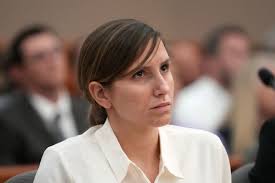
Nearly four years after Eric Richins was found dead in the couple's bedroom with five times the lethal dosage of fentanyl in his system, his wife Kouri Richins is finally approaching trial. And today's hearing in Park City, Utah showed just how fiercely both sides are fighting over what evidence the jury will actually hear.
The 35-year-old realtor and mother of three faces aggravated murder charges. Prosecutors say she spiked her husband's Moscow mule cocktail on March 4, 2022, and that this wasn't her first attempt. They allege she poisoned his Valentine's Day sandwich two weeks earlier. The sandwich that made him break out in hives and black out. The sandwich he ate one bite of before setting it down.
One bite. According to prosecutors, that's how she learned it takes "a truckload of fentanyl" to kill someone. So she allegedly adjusted her approach and put it in a lemon shot he'd throw back all at once.
Richins maintains she's innocent. She pleaded not guilty to all charges. And today, her defense team scored some significant victories in limiting what the jury will hear.
The "Pathway to Violence" Battle
The main event was the fight over Molly Amman, a former FBI profiler the state wanted to use as an expert on something called the "pathway to violence" model. It's a framework that supposedly identifies stages people go through before committing planned acts of violence: forming a grievance, an inability to let it go, developing a plan, preparation, and ultimately the attack.
The defense brought in their own former FBI expert, Dr. Breonna Fox, to tear it apart. Fox, now a tenured professor at the University of South Florida who spent years in the FBI's Behavioral Science Unit, didn't mince words. She called the pathway to violence "pure theory" with no scientific testing or reliability. No error rate. No accuracy rate. Never published in any legitimate peer-reviewed journal.
Fox's fundamental point was devastating: the model was created by looking backward at people who actually committed violence. Of course you can identify patterns after the fact. But it tells you nothing about how many people fit those same patterns and never hurt anyone. It's like predicting lottery numbers after the drawing already happened, she said.
Amman, who testified for the state, defended the model as "foundational" to behavioral threat assessment. But she had to acknowledge it cannot predict violence and cannot generate any numerical probability. It's descriptive, not predictive. She used a cardiology analogy: if you show up overweight, sedentary, with high cholesterol and terrible diet, a doctor can't tell you you'll have a heart attack Tuesday at 9:24am. But they can say you're at heightened risk.
The problem with that analogy in a criminal case is obvious. We're not trying to prevent something. We're trying to prove someone already did it.
The Ruling on Amman
Judge Richard Mrazik ultimately split the baby. He ruled Amman is qualified as an expert and that her testimony meets the minimum threshold for reliability under Utah's Rule 702. But he severely limited when she can testify.
She cannot testify in the state's case-in-chief. She cannot be used as substantive evidence of guilt. The prosecution cannot argue to the jury that because Kouri Richins exhibits characteristics of the pathway to violence, she must be guilty.
The only circumstance under which Amman can testify: if the defense makes a categorical, generalized statement during its case that "this is simply not how murder works." Something like arguing that wives don't plan week-long campaigns to kill their husbands, that murder always happens in the heat of passion or in response to an immediate threat.
If the defense opens that door, Amman can walk through it to rebut that categorical claim. But she still can't say Richins fits any profile. It's an extremely narrow use case.
The Handwriting Expert Stays
The defense fared worse with Mark Throckmorton, the state's handwriting expert. He's expected to testify that Eric Richins' signature on a life insurance application was "probably not" authored by Eric and appears to be a simulated forgery by someone familiar with his signature.
The defense attacked handwriting analysis itself, citing scientific community concerns that it's slowly being relegated to "junk science." But the judge wasn't buying it. Throckmorton has testified extensively in Utah courts. His methods follow established standards. His analysis was reliable and not unfairly prejudicial.
Motion to exclude: denied.
The Domestic Violence Expert: A Conditional Ruling
The third expert was the most interesting from a due process standpoint. Dr. Venino is a domestic violence expert the state wanted to use to explain why a victim of intimate partner abuse might not leave their abuser. Why Eric Richins, if he knew his wife had tried to poison him on Valentine's Day, would stay in the marriage for two more weeks until she succeeded.
The problem? There's no admissible evidence Eric actually knew.
The state pointed to text messages, to observations about how Eric sounded on a phone call that day, to the fact that he got food for his wife later that evening. But none of that directly shows he concluded "my wife just tried to kill me."
Without that foundation, the judge ruled Dr. Venino cannot testify. Her testimony would invite the jury to speculate about domestic violence in a relationship where there's no evidence of domestic violence. It would be unfairly prejudicial and could mislead jurors.
But the judge left the door open. If the state can lay sufficient foundation during its case-in-chief, if they can establish a non-speculative basis for the jury to conclude Eric knew about the Valentine's Day attempt and chose to stay anyway, then Dr. Venino may be allowed.
Tomorrow's Hearing Goes Dark
There's another hearing scheduled for tomorrow on numerous other motions in limine. What evidence comes in, what stays out, what exhibits the jury will see.
That hearing will be closed to the public.
The judge sealed it. Potential jurors have already received questionnaires. To protect the integrity of voir dire and prevent exposure to information about inadmissible evidence, the public and press will be excluded. Only the attorneys, the defendant, and designated victim representatives will attend.
The rulings themselves will eventually become public record. But the arguments, the details of what evidence is being fought over, the specific content the state wants to show the jury and the defense wants to hide? We won't hear any of it until after the judge decides.
What's Next
Jury selection is set for February 2026. After nearly four years of investigation, arrest, a children's grief book, allegations of witness tampering from jail, key witnesses recanting, and 26 additional charges for alleged mortgage fraud in a separate case, Kouri Richins will finally face a jury.
The state's theory is straightforward: she was on the brink of financial collapse, had taken out life insurance policies on her husband without his knowledge, and stood to benefit enormously from his death. On the day Eric died, her real estate business owed hard money lenders at least $1.8 million. By the next day, it owed nearly $5 million. But his estate was worth approximately $5 million too.
The defense's challenge is equally clear: prove she actually did it. Prove she obtained the fentanyl. Prove she administered it. Connect the dots with something more than circumstantial evidence and suspicious timing. Especially now that a key witness has recanted his statement about providing the fentanyl to the housekeeper who allegedly sold it to Richins.
Today's rulings mean the prosecution can't use an FBI profiler to tell the jury that Richins fits the profile of a killer. They can use their handwriting expert. And they have one more chance to establish that Eric Richins knew, that he stayed anyway, and that this somehow makes their case stronger rather than raising more questions about reasonable doubt.
We'll be watching when this trial begins. Because whether Kouri Richins murdered her husband or lost him to a tragic accident she had nothing to do with, the system is about to make that determination. And that process matters.
Watch the system. Question everything.
— Justice
Latest from the Desk
Want More?
Subscribe to Justice Is A Process on YouTube for live trial coverage, No Breaks editions, and breaking news as it happens.
🔴 Subscribe on YouTube111,000+ subscribers watching the system with us
Discussion