The Impossible Choice: When "Guilty" Means Survival
Tom Imschweiler sits in a North Carolina prison for his son's death. He says he's innocent. So does the county's own former medical examiner. So why is he still there?
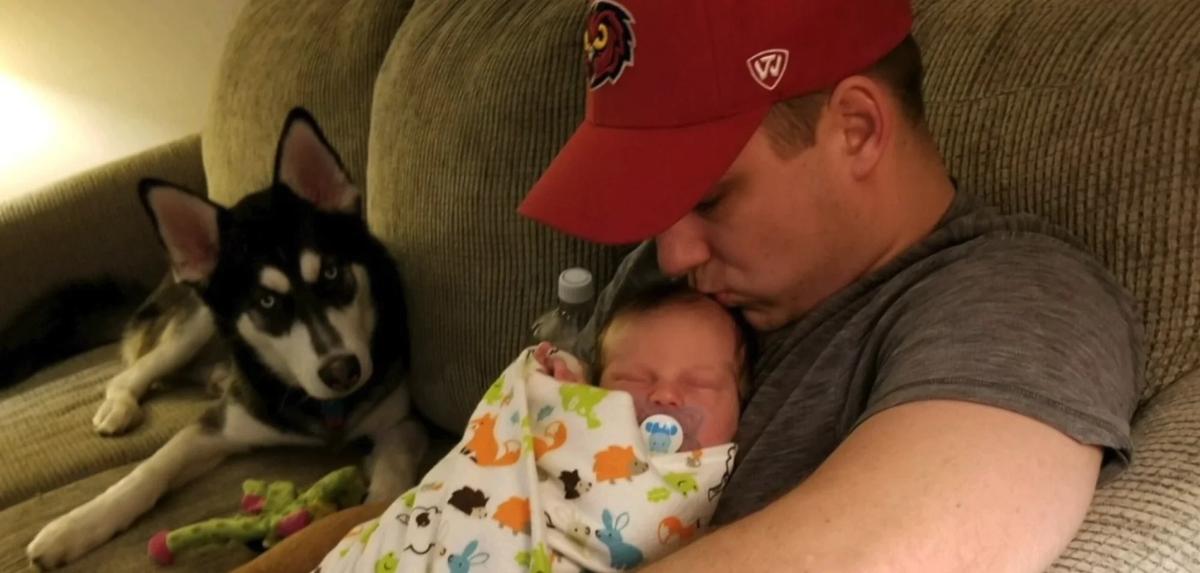
Look at that photo. A father holding his newborn son. The family dog nearby. A moment frozen in time before everything fell apart.
Tom Imschweiler is in his fourth year of a five to seven year prison sentence at Sanford Correctional Center in North Carolina. He took an Alford plea to voluntary manslaughter in the death of his infant son Franklin. An Alford plea is a legal mechanism that allows a defendant to accept a conviction while maintaining their innocence.
Why would anyone plead guilty to killing their own child if they didn't do it?
Because the alternative was life without parole.
What Happened That Night
July 2018. The Imschweiler family drove from Harrisburg, Pennsylvania to Corolla, North Carolina for a beach vacation. Tom, his girlfriend Laura, their four month old son Franklin, and several extended family members. Franklin had been sick before the trip with hand, foot, and mouth disease, running a 104 degree fever. The doctor cleared them to travel. The virus would run its course.
Around 3:30 in the morning on July 17th, Franklin was fussy. Tom got up to tend to him, the way parents do. He carried Franklin downstairs, set him on the couch, and went to the kitchen to prepare a bottle.
When he came back, Franklin was face down. Not breathing.
Tom screamed for Laura. Family members performed CPR. Franklin was airlifted to Children's Hospital of the King's Daughters in Norfolk, Virginia. He died five days later.
The medical examiner in Norfolk found brain swelling, retinal hemorrhaging, and subdural hemorrhaging. The "triad." The supposed signature of Shaken Baby Syndrome. Doctors also noticed a healing rib fracture, which a child abuse pediatrician said was further evidence of violence. Tom was arrested and charged with felony child abuse. Two months later, while he sat in jail on $2.7 million bail, the charge was upgraded to first degree murder.
But here's something the prosecution didn't want to hear about that rib fracture.
When police showed up to arrest Tom at his parents' house in Pennsylvania, his mother Leslie collapsed. She fell to Laura's feet, begging for forgiveness. A few months earlier, she had taken Franklin for a drive to help him sleep. She hadn't buckled him into the car seat. When she braked, Franklin flew forward and hit the dashboard. She never told anyone because she thought he was fine. She didn't want to worry them.
That healing rib fracture the doctors saw as proof of ongoing abuse? It had an explanation. One that had nothing to do with Tom.
The Problem With "Shaken Baby Syndrome"
For decades, prosecutors and certain medical professionals treated the "triad" of symptoms as an automatic diagnosis of abuse. See the triad? Someone shook this baby. End of analysis.
Except the science doesn't hold up.
Since 2001, over 200 convictions based on Shaken Baby Syndrome have been overturned when medical re-evaluation exposed alternative explanations. The National Registry of Exonerations documents case after case where parents and caregivers went to prison based on a diagnosis that turned out to be wrong.
In November 2025, the New Jersey Supreme Court ruled that expert testimony about Shaken Baby Syndrome is "scientifically unreliable" and inadmissible in upcoming trials. The biomechanical research doesn't support the theory. The medical community itself shifted away from the term, rebranding it as "Abusive Head Trauma," because the original name implied causation that couldn't be proven.
— Dr. Mary Gilliland, former Medical Examiner for Currituck County, North Carolina (30 years)
Dr. Mary Gilliland served as the medical examiner for Northeastern North Carolina, including Currituck County where the Imschweilers were vacationing, for three decades. After reviewing Franklin's case, she concluded this wasn't Shaken Baby Syndrome. It was accidental suffocation. The same "triad" of symptoms can occur when an infant suffocates face down on a soft surface.
She provided video testimony and a detailed report to the District Attorney's office. She did this work without payment because she believed in Tom's innocence.
When a forensic pathologist with no connection to the case reviewed the documentation, he told reporters he would have ruled it "undetermined cause of death and undetermined manner of death." He said he would have lost a lot of sleep over it.
The DA pushed forward anyway.
The Kind of Man People Believed In
When Tom was arrested and bail was set at nearly $3 million, something remarkable happened. Fifteen families put up their homes as collateral to get him out. One family put up two houses. These weren't wealthy people gambling on a stranger. These were people who knew Tom, who had watched him become a father, who refused to believe he was capable of what the state was claiming.
Think about that for a second. Would you risk losing your home for someone you thought might have killed a baby?
The Coerced Choice
By the time the case was set for trial, three years had passed. Laura was seven months pregnant with their second child. Tom's attorney was confident they could win. The evidence supported the suffocation theory. There was no history of abuse. No pattern. No red flags anywhere in Tom's 34 years of life.
But "confident" isn't certain. And the stakes were everything.
First degree murder in North Carolina carries life without parole. Tom was looking at potentially 50 plus years in prison if a jury got it wrong. Even with a 90 percent chance of acquittal, that 10 percent meant never holding his daughter. Never being a father again. Never coming home.
The state offered a deal. Plead to voluntary manslaughter. Five to seven years. Maintain your innocence through an Alford plea. Take the guaranteed release date instead of gambling with forever.
Tom took it. Ten days after marrying Laura in a Pennsylvania courthouse, he went to North Carolina and pleaded guilty to killing the son he says he didn't hurt.
"I couldn't put my life in the hands of 10 to 12 jurors," he told reporters. "Even if I had a 90 percent chance of winning, what about that 10 percent? That 10 percent, I can't risk."
This Is How Innocence Gets Buried
I know something about impossible choices in the legal system.
When my father was prosecuted for refusing to testify in federal drug trials, the government charged him with conspiracy to distribute cocaine, claiming his refusal was proof he was part of an ongoing drug operation. They also charged him with criminal contempt. He took a plea that left the contempt charge open, meaning the judge would decide after a hearing whether it was civil or criminal.
The government asked for 23 years, arguing he refused to testify to obstruct justice and cover up his role in a conspiracy. The probation department recommended 15 years. His attorneys asked for a fine, arguing it should be considered civil contempt since he had raised legitimate constitutional challenges to protect attorney-client privilege.
The judge rejected the conspiracy theory. He found my father's refusal wasn't about being part of a drug operation. It was driven by his desire to cover up his own drug addiction. Criminal contempt, but without obstruction of justice. Twelve months. Five on home confinement, seven in federal prison.
My father took a deal too. Different circumstances, different stakes, but the same fundamental reality: when the system has you in its grip, sometimes survival means accepting an outcome you know isn't right.
I watched both prosecutions. I know what it looks like when the system decides someone is guilty before the evidence is in. I know what it looks like when the only "choice" offered is between bad and catastrophic.
The Alford plea is supposed to be a safety valve. A way for defendants to accept a deal while preserving their claim of innocence. But it's also a trap. Once you take it, you waive your right to appeal. The only way out is a pardon or commutation from the governor.
Tom's wife Laura spent years fighting. Over 38,000 people signed a petition asking North Carolina Governor Roy Cooper to commute Tom's sentence. She wrote letters. She did interviews. She raised their daughter Emilia alone while begging for mercy from a system that had already made up its mind.
Cooper left office on January 1, 2025. In his final days, he commuted 15 death sentences. He issued two other non-capital commutations. Tom Imschweiler wasn't among them.
The Questions That Won't Go Away
How many parents are sitting in prison right now because a medical examiner saw a "triad" and stopped looking for other explanations?
How many took plea deals because the alternative was dying behind bars?
How do we call this justice when the county's own former medical examiner says the conviction is wrong, when an independent pathologist says the cause of death should have been ruled undetermined, when a state supreme court rules the entire diagnostic framework is scientifically unreliable?
Tom Imschweiler lost his son. Then he lost his freedom. His daughter Emilia, now three years old, has never known her father outside of prison visits and phone calls. Laura makes the ten hour drive from Pennsylvania to North Carolina a few times a year. Tom works in a warehouse for $16.84 a week.
The District Attorney who inherited the case says he won't reopen it. The medical examiner's office says their ruling stands. The sheriff's department says they had a solid case and Tom took a deal.
Everyone followed the rules. The procedures were observed. The system functioned exactly as designed.
And a father who may be innocent is counting down the days until he can hold his daughter without a guard watching.
What Can Be Done
North Carolina has a new governor now. Josh Stein took office on January 1, 2025. The clemency petition still exists. The evidence of Tom's innocence hasn't changed. The science discrediting Shaken Baby Syndrome keeps accumulating.
If you believe this matters, if you believe the system should correct its mistakes when the evidence warrants it, there are things you can do:
Sign the petition at Change.org. It currently has over 38,000 signatures.
Learn more about Tom's case at InnocentFather.com.
▶️ WATCH THE NBC INVESTIGATION Father imprisoned for shaken baby case avoids life sentence, but maintains his innocenceContact Governor Josh Stein's office and ask him to review Tom Imschweiler's clemency petition.
Pay attention to how Shaken Baby Syndrome cases are handled in your own state. The New Jersey ruling may be a turning point. Other states need to follow.
The system only works if we force it to work. If we watch. If we question. If we refuse to let them operate in darkness.
Tom Imschweiler is due to be released next summer, according to a recent NBC investigation. August 2026. His daughter Emilia will be almost five years old by then. She's never known her father outside of prison visits.
His son Franklin would have been seven years old this year. Instead, there's just a grave, and a father who maintains he did nothing wrong, and a medical examiner who agrees with him, and a system that branded him a child killer based on science that courts are now rejecting as unreliable.
That's not justice. That's a tragedy compounding a tragedy.
We should be better than this.
Latest from the Desk
Want More?
Subscribe to Justice Is A Process on YouTube for live trial coverage, No Breaks editions, and breaking news as it happens.
🔴 Subscribe on YouTube111,000+ subscribers watching the system with us
Watch the system. Question everything.
— Justice