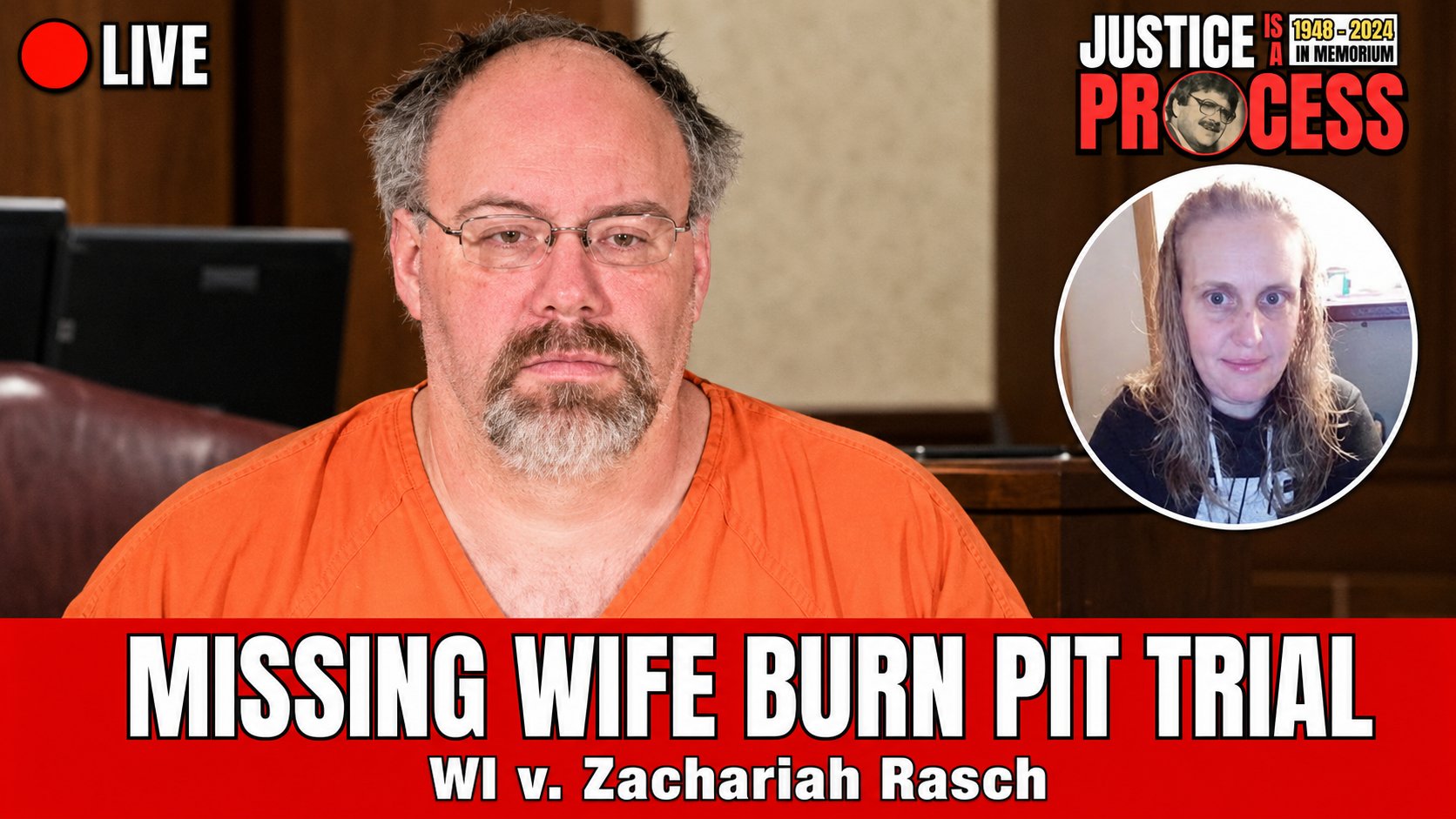
State of Wisconsin v. Zachariah Rasch, Dodge County, Wisconsin
June 2026 | Justice Is A Process
On the afternoon of June 11, 2024, Crystal Rasch walked through a Goodwill store in Oconomowoc, Wisconsin.
She was not alone. Her estranged husband was there too. According to the criminal complaint, the two of them shopped separately that day, then walked out of the store together.
That is the last time anyone other than her own family ever placed Crystal Rasch alive.
She was thirty-seven years old. She had her own house in rural Clyman. Her own bank accounts. Her own car, which would sit parked in her garage while the days stacked up and the phone calls went unanswered. She had filed for divorce. She was, by every public record we have, building a life away from the man she walked out of that store beside.
Twelve days later, her family picked up the phone and called the Dodge County Sheriff's Office. No one had heard from Crystal since that June afternoon. Her phone rang straight to voicemail. Her stepmother had driven to the house and seen the car still in the garage.
What investigators say they found in the weeks that followed turned a missing-persons search into one of the most disturbing homicide prosecutions Dodge County has ever seen. Blood inside a car. A burn pit. Bones. A single tooth. A string of internet searches that read like a to-do list. And a husband who, the state alleges, spent his missing wife's money on cleaning supplies and acid while her family was still praying she would walk back through the door.
Today, Zachariah Rasch is on trial for her murder.
Here is what I want you to carry with you before we go one step further, because it is the whole reason twelve people are about to sit in a Dodge County jury box for weeks. The state has built a mountain of circumstantial evidence. What the state does not have is a cause of death. Crystal's body was burned down to almost nothing. No autopsy could tell anyone how she died. No murder weapon has been tied to her death. No one watched her die. No confession exists.
So this trial is not really a fight over whether something terrible happened to Crystal Rasch. It is a fight over whether the state can prove, beyond a reasonable doubt, that Zachariah Rasch intentionally killed her, when the single piece of evidence that usually answers that question, her own body, was reduced to bone and ash before anyone could examine it.
That is a hard thing to sit with. It is supposed to be.
I am not here to tell you he did it. I am not here to tell you he did not. Zachariah Rasch is presumed innocent, and that presumption is not a loophole or a technicality. It is the floor the entire system stands on. My father spent his life defending that floor, and the system made him pay for it twice. So when I tell you we are going to watch this trial closely, I mean we are going to watch one thing above all else: whether the state carries the full weight the Constitution puts on its shoulders, and on no one else's.
This is Justice Is A Process. Let's begin.
Before we get to the courtroom, you need the story the state is telling. Not because it is true. Because it is the case the prosecution will spend two to three weeks trying to prove, and you cannot judge whether they proved it until you know what "it" is. Everything in this section comes from the criminal complaint and from public reporting on the investigation. Every word of it is an allegation until a jury says otherwise.
June 11, 2024. Crystal and Zachariah Rasch were captured on surveillance video at the Goodwill in Oconomowoc. According to the complaint, they shopped separately and left together. Crystal was last seen wearing a black Wisconsin Dells sweatshirt with a large "D" on the front. Such a small, human detail. The kind of thing you would never notice until it became the last description anyone could give.
By that point, the marriage was already over in every way that mattered. Crystal and Zachariah were living apart. They had separate bank accounts. She had filed for divorce in September of 2023. This was not a couple in crisis. This was a woman who had already left.
Crystal had two phones. The complaint indicates one of them last showed activity on June 8 near Juneau, and the other pinged near Adams, Wisconsin, on June 17, with an earlier call from that same area on June 10. After June 11, the woman herself simply went quiet.
On June 23, her stepmother called the Dodge County Sheriff's Office. No one in the family had heard from Crystal in nearly two weeks. The stepmother had gone to the house and found the car parked in the garage, exactly where it should not have been if Crystal had driven off somewhere on her own. Investigators began treating it as a missing-persons case, and Sheriff Dale Schmidt asked the public to stay away from search areas around Clyman so evidence would not be disturbed.
Then investigators did something that broke the case wide open. They looked at Crystal's finances.
What they found, according to the complaint, was a pattern of transactions on Crystal's accounts during the exact window she was unreachable. The state alleges those charges were made by Zachariah Rasch, without her consent. Surveillance captured a man using her debit card. The purchases were not random. The complaint lists drain cleaner. Stain remover. Sulfuric acid. Chemical-resistant nitrile gloves. Other cleaning supplies. There were also several ATM withdrawals that, together with the purchases, added up to roughly $6,500 pulled from the account of a woman no one could find.
On June 26, 2024, Zachariah Rasch was arrested. Not for homicide. Not yet. He was charged with seven felony counts of misappropriating another person's identifying information to obtain money, and held on a $250,000 bond. When a deputy showed him a photo and asked questions, the complaint describes Rasch sitting quietly, staring at the photo, saying he could not remember, and then eventually admitting he had been lying and had in fact been using Crystal's account without her permission.
Think about the timeline the state is building here. A woman vanishes. Within days, her estranged husband is allegedly buying acid and gloves with her own money. That is the sequence the prosecution wants the jury to sit with.
The same day Rasch was arrested, investigators executed a search warrant at his home on Wood Road in the Town of Clyman. They seized a cell phone and multiple vehicles. A second search warrant took them to land owned by Rasch's family in Adams County, near the Town of Springville, in the same area where Crystal's phone had pinged.
On that family land, investigators found a 2023 Mitsubishi Eclipse registered to Zachariah Rasch. It was the same vehicle the complaint connects to the Goodwill trip. Inside and around the passenger seat, investigators reported finding blood spatter. When it was tested by the Wisconsin State Crime Lab, the complaint says the blood matched Crystal Rasch's DNA profile. Authorities came to believe the car had been parked at the Wood Road home from June 11 until it was moved to the Adams County property on June 24, two days after the last family contact and one day after the missing-persons report.
And then there was the burn site. On property connected to Rasch, investigators recovered human remains, bones and a tooth, that were identified as Crystal's. I want to be careful and honest with you here, because accuracy is the whole job. Different news outlets have reported the burn pit in different places, some at the Clyman home, some on the Adams County family land. The criminal complaint is the document that settles it, and we will confirm the exact location as the testimony comes out. What every account agrees on is the grim core of it: what was left of Crystal Rasch was found in a burn area, reduced to fragments.
Investigators recovered Zachariah Rasch's cell phone, and the complaint lists internet searches that the state will almost certainly put in front of the jury. According to the complaint, the searches from late May and June included inquiries about gunshot wounds to the chest versus the head. On June 11, the day she was last seen, a search allegedly asked whether a 9mm would kill an animal if it was shot in the head. On June 12, a search for "carpet cleaner." On June 23, the very day Crystal was reported missing, a search asking whether police can get search warrants on a Sunday in Wisconsin. The next day, searches about sulfuric acid, including whether sulfuric acid is flammable.
I am not going to dress that up. Read as a sequence, those searches are devastating for the defense. But read them carefully too, because a search history is not a cause of death. It is a window into what someone may have been thinking. The state still has to connect that thinking to an intentional killing, and that connection is exactly what this trial will test.
The search of the Adams County area was not small. Reporting indicates nearly 100 law enforcement officers from roughly 28 departments combed the parcels of land tied to Rasch's family. This was a major operation, and it ended with a homicide charge.
The phone evidence adds another layer the state will lean on. Crystal carried two phones, and their final signals do not line up with a woman who simply left town on her own. One went dark near Juneau on June 8. The other surfaced near Adams on June 17, days after she was last seen in person, in the same stretch of Wisconsin where the family land sits and where her blood-stained vehicle would later be found. The state will argue those signals trace not Crystal's own movements, but the movement of her phone and her car after she could no longer carry either. The defense will want to know exactly who the state can prove was holding that phone, and when, because a phone in a location is not a person in a location.
We do not have an obituary to pull from, and I am not going to invent a version of Crystal Rasch to make this story land harder. She deserves better than that. So here is what the record tells us, plainly.
Crystal Rasch was thirty-seven years old and lived in rural Clyman, Dodge County. She was a mother. We know that because the court record shows Zachariah Rasch's parental rights were terminated on June 17, 2024, which means there were children in this family's life. She had her own home and kept her own bank accounts separate from her husband's. She had filed for divorce in September 2023, and court papers show she had filed once before, in 2019, alleging her husband had threatened her with abuse. That earlier divorce was not finalized.
Put those facts together and a picture forms without any embellishment from me. This was a woman who had tried to leave before, who tried again, and who had built a separate life with her own front door and her own bank card. Her family noticed she was gone within days and would not let it rest. That is who the state says was reduced to bone and a tooth in a burn pit. Whatever the verdict, Crystal Rasch was a person, and a family is sitting in that courtroom carrying her absence.
Zachariah Rasch is forty-three years old, listed in records as living in Clyman and in Juneau. He is Crystal's estranged husband. He is charged, and he is presumed innocent of every count.
His path to this trial has not been a straight line, and one detail matters more than the rest. After his arrest, the question of his competency became central. In the summer of 2025, a Dodge County judge found Rasch incompetent to stand trial. Both the defense and the prosecution agreed, at that point, that he could not proceed. The District Attorney asked the court to keep the case active and to pursue treatment, betting he would regain competency. By December of 2025, after additional evaluation, the court found that he had. Hold that fact. A defendant with a documented period of incompetency, and no confession to the killing itself, is a defendant whose lawyer has something to work with.
The family connection to the Adams County land is part of the state's story too. It is where the car was found. It is, by some accounts, where the remains were recovered. None of that has been proven against him in a courtroom yet, and that is precisely the point of holding a trial at all.
The prosecution is led by Dodge County District Attorney Andrea Will, who filed the homicide charges and who fought to keep the case alive through the competency fight. Early in the investigation, when Rasch faced only the financial counts, the office's managing attorney James Barkei spoke to the connection between those charges and the disappearance, and a court commissioner, Steven Seim, called Rasch the "prime suspect" at his first appearance.
Representing Zachariah Rasch is defense attorney Zaki Zehawi, who stood with his client through the competency rulings and pushed for treatment to begin quickly so the case could move forward.
The judge who set this trial, after finding Rasch competent in December, is Judge Brian Pfitzinger, who blocked out three weeks on the Dodge County calendar beginning June 1, 2026. An earlier competency ruling in the case was handled by Judge Joseph Sciascia. And the agency that built the case is the Dodge County Sheriff's Office under Sheriff Dale Schmidt, with forensic work done by the Wisconsin State Crime Lab in Madison.
Two charges. One of them carries the rest of his life. Let's break down what the state actually has to prove, because the charge is not the conviction. The charge is the promise the prosecution makes to twelve strangers, and the trial is where they either keep that promise or they do not.
The statute: Wisconsin Statute 940.01. This is a Class A felony, the most serious category of crime in Wisconsin.
What it means: The state must prove that Zachariah Rasch caused the death of Crystal Rasch, and that he did so with the intent to kill her. In Wisconsin, "intent to kill" means he either had the mental purpose to take her life or was aware that what he was doing was practically certain to cause her death.
What the state must prove, beyond a reasonable doubt: First, that Crystal Rasch is dead. Second, that Zachariah Rasch caused that death. Third, that he acted with intent to kill. The middle and the third pieces are where a case like this lives or dies, because the body that would normally help prove how she died was destroyed.
The domestic abuse enhancer: Because Crystal was Zachariah's spouse, the homicide count carries a domestic abuse modifier under Wisconsin law. It formally marks this as a domestic abuse offense and carries weight at sentencing. On a charge that already carries a life term, the enhancer does not raise the ceiling, but it tells you something about how the state frames this case: not a stranger, not a robbery, a husband and the wife who was leaving him.
The potential sentence: Wisconsin has no death penalty. A conviction for first-degree intentional homicide carries a mandatory life sentence. The judge decides whether the defendant is ever eligible for release to extended supervision, or never.
The statute: Wisconsin Statute 940.11. Hiding a corpse with intent to conceal a crime is a Class F felony.
What it means: The state must prove that Zachariah Rasch hid or concealed a corpse, and that he did it with the intent to conceal a crime.
What the state must prove, beyond a reasonable doubt: That there was a corpse, that Rasch concealed it, and that his purpose in doing so was to hide a crime from discovery. The burn pit, the moved vehicle, and the chemical purchases are the kind of evidence the state will point to here.
The potential sentence: A Class F felony in Wisconsin carries a maximum of twelve and a half years.
One thing about both of these charges that I never want you to lose sight of. The burden sits entirely on the state. Zachariah Rasch does not have to prove he is innocent. He does not have to testify. He does not have to explain the searches, the purchases, or the blood. He does not have to put on a single witness. The prosecution has to walk in and prove every element of every charge beyond a reasonable doubt, and if there is a reasonable doubt left standing when the evidence is done, the law says the jury must acquit. That is not me being soft on a hard case. That is the rule that protects every one of us from being convicted on a story that feels true but was never actually proven.
One more thing about that homicide count, because it is where the real fight lives. In Wisconsin, the line between first-degree intentional homicide and the lesser homicide charges is the defendant's state of mind. Intent to kill is what separates the top count from charges like reckless homicide. Depending on how the evidence comes in and what the court decides to instruct, a jury in a case shaped like this one can sometimes be given the option to consider lesser or alternative homicide charges, not only the most serious count. Keep that in the back of your mind as the testimony unfolds, because "did he do it" may not be the only question the jury has to answer. If he caused her death, what was in his mind when it happened can matter just as much. And in a case with no cause of death, proving what was in someone's mind is a mountain all its own.
Most murder cases that reach a jury reach it for a reason. Something in the case is genuinely in dispute. Here, the dispute is not hard to find, and it is not the kind of thing the state can paper over with volume.
The state cannot prove how Crystal Rasch died.
Her remains were burned down to bone fragments and a tooth. There was no body to autopsy in any meaningful sense, no cause of death determined, no wound to point to, no weapon recovered and tied to her death, no eyewitness to a killing, and no confession to one. What the state has instead is a chain of circumstances: blood in a car, a moved vehicle, acid and gloves bought on her card, a burn pit, and a phone full of dark searches.
That is the entire ballgame. The state will ask the jury to look at the chain and conclude that no innocent explanation survives it. The defense will work, link by link, to show that a chain of suspicious facts is not the same thing as proof that Zachariah Rasch intentionally killed his wife. Suspicion is not a verdict. Motive is not method. A pile of circumstantial evidence can absolutely convict, Wisconsin law allows it, but only if it eliminates every reasonable doubt. The fight in this courtroom is over whether it does.
The prosecution's theory writes itself from the complaint. An estranged husband, deep in a divorce his wife filed to get away from him, killed her, then set out to make her disappear. The state will argue the purchases, sulfuric acid, drain cleaner, stain remover, gloves, were tools to destroy a body and clean a scene. It will argue the burn pit is where that plan ended. It will argue the blood in the Mitsubishi puts Crystal in his vehicle and puts her blood where it never should have been. It will argue the searches show planning and consciousness of guilt: a man researching gunshot wounds before, and search warrants and acid after. And it will argue the financial activity shows a man moving on with her money while pretending he did not know where she was.
It is a powerful narrative. The state's job is to make the jury feel that every piece points one direction and that no honest person could explain them all away.
Motive will run underneath all of it. The state does not have to prove why someone killed, but juries want a why, and this case hands them one. A marriage Crystal was ending. A 2019 filing in which she alleged her husband had threatened her with abuse. A 2023 divorce she filed to finish what the first one started. A husband whose parental rights were terminated in the same window she vanished. The prosecution will frame that as a man losing his wife, his marriage, and his children all at once, and deciding she would not get to walk away. I will say the thing that has to be said, though. A bad marriage and an ugly divorce are not evidence of murder. Millions of people survive both without anyone ending up in a burn pit. Motive can make a story feel complete. It cannot, by itself, prove a killing. The jury has to keep those two things separate. So do we.
Here is where I have to be straight with you about what we know and what we are still waiting to see. The defense has not laid out its trial strategy in public the way the prosecution's theory has spilled into the complaint and the coverage. So far, the most visible defense activity has been the competency litigation. What follows is the terrain a defense lives on in a case shaped like this one, and we will update it the moment the actual strategy shows itself in the courtroom.
The center of gravity is the missing cause of death. Expect the defense to press every state expert on a single point: you cannot tell this jury how Crystal Rasch died. Not by gunshot, not by anything else, because there was not enough left to say. Expect them to separate the disturbing from the proven. Buying acid is not killing. Using a debit card is a financial crime, and Rasch was charged with exactly that, but it is not a homicide. A search history reveals thoughts, not acts. The defense will argue the state has stacked a tower of suspicion and is asking the jury to call it proof.
And the competency history may matter more than it looks. This is a defendant who was found unable to stand trial for a period, and who never confessed to the killing. A capable defense attorney will make sure the jury understands the difference between a man the state finds suspicious and a man the state has actually proven to be a murderer.
This case did not move fast, and the reason is the competency question. In June and July of 2025, the court found Rasch incompetent to stand trial. The defense and the prosecution agreed he could not proceed at that time. District Attorney Andrea Will asked the court to keep the case active and noted he was likely to regain competency, and the court ordered evaluation and treatment. In December of 2025, after more testing, Judge Brian Pfitzinger found Rasch competent and set the trial. That is why a 2024 disappearance is reaching a jury in the summer of 2026.
This is the part where other channels recap. We do something different here. We watch whether the system actually works, because a system that only works when the defendant seems sympathetic is not a system at all. It is a mood.
So here is the lens we bring to every day of this trial.
The burden never moves. Watch for any moment, in argument or in the way the evidence gets framed, where the pressure quietly shifts onto Zachariah Rasch to explain himself. The instant a trial starts feeling like the defendant has to prove the searches were innocent or the purchases were ordinary, the burden has slipped, and the burden is not allowed to slip. It belongs to the state from the first witness to the last word of closing.
Circumstantial evidence is legitimate, and it is also dangerous. Let me be clear, because people get this wrong in both directions. Circumstantial evidence can convict. A case built entirely on circumstances can be airtight. But circumstantial evidence asks a jury to draw inferences, and inferences are where reasonable doubt either dies or survives. The question is never whether the inferences are possible. It is whether they are the only reasonable conclusion. Watch how the state asks the jury to connect the dots, and watch whether the defense can show a second reasonable picture in the same dots.
The destroyed body cuts in two directions. The state will argue that destroying a body is itself evidence of guilt, why would an innocent man burn his wife's remains. That is a fair argument. But the destruction also robbed the state of the proof it would normally need, the cause of death, the manner, the forensic story of the final moments. A jury has to decide whether the absence of that proof is the defendant's fault or the state's problem, and under our system, gaps in the state's proof are the state's problem. Watch how both sides handle that tension, because it is the soul of this case.
"Beyond a reasonable doubt" is a real standard, not a vibe. You are going to hear that phrase a hundred times over the next few weeks, on the news, in the courtroom, maybe at your own kitchen table. So let's be precise about it, because the whole trial turns on it. Beyond a reasonable doubt does not mean beyond all possible doubt. The law does not demand certainty, because almost nothing in human life is certain. A reasonable doubt is a doubt based on reason and common sense, the kind that would make a careful person hesitate before acting in the most important matters of their own life. It is not a doubt manufactured to dodge a hard decision. If a juror weighs all the evidence and is firmly convinced Zachariah Rasch intentionally killed Crystal, that is proof beyond a reasonable doubt. If a juror is left with a real, reason-based hesitation, the law commands an acquittal, no matter how strong the suspicion. That bar is high on purpose. It is the line between a courtroom and a mob, and in a case with no cause of death, it is exactly where the defense will plant its flag.
And no, the state does not need a body. People ask me this constantly, and the answer surprises them. Wisconsin law does not require the prosecution to produce a body, or even a determined cause of death, to win a murder conviction. The state can prove that a death happened, and that it happened through criminal action, on circumstantial evidence alone. Juries have convicted in cases where no remains were ever found at all. So the burned body does not automatically sink the prosecution. But it drives the difficulty through the roof. Without a cause of death, the state has to build intent and criminal agency entirely out of inference, the blood, the chemicals, the burn pit, the searches, the lies about the money. And the defense gets to stand in front of that inference and keep asking the one thing the science cannot answer for the jury. If you cannot tell us how she died, how can you be sure, beyond a reasonable doubt, that this was an intentional killing and not something the state simply cannot explain? That question is the whole trial in a single breath.
Presumption of innocence is not a slogan. Zachariah Rasch walks into that courtroom innocent. Not "innocent unless the evidence is bad." Innocent, period, until the state changes that with proof. The searches are ugly. The purchases are worse. None of it lowers the wall he is entitled to stand behind until twelve people agree, unanimously and beyond a reasonable doubt, to take it down.
My father, Steven Askin, spent twenty-three years as a criminal defense attorney in West Virginia, and then he spent the rest of his life as a man the system had broken for insisting on these exact principles. He went to prison once for protecting attorney-client privilege under the Fourth Amendment. He was prosecuted again for teaching people their rights from a coffee shop. He understood something that is easy to forget in a case with a burn pit and a tooth: the protections only mean anything when we apply them to the cases that make us uncomfortable. Anybody will give due process to a defendant they like. The test is whether we give it to one we do not. That is the test we are watching Dodge County take.
Here is how the case got from a quiet June afternoon to a three-week trial block, laid out in order.
Starting today, we are in this trial with you. Every day it is in session.
You will get LIVE broadcasts as the testimony happens. NO BREAKS editions so you can watch the full day uninterrupted, in your own time. Trial Analysis Podcast episodes for the deep dives. And Key Moments and testimony segments so you never miss the piece that mattered.
We are not here to speculate, and we are not here to convict Zachariah Rasch from a thumbnail. We are here to watch the system do the one job it has: prove its case beyond a reasonable doubt while protecting the rights of everyone in the room, including the man it accuses.
Crystal Rasch's family is owed the truth. Zachariah Rasch is owed his presumption of innocence. Those two things are not in conflict. They are both what justice looks like.
Let's watch the system together.
Subscribe to Justice Is A Process on YouTube for live trial coverage, No Breaks editions, and breaking news as it happens.
🔴 Subscribe on YouTube111,000+ subscribers watching the system with us
Discussion