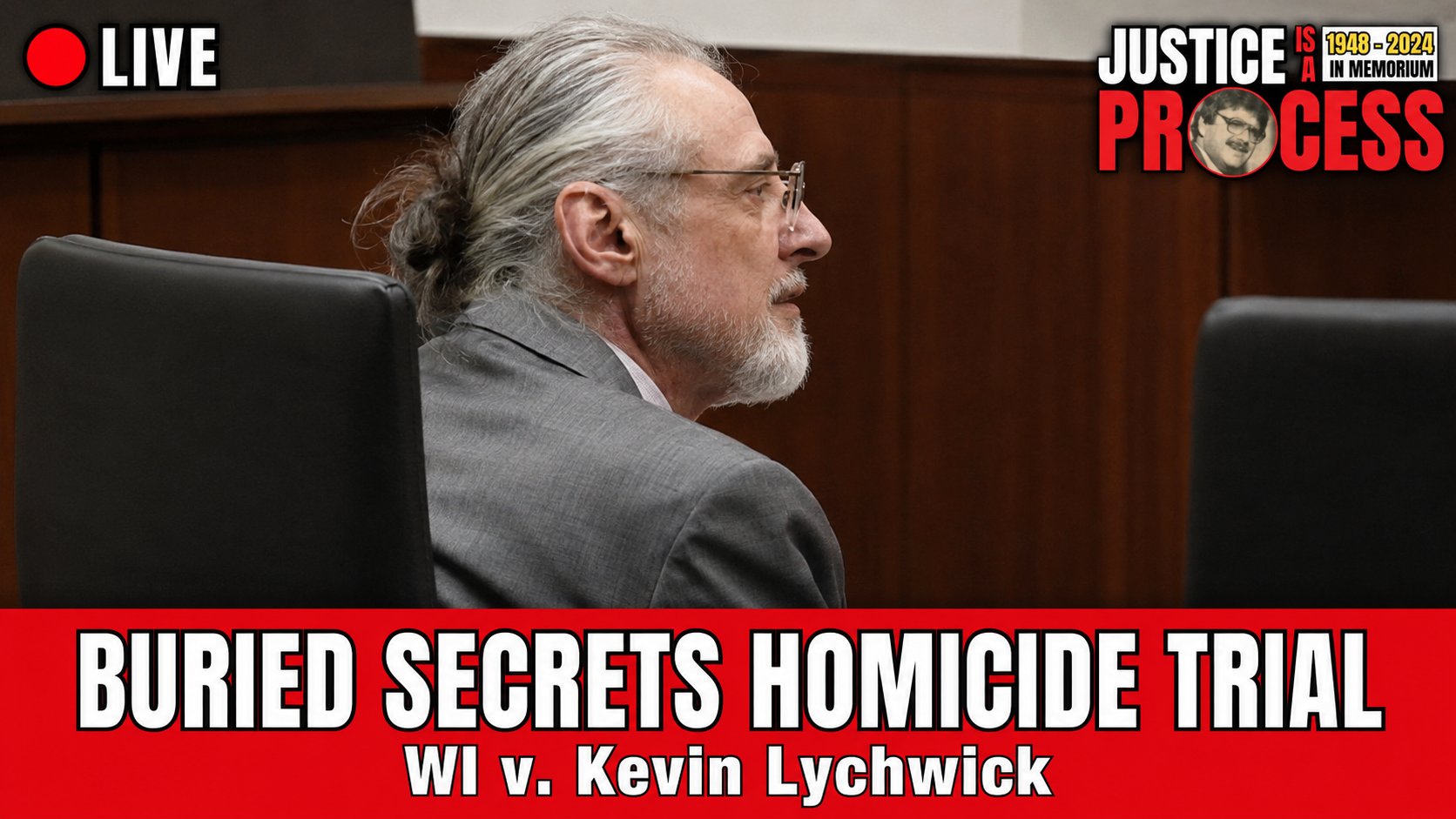
A hidden body, a traffic stop, and a man who fired his lawyer to face the State of Wisconsin alone.
June 2026 | Justice Is A Process
Carlos Maldonado was a father. He had daughters who kept in touch, who expected to hear from him, who knew his rhythms well enough to know when something was wrong.
In April of 2024, the calls stopped getting answered.
By May, his daughters had reported him missing. They told police they had not heard from him since the middle of April, and that the silence was not like him. Weeks passed. Then months. Spring turned into summer, summer into fall, and Carlos Maldonado was still gone.
Then, on a day in late October 2024, a worker doing maintenance behind an apartment building on East North Street in Waukesha walked into the wooded area near Frame Park and found something that did not belong there. A body, wrapped in a tarp and heavy black plastic, hidden under cover where the trees grow thick. It had been there a long time. The remains were so decomposed that it took dental records to confirm who it was.
It was Carlos. He had been shot twice, once in the head and once in the abdomen. The medical examiner noted tape across the bones of his hands, the kind of detail that tells investigators someone may have been bound before they died. Based on the condition of the body and a six-week police investigation, the timeline pointed back to April, the same month his family last heard his voice.
The man the state says is responsible lived in the same building. His neighbor. Kevin Lychwick, now 63 years old, a retired Air Force veteran. Prosecutors have charged him with first-degree intentional homicide and hiding a corpse. He has pleaded not guilty.
Here is why this case matters, and why we are going to be in that courtroom every day. The gun that ties Lychwick to this killing was not found at a crime scene. It was found in his car, after police stopped him for speeding. He fought to keep that search and everything it produced out of his trial, arguing that police never had the right to go through his vehicle. He lost that fight. And now, after telling a judge his public defender was not doing enough for him, Kevin Lychwick is standing in front of a jury alone. No lawyer at his side. Just one man, cross-examining the detectives and the experts who built the case against him, against the full weight of the State of Wisconsin.
We are not here to tell you he did it. We are not here to tell you he did not. We are here to watch whether the state proves what it has charged, beyond a reasonable doubt, the way the Constitution requires it to. That is the whole job. This is Justice Is A Process. Let's begin.
Before we go any further, hold onto one thing. Everything in this section is what the state alleges. It is the prosecution's version of events, drawn from the criminal complaint and public reporting. Kevin Lychwick has pleaded not guilty, and he is presumed innocent. The state has to prove every piece of this to a jury. He does not have to prove anything. Keep that frame as we walk through it.
According to the complaint, Carlos Maldonado was killed on or about April 14, 2024. For a long time, though, nobody knew that. What people knew was that he had gone quiet. His daughters reported him missing in May, telling investigators they had not heard from him since April and that it was unlike their father to go dark.
A missing persons report is one thing. A homicide investigation is another. For most of 2024, there was no body, no scene, and no clear answer about where Carlos had gone. The case that is now going to trial did not start as a murder case at all. It started as a man who vanished.
That changed in late October 2024. A person doing maintenance on the apartment building in the 1500 block of East North Street found human remains in the wooded area behind the property, near Frame Park. The body was wrapped in a blue tarp and black plastic and concealed under leaves and branches. Investigators believe it had been there roughly six months, which lines up with the April timeline.
The autopsy told a grim story. Two gunshot wounds. One to the head, one to the abdomen. Tape over the bones of the hands, suggesting they had been bound. The level of decomposition meant the medical examiner had to rely on dental records to confirm the identity. This was Carlos Maldonado, and he had not simply disappeared. According to the state, he had been killed and hidden.
Waukesha police tagged Lychwick as a person of interest and built their case over a roughly six-week investigation. According to the complaint, they obtained multiple search warrants. On one round of searches in late November, covering his apartment, a storage unit, his electronics, and his vehicle, investigators reported finding nothing of obvious value to the case.
So they kept watching. Police placed a GPS tracker on Lychwick's car. On December 1, that tracker led them to follow him to a storage unit in Kimberly, Wisconsin, where they say video footage showed him loading duffel bags into his vehicle. Detectives followed him back toward Waukesha. Then, on Pewaukee Road, officers stopped him for speeding.
That traffic stop is where the case turns. According to the complaint, when police searched the car they found the duffel bags, and inside them were items that matched the scene where Carlos was found: tape, and heavy black plastic bags like the material wrapped around the body. They also found a 9mm Luger pistol fitted with a homemade suppressor fashioned from rags and rubber bands. The gun went to the State Crime Lab, where investigators say analysis tied it to the bullets recovered from Maldonado's body.
There was more. Inside Lychwick's apartment, investigators say they recovered a handwritten document they describe as a hit list, with Carlos Maldonado's name at the top, written in a kind of coded, operation-style language. A Waukesha detective testified at an early hearing that police interpreted the list that way. Officers said the list referenced grievances with other people, though they indicated those others were not local. Investigators also reported finding items in the apartment they connected to the case, including black silk pillowcases, ammunition, zip ties, and scissors.
That is the spine of the state's case as it heads into trial. A matching gun. Materials that resemble what was found with the body. Surveillance that places Lychwick at the wooded area on more than one occasion. And a list that prosecutors say shows intent. Whether all of that adds up to first-degree intentional homicide beyond a reasonable doubt is exactly what a jury is now being asked to decide.
There is a detail here that does not get enough attention, and it matters for both sides. Carlos Maldonado's body was not found for roughly six months. By the time it was recovered, it was badly decomposed, decomposed enough that confirming who it was required dental records. A body in that condition can make the forensic picture harder to read. Time of death becomes an estimate rather than a fixed point. Some evidence degrades or disappears. The clean, made-for-television certainty that crime shows promise is rarely what a real decomposed-remains case delivers.
For the state, that is a hurdle. Prosecutors have to connect a death that happened months earlier to a defendant, largely through what was found later and what can be reconstructed. For the defense, that same uncertainty is an opening. Every gap in the timeline, every thing the science cannot say for sure, becomes room to argue reasonable doubt. The condition of the evidence is not a side issue in this trial. It is part of the contest. Watch how the state's experts handle what they can and cannot establish, and watch whether the man representing himself knows to press on that difference.
It is easy, in a case full of evidence logs and statutes, to let the person at the heart of it disappear into a word. The victim. Carlos Maldonado was 56 years old. He was a father. He had daughters who noticed, within weeks, that something was wrong, because a man who stays in touch does not simply stop.
Think about what that means. The first people to sound the alarm were not detectives. They were his kids. They were the ones who carried the weight of not knowing, through the spring and the summer and into the fall, while their father's body lay in a wooded area a short distance from where he lived. Whatever a jury decides about who is responsible, that loss is real, and it belongs to a family. We are going to keep Carlos at the center of this, not as evidence, but as a person someone loved.
Kevin Lychwick is 63 years old. He was 62 when he was charged in December 2024. He is described in public records as a retired Air Force veteran, and he lived in the same Waukesha apartment building as Carlos Maldonado. He is being held on five million dollars cash bail.
And he is presumed innocent. I am going to say that more than once in this report, because it is not a slogan. It is the law, and it is the spine of everything this channel stands for. Being charged is not being guilty. Being a person of interest is not being guilty. The state has accused Kevin Lychwick of a terrible crime, and the state now has to back that accusation up in front of twelve people, with evidence, under rules designed to protect even the least sympathetic defendant. That protection is not for him. It is for all of us.
The judge is David Maas, who took over the case after he was elected to the seat previously held by Judge Bridget Schoenborn. Judge Maas is the one who has been managing the pretrial fights, the scheduling, and the decisions that brought this case to trial when it did.
The defense table is where this case gets unusual. Lychwick had been represented by a public defender, attorney Pablo Galaviz. In early June 2026, days before trial, Lychwick told the court his public defender was not doing enough for his defense and asked that the attorney be allowed to withdraw. Judge Maas granted the request. That decision left Kevin Lychwick representing himself, a choice we will come back to, because it shapes everything about how this trial will look.
On the other side is the State of Wisconsin, prosecuted through the Waukesha County District Attorney's office. The investigation was led by the Waukesha Police Department, and a department captain and at least one detective have already been public figures in the case through early hearings and press briefings. As the trial unfolds, the detectives and forensic analysts who built this case are the witnesses Lychwick will have to question himself.
Kevin Lychwick faces two felony charges. Let's take them one at a time, in plain English, and be clear about what the state has to prove for each.
What it means: This is the most serious homicide charge Wisconsin has. In plain terms, the state is saying Lychwick caused Carlos Maldonado's death on purpose, with the intent to kill him.
What the State must prove: Two core things, beyond a reasonable doubt. First, that Lychwick caused the death of Carlos Maldonado. Second, that he acted with the intent to kill. Intent is the heart of it. An accidental death, or a death caused without that intent, is a different and lesser charge.
Potential sentence: First-degree intentional homicide is a Class A felony. In Wisconsin, that carries a mandatory sentence of life imprisonment. Wisconsin does not have the death penalty, so life is the top of the scale. There is no separate jury penalty phase the way there would be in a death-penalty state.
The burden: Entirely on the state. Lychwick does not have to prove he is innocent. He does not have to prove anything at all.
What it means: This charge is about what allegedly happened after the death. The state says Lychwick hid Carlos Maldonado's body to conceal a crime or avoid being caught.
What the State must prove: That Lychwick hid or buried a corpse, and that he did it with the intent to conceal a crime or avoid apprehension, prosecution, or conviction. Wisconsin's pattern jury instructions break it down to those two elements: the hiding, and the intent behind it.
Potential sentence: Hiding a corpse is a Class F felony. That carries a maximum of up to 12 years and 6 months, which Wisconsin law splits into up to 7 years and 6 months of initial confinement followed by up to 5 years of extended supervision, plus a possible fine of up to $25,000.
The burden: Again, entirely on the state. Two separate charges, two separate sets of elements, and the prosecution has to carry every one of them.
One thing worth sitting with. These two charges tell a sequence: a killing, and then a concealment. But they are legally separate. A jury could find the state proved one and not the other. The evidence that supports hiding a body is not automatically the same evidence that proves an intentional killing. As you watch, keep the two questions apart, because the defense will.
The hardest thing to prove in an intentional homicide is the intent. Nobody can climb inside another person's head and show a jury what they meant to do. So intent almost always gets proven the indirect way, through actions and circumstances. The number of wounds. Where on the body they landed. Whether there was planning beforehand. Whether steps were taken afterward to hide what happened. In this case, the state will argue that two gunshot wounds, the alleged concealment of the body, and a document it calls a hit list all point to a deliberate, intended killing rather than an accident or a moment of panic.
That matters, because Wisconsin homicide law is a ladder, not a single rung. First-degree intentional homicide sits at the top, and it requires that intent to kill. Below it are other offenses. Second-degree intentional homicide, which Wisconsin treats as analogous to the old crime of manslaughter, can apply when certain mitigating circumstances are in play. First-degree and second-degree reckless homicide apply when a death was caused recklessly rather than intentionally, and they carry serious but lesser penalties, reaching into decades of prison rather than mandatory life.
Why should a viewer care about the ladder? Because juries are sometimes asked to consider those lesser charges as alternatives, depending on the evidence and what the parties request. A jury that is not convinced the state proved intent to kill is not automatically stuck choosing between life in prison and letting a man walk free. The structure of the law can give them other doors. Keep that in mind as the evidence comes in, because the distance between these charges is the distance between very different outcomes for Kevin Lychwick.
Every case that reaches a jury is there for a reason. Something is genuinely in dispute. So before we talk about what each side will argue, let's name the real fight in this trial.
The gun is the case. The single most powerful piece of evidence the state has is a 9mm pistol that the crime lab connected to the bullets in Carlos Maldonado's body. Take that gun out of the equation and the state is left with circumstantial pieces, materials that resemble what was at the scene, surveillance near a wooded area, a disputed list, and no clearly established motive or even a clear explanation of the relationship between these two men. With the gun, the state has a forensic link. Without it, the case looks very different.
And here is the thing. That gun was almost not in this trial at all. It was found because police stopped Lychwick for speeding and searched his car. His defense fought hard to throw that search out, arguing the police had no lawful basis to go through the vehicle after a traffic stop. The judge denied that motion. So the gun is in. The fight over whether it should have been is the fight that defines this case.
The prosecution's theory is that this was a deliberate, planned killing, and that Lychwick took steps to cover it up. They will point to the ballistics match between the recovered pistol and the bullets in the body. They will point to the tape and black plastic in the duffel bags that resemble the material wrapped around Carlos. They will point to surveillance footage they say shows Lychwick coming and going from the wooded area where the body was hidden. And they will lean on the document they describe as a hit list, with Carlos at the top, as evidence of intent and premeditation. The state's story is that the pieces, taken together, point in one direction.
Because Lychwick is representing himself, we do not have the kind of clean, lawyer-articulated defense theory you would normally get from pretrial filings and opening remarks. What we do know is where the pressure points are. The defense has already challenged the legality of the car search, the search that produced the gun. With no proven motive on the table and no clear account of how these two neighbors were connected, reasonable doubt is the natural ground to fight on. A circumstantial case invites a simple question, asked over and over: does this actually prove he did it, or does it just prove the state found troubling things and built a story around them? Whether Lychwick, without legal training, can press that question effectively is one of the central dramas of this trial.
One thing the state has not clearly offered is a motive. Police themselves said it was unclear what the relationship between Lychwick and Maldonado was, or why this killing happened. The document investigators describe as a hit list suggests Carlos was a target, but it does not explain the grievance behind it, and officers indicated the other names on it were not local. The law does not require the state to prove motive. A prosecutor can win a conviction without ever explaining why. But juries are human, and the why is often what they want most. An unexplained killing between two neighbors, with no clear history of conflict in the public record, leaves a hole in the story. The state will try to fill it with evidence of intent and planning. The defense, even a self-represented one, will likely point straight at that hole and ask the jury to sit in the discomfort of not knowing. Motive is not an element. But it is a question the jury will be asking themselves anyway.
This is the part every viewer should understand, because it is the constitutional heart of the case. According to court filings, the sequence went like this. Police searched Lychwick's apartment, storage unit, electronics, and car under warrant in late November and reported finding nothing. They then put a GPS tracker on his vehicle. The tracker led them to a storage unit in another town, where they say he loaded duffel bags into the car. They followed him, stopped him for speeding, and searched the vehicle. That search produced the gun.
The defense moved to suppress everything from that car search, arguing police lacked the legal cause to go through the vehicle after a simple speeding stop. If that motion had been granted, the gun and the matching materials could have been excluded, and the state's case could have collapsed. The judge denied it. The evidence comes in. But the questions that motion raised, about what police can search and when, do not go away just because a judge ruled. They sit underneath this entire trial.
Step back and look at the shape of it. Police had already searched Lychwick's home, storage unit, electronics, and car under warrant and, by their own account, come up empty. What changed was the traffic stop and the vehicle search that followed. That is the moment the case was made. So the defense's argument was not a technicality hunt. It went to the foundation. If the search that produced the gun was unlawful, then the most important evidence in the trial arguably should never have reached a jury at all. The judge weighed that and ruled the evidence admissible. Reasonable judges apply settled rules to messy facts, and this one concluded the search cleared the bar. But knowing this is where the case was built helps you watch the trial with the right eyes. When the state walks the jury through the gun and the crime lab match, you are watching the payoff of a search the defense fought all the way to a written ruling.
This is the part where Justice Is A Process does something most trial coverage does not. We are not just going to tell you what happened in the courtroom. We are going to watch whether the system did its job. And this case hands us two constitutional questions worth watching closely.
The first is the Fourth Amendment. The Fourth Amendment protects all of us from unreasonable searches and seizures. It is the reason police usually need a warrant, or a recognized exception, to go through your home, your phone, or your car. This case has a GPS tracker placed on a vehicle, a traffic stop for speeding, and a search of that vehicle that turned up the most important evidence in the trial. The U.S. Supreme Court has held that attaching a GPS device to track someone's car is itself a search under the Fourth Amendment. Cars get less protection than homes, but they are not protection-free. The defense already argued, in pretrial, that police crossed the line. The judge disagreed and let the evidence in. As the trial plays out, watch how the state explains the basis for that stop and that search, because the legitimacy of the centerpiece evidence depends on it.
The rules police operate under explain why this was worth fighting over. As a baseline, the Fourth Amendment prefers a warrant signed by a neutral judge. But cars are treated differently from homes. Under what courts call the automobile exception, officers can search a vehicle without a warrant if they have probable cause to believe it holds evidence of a crime, because cars move and because we expect less privacy in them. There are other doors too, like a search connected to an arrest or an inventory of an impounded vehicle. The question in a case like this is always whether one of those doors actually applied, or whether police walked through a door that was not open to them. The GPS piece is its own thread. The U.S. Supreme Court has held that secretly attaching a tracking device to someone's vehicle is itself a search. Stack a tracker, a follow, a traffic stop, and a vehicle search on top of one another, and you get exactly the kind of sequence defense lawyers probe and judges have to rule on. If a court ever found one link in that chain unlawful, the doctrine called fruit of the poisonous tree can reach forward and taint everything that flowed from it.
The second is the Sixth Amendment, and the right that flows from it that most people never think about until they see it in action: the right to represent yourself. The Supreme Court recognized decades ago that a defendant who knowingly and voluntarily gives up the right to a lawyer can act as his own counsel. It is a real right. It is also, in a first-degree homicide trial, an enormous risk. Kevin Lychwick will be cross-examining trained detectives. He will be making his own objections, his own arguments, his own decisions about evidence, against career prosecutors who do this for a living. Watch whether the judge protects his rights along the way, whether the trial stays fair when the playing field is this uneven, and whether a man with no legal training can hold the state to the standard the Constitution demands.
The right to represent yourself comes with guardrails, and they are worth watching. Before a judge lets someone give up a lawyer, the judge is supposed to make sure the choice is knowing and voluntary, made with eyes open to the dangers. Courts have warned for decades that a person who represents himself takes on a job most trained lawyers would not want in a murder trial. He has to know the rules of evidence well enough to object in real time. He has to cross-examine witnesses without the distance a lawyer brings. He has to argue his own case to a jury that is watching him, the accused, speak for himself. Judges can appoint what is called standby counsel, a lawyer kept nearby to help if asked, but standby counsel is not the same as having an advocate who runs your defense. There is a longer shadow here too. When a defendant represents himself and is convicted, he generally cannot turn around and claim his lawyer was ineffective, because he was the lawyer. Going it alone narrows the road out later. We will be watching how Judge Maas handles all of it, because a trial that is fair on the record is a trial that holds up, and a trial that cuts corners against a self-represented man is a trial that can come undone.
And there is the burden of proof, sitting over all of it. The state must prove every element of every charge beyond a reasonable doubt. Lychwick proves nothing. That is true whether a defendant has the best lawyer money can buy or no lawyer at all. The burden does not get lighter because the man across the courtroom is representing himself.
I think about my father here. Steven M. Askin spent the back half of his life helping people stand up to a system that was built to roll over them, often people who could not afford a lawyer, who were fighting alone. He taught them how to push back, how to demand their rights, how to make the state prove its case. He was prosecuted twice for the way he practiced, once over a Fourth Amendment fight, once for teaching people the law from a coffee shop. So when I see a 63-year-old man stand up to represent himself in a murder trial, with the key evidence resting on a contested search, I do not see a curiosity. I see the exact place where constitutional protections either mean something or they do not. That is why we will be watching this one closely.
None of this is a comment on whether Kevin Lychwick is guilty or innocent. It is a comment on the process. The process is the point. The process is what protects everyone, including you, if the day ever comes that the state turns its attention your way.
This case did not move quickly, and the path it took explains a lot about where it stands today.
What to expect from here is a trial measured in days, not weeks. The state will put on its investigators, its forensic analysts, and the evidence it gathered, the gun, the materials, the surveillance, the list. And every one of those witnesses will face cross-examination not from a defense attorney, but from the man on trial. That is the picture we will be watching unfold.
The path to this trial tells you something on its own. The case was delayed more than once. The defendant asked for a speedy trial at one point and later asked to slow it down. A new judge inherited it. His lawyer left days before opening. A trial that arrives this way, with a self-represented defendant who told the court he was not ready, is a trial worth watching carefully. Not because the outcome is decided. Because the process is under stress, and stress on the process is exactly where rights get tested. If the system works the way it is supposed to, it works even here, even for a man standing alone, even when the evidence looks heavy. That is the promise. We are here to see whether it is kept.
Live broadcasts every day the court is in session. No Breaks editions for uninterrupted viewing. A Trial Analysis Podcast that breaks the case down testimony by testimony. Key moments and clips of the exchanges that matter most.
Kevin Lychwick is presumed innocent until proven guilty beyond a reasonable doubt. That is not a technicality. That is the foundation of everything we do here.
Let's watch the system together.
Subscribe to Justice Is A Process on YouTube for live trial coverage, No Breaks editions, and breaking news as it happens.
🔴 Subscribe on YouTube111,000+ subscribers watching the system with us
Discussion