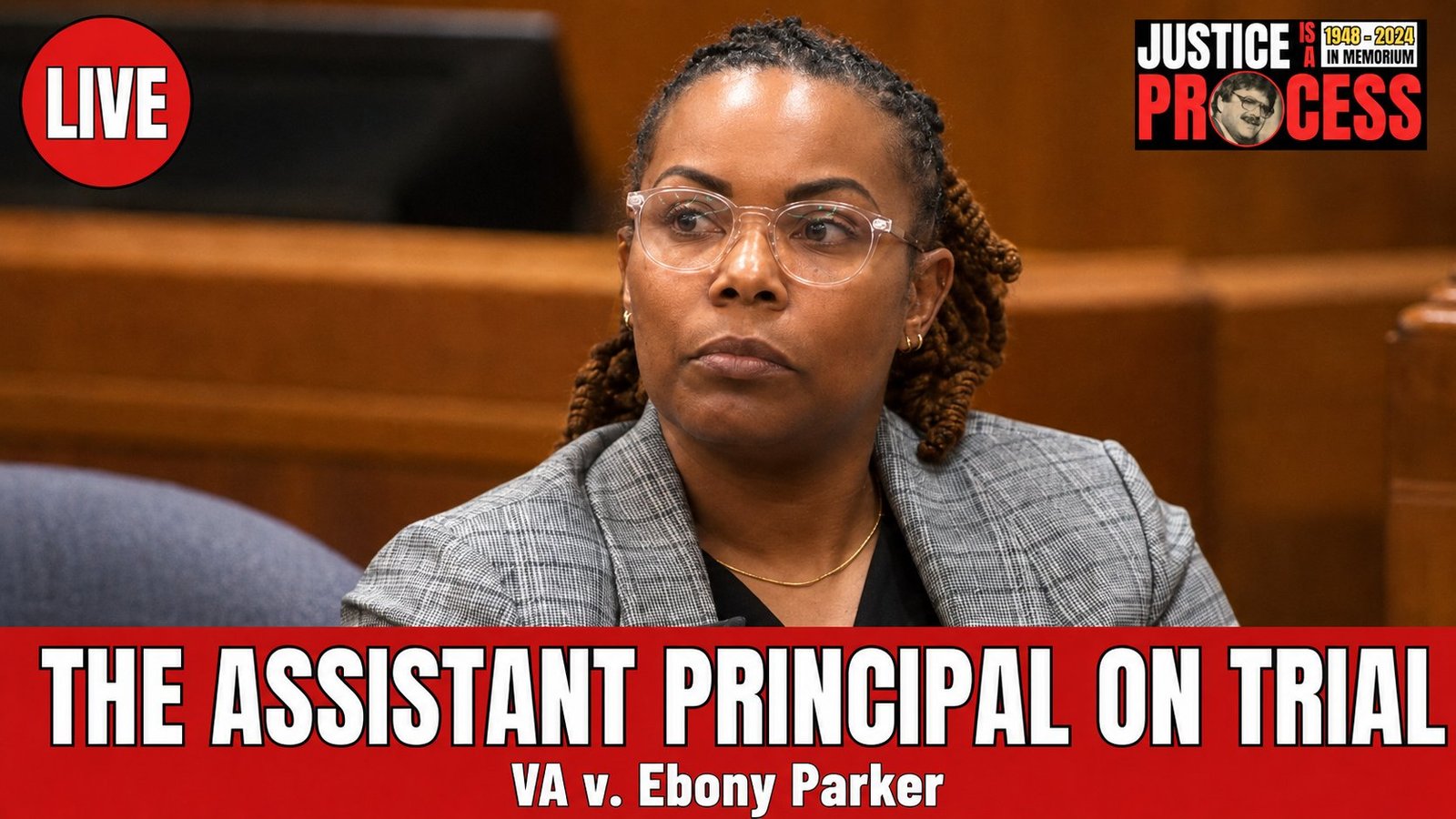
Eight bullets. Three warnings. One question for the jury.
May 2026 | Justice Is A Process
On the morning of January 6, 2023, Abby Zwerner was sitting at a reading table in her first-grade classroom at Richneck Elementary School. Newport News, Virginia. A Friday. Twenty children in the room, give or take, scattered across the rug and the desks the way first-graders always are.
One of those children stood up.
He was six years old. He pulled a 9mm handgun from somewhere on his body, raised it, and shot his teacher in the chest and the hand.
What happened next, Abby Zwerner has described herself. She somehow got her students out of the room. She got to the school office. She passed out. Later, in a $40 million civil lawsuit she filed against the school's former assistant principal, she would describe the moment the shot was fired in words that no first-grade teacher should ever have to say.
"I thought I had died. I thought I was on my way to heaven or in heaven."
She survived. Barely. She has lasting injuries to her hand. She has post-traumatic stress disorder. She testified at her own civil trial that she still cannot shake the look on the six-year-old's face as he aimed the weapon at her. A blank look. That is the word she used.
Three years and four months later, on Monday May 18, 2026, the trial began for the only person any prosecutor has chosen to put before a criminal jury for what happened at Richneck Elementary that day. The boy will never be charged. He was six. His mother already went to prison. The principal was reassigned. The superintendent was voted out. The school board paid out a $10 million civil verdict in November. And on Monday, in a Newport News courtroom, the woman who was the assistant principal at Richneck Elementary on January 6, 2023, pleaded not guilty to eight felony counts of child abuse and disregard for life.
Her name is Dr. Ebony Parker. She faces up to forty years in prison. Each of the eight counts represents one of the bullets in the gun the six-year-old brought into her school.
This case may be the first time in American history a school administrator has stood before a criminal jury for what she did not do. That is not a small claim. Parents have been criminally convicted in school shooting cases. James and Jennifer Crumbley in Michigan. The father of the Apalachee High School shooter in Georgia. Resource officers have been tried. Scot Peterson in Parkland. But an administrator, prosecuted on a theory that her inaction in the hours before the shooting amounted to a Class 6 felony, eight times over? I cannot find another one.
So that is the question. The state will spend the week telling twelve jurors that Dr. Parker was warned about a gun in her school three different times that morning and did nothing. The defense will spend the week telling those same twelve jurors that the law cannot put an educator in prison for a tragedy she did not cause, could not have foreseen, and had no legal duty to prevent.
The presumption of innocence belongs to Dr. Parker. The burden of proof belongs to the Commonwealth. The decision belongs to twelve people who already had to be filtered out of a jury pool of eighty-four because so many of them watched the civil trial and had already made up their minds.
That is the case. This is Justice Is A Process. Let's begin.
The Commonwealth's case rises and falls on a single proposition: that Dr. Parker received multiple, specific, escalating warnings that a six-year-old in her school had a gun, and that she did not act on any of them. To make sense of that argument, walk the morning hour by hour.
According to the special grand jury report that resulted in her indictment in 2024, and according to testimony already presented in last November's civil trial, the warnings began that morning before the shooting and came from more than one source.
The first warning, as Abby Zwerner herself testified in the civil case, came through a reading specialist. Students had told the specialist that the boy, identified in court only as "JT," had a gun. The reading specialist passed that information up the chain. The next link in that chain was the assistant principal. Dr. Parker.
The second warning came from another teacher. According to civil trial testimony, multiple staff members reported the same concern to Dr. Parker that morning. Different teachers. Different students they had heard from. The same alarm.
The third warning, according to Zwerner's civil attorneys, came from a student on the playground who saw the six-year-old take a weapon out of his pocket. That sighting was reported. It traveled, in the way these things travel in elementary schools, back through staff and eventually back to the administration.
Three warnings. One administrator. Several hours.
By late morning, the boy was back in Abby Zwerner's classroom. She was sitting at a reading table when he pulled the weapon. The gun was a 9mm handgun, loaded, which the boy had taken from his mother's purse and carried to school in his backpack. He fired once. The bullet went through Zwerner's hand and into her chest.
She got the children out. The remaining first-graders, the ones who had been sitting on the rug a moment ago, the ones whose lives the prosecution will argue were placed in mortal danger by the failure of the adult in the building responsible for keeping them safe. She got them into the hallway. She walked herself to the school office. She collapsed there.
Police arrived. Paramedics arrived. Zwerner was rushed to Riverside Regional Medical Center. She survived. She underwent surgery. The boy, the six-year-old who pulled the trigger, was taken into custody and into emergency mental health care.
Dr. Parker resigned her position two weeks later. She has not given any public account of what she did or did not know that morning. She did not testify at the civil trial. She has not testified at the criminal trial. She is under no legal obligation to do either.
What happened at Richneck Elementary did not stay quiet for long. A six-year-old shooting his teacher made national news within hours. By the end of that weekend, every major outlet in the country was running the story. Parents in Newport News wanted answers. Teachers wanted answers. The school board found itself facing a community that did not believe what it was being told.
Within days, school officials began offering different accounts of what they knew and when. The story shifted. Then a special grand jury was empaneled to investigate.
That grand jury met. It interviewed witnesses. It reviewed documents. And in 2024, more than a year after the shooting, it returned a thirty-one-page report. The report concluded that Dr. Parker had been told repeatedly about the boy having a gun and had not taken the steps that, the grand jurors believed, would have prevented the shooting. The report also pointed to broader institutional failures at Richneck Elementary and within Newport News Public Schools, including what Zwerner's civil attorneys would later characterize as an apparent cover-up of the boy's disciplinary records both before and after the shooting.
The same grand jury returned a true bill against Dr. Parker. Eight felony counts. One for each bullet that had been in the gun.
It matters who Abby Zwerner is. The case will turn on what others did, but it exists because of what was done to her.
She was twenty-five years old when she was shot. A first-grade teacher. Newport News kid herself, as far as the public record goes. She had been at Richneck Elementary not long. She loved her students. That is how every teacher who taught alongside her has described her. She was the kind of person who got down on the floor with six-year-olds and met them where they were.
And then a six-year-old shot her in her classroom. With his teacher's body still wounded, she got her kids to safety. She passed out from blood loss in the office where she had hoped to find help. Three years later, she still cannot open a water bottle one-handed. She has PTSD, diagnosed at trial by a psychiatrist who testified in her civil case. She has described feeling numb around other people.
She is expected to take the stand again this week. The Commonwealth has her on its witness list. No matter how this trial ends, what this woman has carried for three years on behalf of every child in that classroom that day deserves to be said clearly: she did her job. She kept twenty first-graders alive. Her body absorbed what was meant for them.
Dr. Parker has a doctorate in education. She rose through the Newport News Public Schools system into a building-level administrator role. By January 2023 she was the assistant principal at Richneck Elementary. The number-two administrator in the building, responsible alongside the principal for the day-to-day operations of the school, including, the prosecution will argue, the discipline of students and the safety of the building.
She resigned two weeks after the shooting. She has not given a public statement about what she knew or did not know that day. She did not testify in her own defense at the civil trial last November. She is not required to testify at this one. Those choices are protected by the Fifth Amendment of the United States Constitution and they create no inference of guilt. They cannot. That is the law.
What we have, in terms of how she views these events, comes through her attorneys. Through her civil counsel, Sandra Douglas, who told a Newport News jury last fall that the shooting was "unthinkable" and "unforeseeable" and that Dr. Parker had no legal duty to protect Abby Zwerner from a six-year-old's gun. Through her criminal defense team, who began this week by asking Judge Rebecca Robinson for a continuance based on body camera footage they said had only recently come to their attention.
Dr. Parker sits at the defense table this week presumed innocent. That is not a legal technicality. That is the spine of the American criminal justice system, and the Commonwealth has to break it through every juror in the box before it can take this woman's liberty.
The boy is referred to in court only by his initials. We will do the same. He was six years old when he took a loaded 9mm handgun from his mother's purse, walked it into Richneck Elementary in his backpack, and shot his teacher.
Prosecutors have said the boy has "extreme emotional issues." He has not been criminally charged and will not be. He is too young. Virginia law sets a floor on criminal capacity, and a six-year-old does not have it. Whether he understood, in any meaningful sense, what he was doing when he pulled the trigger is a question for psychiatrists and parents and God, not for the criminal justice system.
He had a history. That history is going to come up at this trial. Prosecutors successfully argued at an April motions hearing that Dr. Parker was aware of a prior incident in which the boy allegedly choked a retired Richneck teacher named Susan White. That testimony will come in. More on that in a moment.
The boy's mother, Deja Taylor, has already been through this system. She pleaded guilty to felony child neglect under Virginia state law for the way her son was able to access her firearm. She served approximately two years in state custody. She also pleaded guilty to federal charges related to a false statement on a firearm purchase form and was sentenced to twenty-one months on those.
According to the Virginia Department of Corrections, Taylor was released from state custody to community supervision on May 13, 2026. Six days before this trial against Dr. Parker began. The timing is coincidence. The connection is not.
However the criminal jury decides this week about Dr. Parker, the question of how a 9mm handgun ended up unsecured in a six-year-old's mother's purse, accessible enough that a first-grader could fit it in a backpack, has already been answered by one criminal verdict. It will not be re-litigated here.
The state's case is going to be built on the testimony of Richneck Elementary staff. The reading specialist. The teacher who reported the second warning. The student or students who reported the playground sighting, where allowed and appropriate given their ages. Officers who responded that day. And, central among them, Susan White.
Susan White is a retired Richneck teacher. According to the Commonwealth, the boy had previously assaulted her at the school. Prosecutors say Dr. Parker knew about that incident. The defense filed a motion to keep White off the witness stand, arguing she could not properly testify about the boy's character. Judge Robinson denied that motion. White testifies. The judge said her testimony was needed "for curative instruction," which is a legal way of saying it goes to whether Dr. Parker knew or should have known what this particular child was capable of when she was warned about the gun.
Hon. Rebecca M. Robinson is presiding in Newport News Circuit Court. She handled the April motions hearings, she has ruled against the defense on the Susan White motion, and she denied the defense's request for a continuance on Day 1 of trial. She told the jury she expects this case to be wrapped up by the end of the week.
The prosecution is being led by Newport News Commonwealth's Attorney Howard Gwynn, whose office secured the original grand jury indictment in 2024 and has carried this case through pretrial.
The defense, as of the start of trial, has been seen in court but, in keeping with the early posture of the criminal case, has spoken sparingly to the press. The civil defense was led by Sandra Douglas. The criminal defense team's members will be confirmed as coverage proceeds.
Zwerner is separately represented in her civil matters by Diane Toscano, Kevin Biniazan, and Jeffrey Breit. They are not the prosecutors in this criminal case, but their work in the civil case framed many of the facts and witnesses the criminal jury is now going to hear.
Eight counts. All of them under the same Virginia statute. Each one a Class 6 felony.
The statute the Commonwealth is using is Virginia Code Section 18.2-371.1(B)(1). Plain English: it is the Virginia felony child neglect law. It says that a person responsible for the care of a child under eighteen commits a Class 6 felony if their willful act or omission in caring for that child is so gross, wanton, and culpable as to show a reckless disregard for human life.
Read that sentence twice. It is going to drive everything that happens in that courtroom this week.
Statute: Virginia Code § 18.2-371.1(B)(1)
Class: Class 6 felony.
What it means in plain English: A person responsible for a child's care committed an act, or failed to act, in a way so reckless that it showed disregard for human life. Each count corresponds to one of the eight bullets in the 9mm handgun the six-year-old brought into Dr. Parker's school.
What the State must prove on each count: (1) Dr. Parker was a person responsible for the care of the relevant child; (2) She willfully acted or willfully failed to act in her care of that child; (3) That act or omission was so gross, wanton, and culpable that it showed reckless disregard for human life. All three elements. Beyond a reasonable doubt. Eight times over.
Potential sentence: Up to five years per count. With eight counts charged, the theoretical maximum exposure is forty years in prison.
Here is what makes this case structurally different from almost every other school shooting prosecution in the country. The state is not alleging that Dr. Parker did anything. They are alleging she failed to do something. An omission case.
Omission cases are hard. They are hard because the law has always been skeptical of punishing people for what they did not do. The American legal tradition has been more comfortable holding people criminally responsible for affirmative acts than for inaction. There are exceptions. Parents who let their children starve. Caretakers who leave the elderly in their charge to die. People who put others into danger and then walk away. The exceptions exist because in those situations, the law has decided, the duty to act is so clear and so basic that failing to act is itself a moral wrong.
The Commonwealth is going to argue Dr. Parker had exactly that kind of duty. She was the assistant principal. The students in her building were in her care. When she was told there was a gun, the duty to act, the prosecution will say, could not have been clearer.
The defense is going to argue the opposite. That an assistant principal does not have the kind of personal duty the statute requires. That school safety is collaborative. That nothing in Virginia law makes an educator the guarantor of her teachers' physical safety in the way the prosecution's theory demands.
That is the battle. Eight times over. One for each bullet.
Every case that reaches a jury exists for a reason. Sometimes the reason is obvious. Sometimes you have to go looking. Here, the reason is in plain sight: the Commonwealth is asking a jury to put a school administrator in prison for what she did not do, and the defense is asking a jury to refuse.
It is not the charges that put this case in front of twelve people this week. It is the gap between what happened and what is criminal. A six-year-old shot his teacher. That is a fact. The teacher was warned about almost by a reading specialist, then by another teacher, then through a student sighting on the playground. Those are reportedly facts. The teacher in question is Abby Zwerner, who almost died because of them. That is a fact.
What is contested, what twelve people will decide this week, is whether the next link in that chain, the assistant principal, committed a crime when she did not act on those warnings the way the prosecution says she should have.
The state's theory is simple, and simple is dangerous to a defense. Howard Gwynn's office will tell the jury that Dr. Parker was the senior administrator in the building that day. Three different warnings. Hours of opportunity. A six-year-old with a documented history of violence in that very school. A loaded handgun in his backpack. Any reasonable assistant principal, the Commonwealth will argue, would have done something. Searched the boy. Locked the building down. Removed the boy from class. Called law enforcement. Called the parent. Anything. Dr. Parker, the Commonwealth will argue, did none of those things. And because she did none of those things, the prosecution will say, Abby Zwerner was shot. The first-grade children in that classroom were placed in mortal danger. Each of them was the child whose care Dr. Parker, in her role as the building's assistant principal, was responsible for.
"A gun changes everything," Zwerner's civil attorney Kevin Biniazan said during the civil trial. "You stop and you investigate. You get to the bottom of it. You get to the bottom of that backpack."
Expect that frame to return this week. Different lawyers, different burden of proof, same underlying argument. A gun in an elementary school is the moment when every other consideration falls away.
The defense playbook is already public. It was deployed at the civil trial last November. We have the closings. We have the expert. We have the structure.
Civil defense counsel Sandra Douglas told the civil jury that the shooting was "unthinkable" and "unforeseeable," that Dr. Parker had no legal duty to protect Abby Zwerner, and that the law required the jury to examine "people's decisions at the time they make them." Not in hindsight. Not knowing what came next. In the moment.
The civil defense called one witness. Amy Klinger, an expert in education administration and school safety. Klinger told the civil jury that the assistant principal's role is collaborative. That school safety is a shared responsibility among all staff. "No one is the sole person responsible for school safety," she said.
That is the defense in compressed form. It was not Dr. Parker's job alone. The reports she got were ambiguous. The situation was unprecedented. A six-year-old bringing a loaded handgun to school had, prior to that morning, never happened at Richneck Elementary or in any meaningful body of caselaw the defense could point to. The decisions Dr. Parker made in the moment were reasonable based on what she knew, when she knew it.
Whether the criminal defense calls Klinger again or substitutes a different expert, expect the architecture to remain the same: no clear individual duty, no foreseeability, no criminal recklessness, no conviction.
Two pretrial rulings have already shaped this case before opening statements.
The first was the Susan White motion. The retired Richneck teacher, whom the boy had previously allegedly choked, is allowed to testify. The defense tried to keep her out, arguing that she could not properly speak to the character of the six-year-old at issue. Judge Robinson sided with the prosecution. White comes in. Her testimony goes to the question of what Dr. Parker knew about this particular child, and therefore to whether the warnings on January 6, 2023, were ambiguous reports about an ordinary kid or specific warnings about a child with a documented history of violence.
That ruling is enormous. It hands the Commonwealth a piece of evidence the defense badly wanted to keep out. It transforms the warnings the prosecution will describe from generic reports of "a kid might have a gun" into a more loaded narrative: this kid, who had already done this kind of thing, might have a gun, and you were told.
The second was a continuance motion the defense made on Monday morning, May 18, before jury selection began. Defense attorneys asked Judge Robinson for additional time, citing body camera footage they said they had only recently become aware of. Judge Robinson denied the motion. The trial proceeded.
Body camera footage matters in this case for a reason that is not immediately obvious. The shooting itself was inside the classroom, not on camera. But what officers found when they arrived, what staff said to officers in the moments after the shooting, what Dr. Parker herself said to anyone in those minutes and hours, may all be on body camera somewhere. The defense apparently believes there is footage in there they need to examine. The judge has told them they can examine it during trial. We will see whether that becomes a Brady issue, a chain-of-custody issue, or nothing at all.
You cannot understand this criminal trial without understanding what happened in November 2025, in the same courthouse, with most of the same evidence.
Zwerner sued the school division and Dr. Parker in 2023, alleging $40 million in damages. The school superintendent and the school principal were dismissed as defendants by a judge before trial. Dr. Parker stood alone as the lone remaining defendant. The case went to a Newport News jury last November on a theory of gross negligence.
The jury found Dr. Parker grossly negligent. It awarded Abby Zwerner ten million dollars in damages. Less than the $40 million Zwerner's team had asked for, but a verdict squarely on the side of the teacher.
That verdict creates two problems for this criminal trial.
The first is the jury pool itself. According to local reporting, of the eighty-four prospective jurors who showed up Monday morning for criminal voir dire, more than forty had seen media coverage of the case, more than thirty had discussed it with friends or family, at least a dozen had watched the civil trial, and more than twenty-five admitted they had already formed opinions about Dr. Parker's guilt or innocence. Judge Robinson and the attorneys spent a full day filtering. Twelve jurors and two alternates were eventually seated. But the contamination of the pool was significant. Every one of those twelve is going to have to set aside not only what they have heard, but in some cases what they have already concluded. The defense will live or die on whether they actually do.
The second problem is money. The Virginia Risk Sharing Association, an insurance pool that covers Newport News Public Schools among other public bodies, is on the hook for the $10 million civil verdict. Dr. Parker has appealed the civil judgment, but if it stands, the Risk Sharing Association pays. If Dr. Parker is acquitted criminally, the insurer's argument that this was an unforeseeable tragedy by a single negligent administrator gets a real boost. If she is convicted, the insurer has a strong argument that her conduct was criminal, the kind of intentional misconduct most insurance policies do not cover, and so they should not have to pay.
Twelve people in a Newport News courtroom this week are not just deciding whether Dr. Parker spends years in a state prison. They are deciding, in part, who eventually writes Abby Zwerner her ten million dollar check. Nobody is going to put it to the jury that way. They will not have to. The verdict will speak for itself.
This is where the watchdog perspective matters. Other channels will recap the testimony. We are going to watch whether the system makes the state earn this conviction.
The first thing to watch is the most basic. Does Howard Gwynn's office actually carry the burden the law assigns them?
Beyond a reasonable doubt is not a slogan. It is the wall that stands between an individual and the power of the Commonwealth. In a civil case, the plaintiff wins if her version of events is more likely than not. Fifty-one percent. A coin flip's worth of difference, and the verdict goes her way. That is what Abby Zwerner won in November.
This is not that case. Criminal beyond a reasonable doubt is a far higher standard. The Commonwealth must prove every element of each of the eight counts to the satisfaction of all twelve jurors. Not most jurors. All of them. If one juror has a doubt grounded in reason, the verdict must be not guilty.
That distinction needs to be alive in the courtroom this week. The state will be inclined to lean on the civil verdict. It will lean on the grand jury report. It will lean on community outrage. None of that meets the criminal burden. What meets the criminal burden is sworn testimony, properly admitted evidence, and an air-tight case on every element of each count.
The second thing to watch is whether the Commonwealth can actually build a case that punishes inaction without sliding into punishing a profession.
School administrators in this country make hundreds of judgment calls a day. Most of them are quiet. They handle behavioral issues. They follow up on reports from teachers. They balance limited time and limited information. Some of those calls are wrong in hindsight. Some are wrong in real time. The question for Virginia, and for every other state watching this case, is whether bad professional judgment, even devastating professional judgment, can be felonized.
There is a version of this case where the answer is yes, and it is narrow. If the prosecution can show that Dr. Parker specifically knew, with reasonable certainty, that a particular six-year-old had a gun on school grounds at a specific moment in time, and then did nothing, that is not professional judgment. That is reckless indifference.
But the further you move from that narrow version, the more dangerous this prosecution gets. If the warnings on January 6 were ambiguous, if multiple staff members heard different versions, if the information that reached Dr. Parker was scattered and contradictory, then what the state is asking jurors to do is convict a school administrator for failing to be omniscient. That is not what the felony child neglect statute was written for. And convicting on that theory means every assistant principal in Virginia is one student rumor away from a Class 6 felony.
Twelve people are going to decide where that line is. The whole country should pay attention to where they put it.
The third thing to watch is the structure of the trial itself. We are going to watch whether the presumption of innocence survives the weight of the civil verdict. We are going to watch whether contaminated jurors honor their oath to set aside what they have seen. We are going to watch whether Dr. Parker's Fifth Amendment right not to testify is treated, as it must be, as a right and not an inference. We are going to watch whether the body camera evidence the defense flagged is fairly disclosed and fairly used. We are going to watch whether Judge Robinson, who has already ruled on two major motions in ways the defense did not want, holds the line on every other evidentiary question.
That is the constitutional floor. It applies to every defendant. It applied to my father when the federal government came after him in the 1990s for refusing to break attorney-client privilege. It applied when they came after him again for teaching pro se defendants their rights from a coffee shop in Martinsburg, West Virginia. It applies to Dr. Parker this week. The presumption of innocence does not care whether the defendant is sympathetic. It does not care about the civil verdict. It does not care about the ten million dollar award. It does not care about public outrage. It cares about whether the state proves its case beyond a reasonable doubt.
That is what we are here to watch.
The fourth thing to watch is something the Commonwealth and the defense will both dance around without naming directly. This case may be a first.
Multiple national outlets, including CNN and the Associated Press, have reported that Dr. Parker appears to be the first educator in the country to face a criminal trial for her inaction in connection with a school shooting. Parents have been convicted. The Crumbleys in Michigan. The Apalachee shooter's father in Georgia. Resource officers have been tried and acquitted. Scot Peterson in Parkland, who was the armed officer on scene and was charged with child neglect for his inaction. He walked.
But an administrator. An educator. An employee of a public school system, who was not armed, who was not the immediate adult in the room when the shooting happened, who is being prosecuted for what she did not do in the hours leading up to it.
Whatever the verdict, the case will be cited for the next twenty years. Either as the moment American law decided educator inaction could be a felony, or as the moment a jury said no, the law cannot go that far.
Those of us covering the case do not get to vote on which precedent gets set. But we owe the audience honest framing about which precedent is on the table.
LIVE BROADCASTS every day the court is in session. Our cameras and pool feed are on this case. You watch the trial unfold the same moment the jury does.
NO BREAKS EDITIONS after each trial day so you can watch the testimony straight through, unedited, without commercial interruption.
JUSTICE BREAKDOWNS nightly. Deep-dive analysis of what each witness changed, what each ruling means, where the state's case advanced or stalled, where the defense closed gaps or left them open.
TESTIMONY SEGMENTS so you can hear every word from every witness without having to scrub through hours of recess and bench conferences.
Dr. Ebony Parker is presumed innocent until proven guilty beyond a reasonable doubt. That is not a technicality. That is the foundation of everything we do here.
Let's watch the system together.
Subscribe to Justice Is A Process on YouTube for live trial coverage, No Breaks editions, and breaking news as it happens.
🔴 Subscribe on YouTube111,000+ subscribers watching the system with us
Discussion