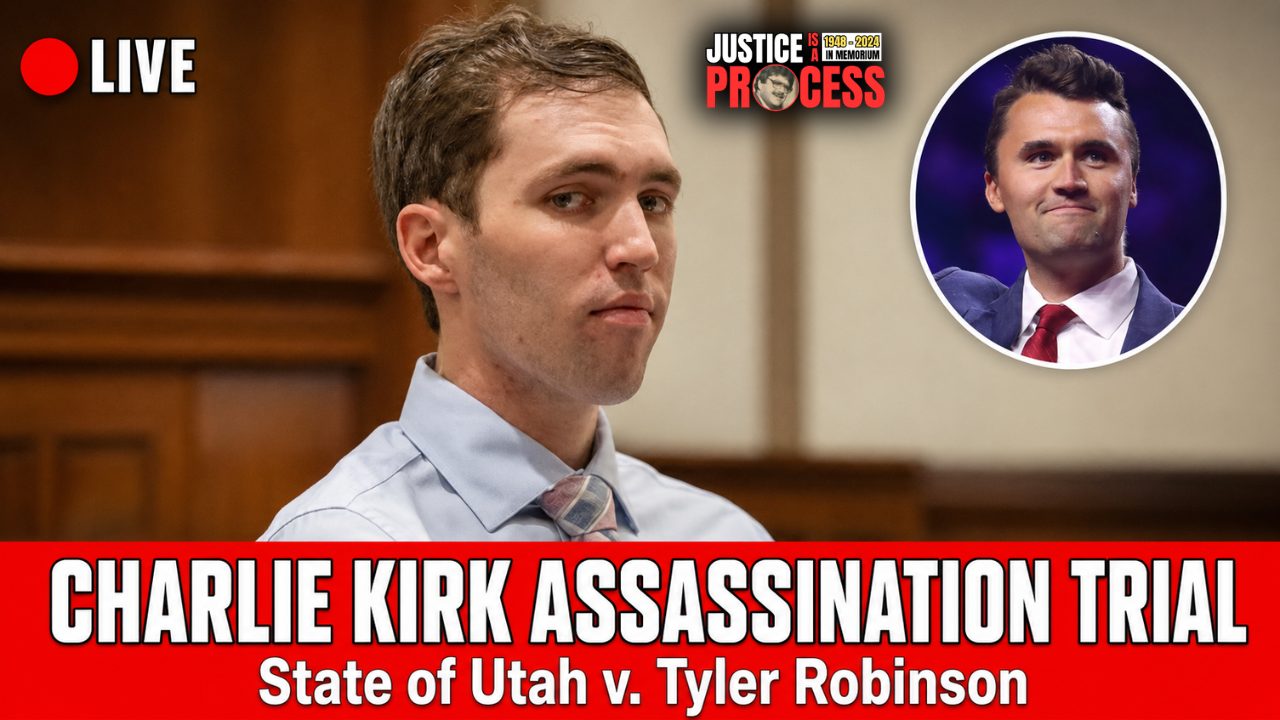
A confession, a contempt finding, and the fight over whether a death penalty case can stay fair
July 2026 | Justice Is A Process
At 12:23 in the afternoon on September 10th, 2025, Charlie Kirk was mid-sentence, answering a question from a student about mass shooters, when a single rifle shot from a rooftop more than a hundred yards away ended his life in front of roughly three thousand people at Utah Valley University.
He never finished the sentence.
Sixty-some miles south, a 22-year-old electrical apprentice named Tyler Robinson had, according to charging documents, spent more than a week planning that exact moment. Within thirty-three hours he would surrender to a sheriff's office two counties from where he pulled the trigger, and only after his own mother looked at a photo the FBI had just released and thought it looked like her son.
That's the short version. Almost everyone in America already knows some version of it. Kirk built Turning Point USA from a teenager's idea into one of the most influential organizing machines in conservative politics, and by the time he was killed he was close enough to Donald Trump that the president credited him with helping mobilize an entire generation of young conservative voters. Robinson grew up in a Latter-day Saint, conservative household in southwestern Utah, and people who knew him described him to reporters as quiet and considerate, not the profile anyone expected for a political assassination.
Ten months later, Robinson still hasn't entered a plea. He hasn't stood trial. He hasn't even had the hearing where a judge decides whether there's enough evidence to hold one. That hearing starts this week, and it will be the first time in this entire case that either side has had to put its actual evidence in front of a camera instead of arguing about who gets to see it.
We're not going to tell you Tyler Robinson is guilty. Not because we're being careful for the sake of being careful. Because the Constitution doesn't let anyone, including us, start there, and because this specific case has already shown what happens when people in power forget that. A Utah prosecutor spent this spring on television and in print talking about the strength of the evidence against Robinson. A judge held him in contempt of court for it. If the system is willing to sanction its own lawyer for saying less than what a lot of the country has already decided about this case out loud, that tells you something about how much weight the next few months are going to carry.
Understand the scale of what happened first. This wasn't a quiet crime discovered days later. It happened in front of a live crowd, on video, at the opening stop of a fifteen-city tour, and within hours it was the lead story on every network in the country. The FBI director flew to Utah personally. The sitting president posted about it before the day was even over. A governor stood at a podium and called it a political assassination, out loud, on camera, before anyone had been arrested. That is the temperature this case has lived at since minute one, and it has not cooled down in ten months.
So this is the job in front of us. Charlie Kirk is dead, and a jury will eventually decide what that means for the man accused of killing him. Our job, the only job this channel has ever had, is to watch whether the system gets there fairly. Whether Robinson, whatever anyone believes about him, gets the trial the Sixth Amendment promises even to people the country has already decided it hates. Whether Kirk's family gets a process that actually answers their questions instead of a spectacle that answers nobody's.
This is Justice Is A Process. Let's begin.
Charlie Kirk arrived at Utah Valley University on September 10th, 2025, as the first stop on Turning Point USA's American Comeback Tour, a nationwide swing with at least fifteen planned dates that was supposed to carry him from Orem to Colorado State University the following week and on from there. Students at UVU had protested and circulated petitions against the visit in the days beforehand, which was not unusual. Kirk's campus appearances almost always drew some organized opposition alongside the crowds that came to see him. What made this stop different from every other one he'd done in thirteen years was not the protest. It was who was already on campus, watching, hours before Kirk arrived.
According to investigators, the man who would later be charged with his murder reached UVU by 11:52 that morning, having driven up from southwestern Utah in a gray Dodge Challenger and changed into dark clothing somewhere along the way. Surveillance footage reviewed by investigators reportedly shows him moving through a campus stairwell, up onto a rooftop, and across it to what officials would later call a sniper's perch, walking with a stiff right leg and a slow, deliberate pace, the kind of detail that only becomes significant once you already know what happens next.
Kirk's event that day followed the format that made him famous on college campuses: a "Prove Me Wrong" table, where any student could walk up and challenge him directly, on camera, no script, no vetted questions. It was the same format that had built his following in the first place, hours of unscripted argument with people who disagreed with him, filmed and posted for millions of views. Around noon, in front of a crowd investigators estimate at close to three thousand people, he started taking questions. One of them, according to multiple outlets that reviewed video of the event, touched on mass shootings and transgender identity. Kirk was answering it when, at 12:23 p.m., a single shot rang out.
He was struck in the neck. Video from the scene shows him grabbing at the wound and collapsing as the crowd scattered. Bystanders got him into a vehicle within seconds. He was rushed to a nearby hospital, where he was pronounced dead.
Investigators say the shot came from the roof of the Losee Center, a campus building roughly a hundred and thirty meters away, something like a football field and a half, from where Kirk had been sitting. Officers reached the scene within sixteen minutes. On the roof, they recovered trace evidence: shoe impressions, a forearm print, a palm print. In a wooded area nearby, where the shooter had apparently fled, they found a bolt-action rifle, a towel, and several cartridges.
The first day was chaotic in the way these things always are. Two people were briefly detained near campus in the immediate aftermath and released once investigators confirmed neither had any connection to the shooting. For a stretch that night, the FBI director publicly stated a suspect was in custody with a high degree of confidence, only for authorities to walk that back and confirm the person of interest had been released after questioning. The actual gunman was still nowhere to be found, and by nightfall on the tenth, law enforcement had recovered what they believed was the murder weapon, a high-powered bolt-action rifle, from the wooded area where the shooter had apparently fled. The FBI laboratory took custody of it for analysis. The following morning, the FBI released video of a figure jumping from the Losee Center roof and running, put up a hundred-thousand-dollar reward, and asked the public directly for help identifying him.
They didn't need long. Tyler Robinson's own family got there first, not a tip line, not facial recognition software, his own parents. According to charging documents, his mother saw the released photo the day after the shooting and thought it looked like her son. She called him. He told her he'd been home sick, that he'd also been sick the day before, on the day of the shooting itself. She wasn't convinced, and she told her husband she was worried. Robinson's father then confronted him directly and, with the help of a youth pastor, convinced him to turn himself in. On the evening of September 11th, roughly thirty-three hours after the shooting, Robinson walked into the Washington County Sheriff's Office with his parents at his side. There was no standoff. No chase. A family made a phone call, and then made a choice.
What investigators say they found afterward became the spine of the prosecution's case, and it built fast. Within six days of the shooting, the State had gone from an unidentified figure jumping off a rooftop to seven filed felony and misdemeanor counts and a death penalty announcement. DNA consistent with Robinson's, according to charging documents, turned up on the rifle's trigger, on other parts of the weapon, on the fired cartridge casing, on two unfired cartridges, and on the towel used to wrap the rifle. Robinson had reportedly described the weapon in messages as his grandfather's rifle, a detail that, if it holds up, connects the murder weapon to Robinson's own family rather than to any outside network or supplier, an important distinction given how much speculation there was in the first weeks about organized involvement.
Investigators also say they recovered a text exchange between Robinson and his roommate at the time, described in court filings as also his romantic partner, in which Robinson allegedly directed the roommate to retrieve a handwritten note from under his keyboard. According to those filings, the note said Robinson had the chance to act against Kirk and was taking it. In messages that reportedly followed, Robinson allegedly told his roommate he'd been planning the attack for more than a week, described markings scratched into the shell casings as an inside joke pulled from internet culture, and, when asked why, said he'd had enough of what he called Kirk's hatred. He allegedly asked his roommate to delete the conversation and, if police came asking questions, to say nothing beyond requesting a lawyer.
Utah County prosecutors filed formal charges on September 16th, six days after the shooting, and announced the same day that they intended to seek the death penalty.
In the weeks that followed, competing theories about Robinson's motive spread faster than confirmed facts did. Elected officials speculated publicly about ideological pipelines and organized networks before investigators had finished their own review. Discord, the messaging platform where some of the wilder theories took root, conducted its own internal audit and reported finding no evidence that Robinson had promoted violence or planned the attack anywhere on its platform. That gap, between what got said out loud in the first two weeks and what investigators could actually document, is a big part of why this channel exists. We'd rather wait for the paperwork than repeat the theory.
None of what's described above has been tested in front of a jury. Everything in this section comes from charging documents, court filings, and reporting on both, not from a verdict, and Robinson has pleaded to nothing yet, because he hasn't been arraigned. That's worth sitting with, because it's easy to read a section like this and feel like the case is already decided. It isn't. A preliminary hearing exists specifically because the government's version of events, however detailed, is not the same thing as proof.
Charlie Kirk was 31 years old when he died. He founded Turning Point USA at eighteen, skipping college himself to build it, and over the next thirteen years turned it into a conservative youth organization with hundreds of college chapters and, by some accounts, close to a hundred million dollars in annual revenue by 2024. That is not a small operation built on enthusiasm alone. It is a national political infrastructure, and Kirk built almost all of it before he turned thirty.
This country was deeply split on his politics long before he died. Split or not, Kirk was unusually good at the specific thing that got him killed: standing in front of a hostile or skeptical crowd and taking direct, unscripted questions for hours at a time, on camera, letting the exchange run long enough to actually go somewhere. That's what he was doing at Utah Valley University. It's what he'd built his entire public career around, and it's part of why the footage of his death spread as fast and as widely as it did. Millions of people had already watched him do exactly this, dozens of times, on exactly this kind of college stage. This time the tape kept rolling past the part anyone expected.
He was a close ally of President Trump, who credited Kirk's organizing with helping turn out young conservative voters in the 2024 election and, according to multiple accounts, considered him one of the most consequential young figures in the movement. He left behind a wife, Erika, and two young children. In the months since his death, Erika Kirk has become a visible presence in the case in her own right, arguing publicly, alongside prosecutors and media organizations, against efforts to keep cameras out of the courtroom, and has spoken out at points about the toll of watching the case move through pretrial motions instead of toward answers. Kirk's parents, Robert and Kathryn Kirk, have largely stayed out of the spotlight since his death, and this week's hearing will reportedly be the first time either of them sits in a courtroom with the man accused of killing their son.
Tyler James Robinson was born April 16th, 2003, and grew up in Washington County in southwestern Utah, in a Latter-day Saint family that, by his own grandmother's account, was overwhelmingly Republican. He attended Riverside Elementary, graduated from Pine View High School in May 2021, and earned college credit along the way at what's now Utah Tech University. He later enrolled at Utah State and dropped out. At the time of the shooting he was training as an electrical apprentice, roughly 240 miles from the campus where Kirk would die.
People who knew him described him to reporters as "squeaky clean" and considerate, not the profile anyone expected for a political assassination. Family photos posted online in the years before the shooting show an ordinary kid on ordinary vacations, family meals, Halloween costumes, nothing that reads, in hindsight or otherwise, as an obvious warning sign. That gap, between the person neighbors and relatives describe and the act he's accused of, is part of what made this case feel so unresolved to so many people in the first weeks, and part of why speculation filled in so fast where facts hadn't yet arrived.
Utah's governor said publicly, without offering specifics, that Robinson had drifted from his family's politics toward what the governor called leftist ideology, and suggested he'd been radicalized in part by internet culture after leaving Utah State. A relative reportedly told investigators that Robinson had expressed dislike for Kirk at a family dinner and mentioned Kirk's upcoming visit to UVU beforehand. We're not building this report around any of that. Be skeptical of anyone, on any side, who sounds certain about a stranger's inner political life based on a press conference or a secondhand dinner-table comment. What actually matters in front of a judge is narrower and more specific: prosecutors allege Robinson targeted Kirk because of Kirk's political expression, and that specific allegation, not a broader theory about ideology, is what the State has to prove.
Robinson is presumed innocent. He has not been convicted of anything. That is not a technicality we're including to cover ourselves. It is the actual legal status of a 23-year-old who has spent ten months in a Utah jail without a trial date.
The prosecution is led by Utah County Attorney Jeff Gray, alongside Deputy County Attorney Chad Grunander and Deputy County Attorney Christopher Ballard, the same Ballard a judge would later hold in contempt of court for talking to reporters. Gray is the elected official who stood at a podium six days after the shooting and announced both the seven charges and the intent to seek death. Robinson's defense team includes Kathryn Nester, a Salt Lake City attorney appointed roughly two weeks after the shooting specifically to handle a capital case of this scale, along with Richard Novak, Staci Visser, and Michael Burt, who joined later as the litigation over media access and forensic evidence intensified. Fourth District Judge Tony Graf Jr. is presiding over the entire case, from the earliest procedural fights through the preliminary hearing starting this week, and every contested ruling described in this report, cameras, hearsay, the contempt finding, the disqualification motion, came from his bench.
One more name matters more than almost any other in this case, and it isn't a lawyer. Lance Twiggs was Robinson's roommate and, according to court filings, his romantic partner at the time of the shooting. Investigators say Robinson confessed to Twiggs by text and by the handwritten note recovered from beneath his keyboard, within hours of the shooting. Twiggs has since become the single most contested witness in the entire case. The defense wanted him in the courtroom in person, where Robinson's attorneys could cross-examine him directly. Prosecutors fought to use a recorded interview instead, and a judge sided with the State. By the defense's own description in a court filing, Twiggs may be the most important witness in this case who isn't a victim.
Every one of these people, the parents who turned in their own son, the roommate who took his confession, the widow now arguing for transparency, will resurface throughout this case. That's not a coincidence. In a case this politically loud, the people closest to both men are often the only ones left telling the truth about what actually happened, as opposed to what the internet decided happened.
Utah County prosecutors charged Robinson with seven counts on September 16th, 2025. Here's what the State actually has to prove on each one, not what a headline decided it means.
What it means: This is Utah's most serious homicide charge, the only one that can carry a death sentence. To convict, the State has to prove beyond a reasonable doubt that Robinson intentionally or knowingly caused Kirk's death, and that at least one aggravating factor applies.
The aggravating factors alleged: a victim-targeting enhancement, that Robinson intentionally selected Kirk because of Kirk's political expression, and that Robinson knowingly committed the killing in the physical presence of a child younger than fourteen.
Potential sentence: death, or twenty-five years to life without the possibility of parole.
The burden: entirely on the State. Robinson doesn't have to prove anything, including that he wasn't there.
What it means: firing a weapon in a way that causes serious injury or death, charged separately from the murder count itself.
What the State must prove: that Robinson discharged the firearm, and that the discharge caused serious bodily injury.
Statutory basis: Utah Code Ann. § 76-8-306(2).
What it means: prosecutors allege Robinson concealed or disposed of the rifle used in the shooting and the clothing he wore that day, specifically to hinder or prevent the investigation into Kirk's death.
What the State must prove: that Robinson believed an official proceeding or investigation was pending or about to be instituted, or intended to prevent one, and that he took specific action, concealing or removing the firearm, to hinder, delay, or prevent that investigation.
What it means: charging documents allege Robinson tried to get his roommate to delete incriminating messages and to stay silent if police came asking questions.
What the State must prove: that Robinson believed an investigation was pending, and that he tried to induce someone to withhold testimony or information.
Statutory basis: Utah Code Ann. §§ 76-3-203.10(2) and 76-3-203.14(3)(a)(ii).
What it means: Utah law separately criminalizes committing criminal homicide in the physical presence of a child under fourteen, when the person doing it knows the child is present and may see or hear it happen. Prosecutors allege that happened here, tied to a specific child under fourteen who was in the vicinity of the shooting.
Worth separating clearly: this child is a different person entirely from the deputy prosecutor's own teenage daughter, who was also in the crowd that day, then eighteen years old, and became the subject of a separate, unrelated fight over whether the prosecutor's office had a conflict of interest in seeking the death penalty. Two different children, two different legal issues, and an easy detail to get tangled if you're not careful. The same underlying fact, that a child was present, also functions as an aggravating factor attached to the aggravated murder charge itself, which is why it appears twice in this case in two different legal forms.
Robinson has not entered a plea to any of these seven counts. He won't be arraigned until after this week's preliminary hearing, and only if the judge finds enough evidence to send the case to trial in the first place. There's a procedural wrinkle worth understanding here too: under Utah law, prosecutors have sixty days after an arraignment to file formal notice of intent to seek the death penalty. Gray's office announced that intent publicly back in September, the day charges were filed, well before any arraignment has happened. That public announcement and the formal legal notice are two different things, and the defense has leaned on exactly that gap, arguing the office moved to pursue execution before the process that's supposed to govern that decision had even started.
Here's the thing almost nobody talking about this case out loud wants to say: nobody with real access to the evidence has publicly floated the idea that Tyler Robinson isn't the man who pulled the trigger. His own defense team hasn't. Not in a filing, not in a hearing, not once in ten months.
So if this case isn't actually a whodunit, and by every indication in the public record it isn't, why has it become one of the most fought-over pretrial processes in recent American history? Because the fight was never really about identity. It's about whether a system already under more political pressure than any single criminal case in a generation can conduct a fair capital prosecution without breaking its own rules along the way.
Consider what the defense has actually spent ten months litigating. Not alibi evidence. Not competing forensics pointing at someone else. A pretrial publicity order, issued in September and tightened again in December. A motion, later successful, to have a deputy prosecutor held in contempt of court for talking to reporters. A fight over whether cameras belong in the courtroom at all. A fight over whether the roommate who took Robinson's confession has to testify in person or can appear by recorded interview. A fight over whether hearsay can even establish probable cause in a capital case. A fight to disqualify the entire prosecutor's office because one deputy's own teenage daughter happened to be standing in the crowd that day. A fight, in January, after a news photographer captured Robinson speaking privately with his attorneys and got barred from filming for the rest of that hearing. A fight over whether a lip reader's claim that Robinson told his lawyers he thinks about the shooting daily should ever have reached the public. Every one of those fights is about process, not guilt.
Prosecutors say they have DNA on the rifle, the casing, and the cartridges, an alleged confession delivered by text and by a handwritten note within hours of the shooting, and a defendant who fled, hid the weapon, and asked a witness to stay quiet before eventually turning himself in. Their theory on the aggravated murder charge rests on the victim-targeting enhancement: that Robinson selected Kirk specifically because of Kirk's political expression, which is what elevates this from ordinary murder to a death-eligible charge.
There's one hole in that presentation worth naming honestly, because pretending it doesn't exist would be its own kind of dishonesty. The single piece of forensic evidence that would definitively tie the fatal bullet fragment to Robinson's rifle, an ATF ballistics analysis, came back inconclusive. Not exonerating. Inconclusive, meaning the lab could neither confirm nor rule out a match. That's a real evidentiary gap, and in a less politically saturated case it might have gotten a full airing in the press without anyone accusing anyone else of misconduct.
That's not what happened here. When word of the inconclusive result got out this spring, after the defense referenced it in a filing, Deputy County Attorney Christopher Ballard went on television and told reporters the government's tests couldn't exclude Robinson's rifle either, and that prosecutors had, in his words to one outlet, ample evidence to overcome Robinson's presumption of innocence at trial. Prosecutors later argued Ballard was simply correcting the record, not offering an opinion on guilt, and that the defense's own filing had left out the part of the ballistics report where the lab said it couldn't rule the rifle out. A judge disagreed with how far that correction went. He found that Ballard's comments violated the court's own gag order and held him in civil contempt, while stopping short of the defense's request to punish the prosecution by taking the death penalty off the table or reducing the murder charge to a lesser, non-capital offense, a remedy the prosecution itself called drastic and unprecedented.
Robinson's attorneys have not, in any public filing we could find, argued that Robinson wasn't the shooter. What they've argued, consistently and aggressively, is that the process around this case has already compromised his right to a fair trial before a single juror is seated. They've pushed to close portions of the preliminary hearing, to keep the confession-carrying witness out of the courtroom, to bar hearsay from establishing probable cause, to sanction the prosecution for its public statements, and to get an entire county attorney's office thrown off the case.
Judge Graf has ruled against nearly all of it. He's allowed cameras. He's allowed hearsay. He's allowed the recorded interview instead of live testimony. He denied the disqualification motion outright, after a two-day hearing in which Grunander and Gray both testified, an officer with the Utah State Bureau of Investigation testified that Grunander's daughter wasn't even interviewed until the week before the hearing, and the daughter herself, an eighteen-year-old UVU student, testified as well, though no cameras were allowed in the room while she spoke. Grunander said his decision-making hadn't been affected "at all," and both he and Gray pointed to a legal doctrine called the zone of danger, testifying the daughter had never actually been in the line of fire. That distinction mattered because the aggravating circumstance tied to Count 1 requires that Robinson placed people other than Kirk himself at grave risk of death. Graf ultimately found no evidence that her presence had swayed any charging decision, including the decision to pursue execution.
In one ruling, Graf acknowledged something rare for a sitting judge to say into a live microphone: that mainstream news, independent media, and social platforms alike have been saturated with information and misinformation about this case, including conspiracy theories and open hostility toward both Robinson and Kirk. He said the noise would keep happening whether cameras were in the room or not, and that Robinson hadn't shown the cameras themselves would make things worse.
Robinson's team hasn't given up on two fights in particular. As of this week, two petitions sit in front of the Utah Supreme Court, one asking the justices to reconsider Graf's ruling that hearsay can establish probable cause at a capital preliminary hearing, the other asking them to reconsider the decision not to compel Twiggs to testify in person. Neither has been decided. Both could, in theory, still upend part of this week's hearing even after it starts, though the justices have already declined once to intervene on the separate cameras question and dismissed Robinson's request to delay the hearing as moot.
Whether any of this turns out to matter for how the hearing actually plays out is one of the things this week will test.
According to filings from the Utah County Attorney's Office, the State plans to call four agents from the Utah State Bureau of Investigation, a Utah Valley University police officer, and to introduce exhibits including photographs of the rooftop shooting position and the rifle recovered in the brush nearby. That witness and exhibit list came from a filing made in May, so it may shift slightly by the time the hearing actually starts. The defense has signaled it wants to bring seven forensic experts of its own to the stand, and at a hearing in late June, prosecutors said they wouldn't object to those experts appearing, though they reserved the right to object to specific questions once testimony begins. Twiggs will not appear in person. Prosecutors intend to play his recorded interview instead, in which he reportedly told investigators Robinson confessed to the killing, described concealing the weapon, and told Twiggs not to contact law enforcement, along with the handwritten note and the text messages recovered from Robinson's phone.
A few real constitutional questions sit underneath all the noise, and they're worth naming plainly, because they'll matter long after this specific case is over.
Does the Sixth Amendment's right to confront witnesses apply at a preliminary hearing, or only at trial? Utah's courts have generally said no, and Judge Graf leaned on exactly that precedent to let prosecutors use a recorded interview with Twiggs instead of live testimony. But "perhaps the most critical witness in this entire case," which is the defense's own description of Twiggs, is a strange thing to keep off the stand in person if the system is genuinely confident in what he'll say.
Can hearsay evidence alone establish probable cause in a case where the potential punishment is death? Utah law says yes at the preliminary hearing stage, because the purpose of that hearing is narrow: does enough evidence exist to justify a trial, not whether someone is guilty. Robinson's attorneys argued that standard violates the Fourth, Sixth, Eighth, and Fourteenth Amendments when a life is actually on the line. They lost that argument in front of Graf. Whether they're right is a genuinely open question, and it's bigger than this one case.
Does letting cameras into the courtroom protect the public's right to see what its government is doing, or does it feed the exact bias it's supposed to prevent? Every party in this case except Robinson's own defense team argued for cameras, including Kirk's widow and the prosecutors trying to send her husband's accused killer to death row. That's an unusual alliance, and it's worth noticing. Utah's own media attorneys point out, correctly, that no criminal conviction in this state has ever been overturned on appeal because of pretrial publicity. That's a real data point in favor of open courtrooms. It's also not a guarantee about what happens the first time a case gets this big.
What does a prosecutor actually owe the public versus the defendant when a case is this politically loaded? Ballard's contempt finding answers part of that question by example: a government lawyer cannot use the press to shore up public confidence in a case, however tempting that is when conspiracy theories are spreading, without risking the defendant's right to a jury that hasn't already made up its mind. The fact that a judge enforced that line against his own state's prosecutor, in a case this politically charged, in front of cameras, is itself a small piece of evidence that the system can still hold itself accountable even when doing so is unpopular.
And underneath all of it: is a victim-targeting enhancement that turns on a defendant's alleged belief about a victim's political expression a clean, narrow aggravating factor, or does it risk putting a defendant's own political and ideological views on trial alongside the killing itself? Prosecutors need to prove Robinson selected Kirk because of what Kirk represented publicly. That's a legally sound theory, and it's a common one in cases where a victim was targeted for a job, a role, or a public identity. It's also exactly the kind of charge that requires unusually careful handling in a case this politically loaded, because the line between "he targeted a person for that person's public political activity" and "we are punishing him for his own political beliefs" has to stay bright, or the enhancement stops meaning what it's supposed to mean and starts meaning something closer to a thought crime. Getting that distinction right, in open court, in front of cameras, in the most watched criminal case in a generation, is not a small task, and it's one more reason this hearing deserves more attention than the process fights that got us here.
My father, Steven M. Askin, went to federal prison for refusing to testify about a conversation he believed was protected by attorney-client privilege. Years later, after he'd rebuilt his practice from a coffee shop, the State of West Virginia convicted him criminally for teaching ordinary people, for free, how to understand and use their own constitutional rights. Both times, the system decided that protecting due process for the wrong person, once a client prosecutors wanted information about, later people who couldn't afford a lawyer, was itself the offense.
I bring that up here because Tyler Robinson may be the least sympathetic defendant this channel will ever cover. He stands accused of assassinating a man in front of three thousand people and his own family. If there's ever a case where it would be easy to decide the Constitution shouldn't fully apply, this is probably it.
That's exactly why it has to. The confrontation clause. The presumption of innocence. The requirement that the State prove its case instead of simply asserting it. None of those protections were written with easy, sympathetic defendants in mind. They exist because someone, eventually, is going to be accused of something unforgivable, and a country that only protects due process for people it likes doesn't actually have due process. It has a popularity contest with a courtroom attached.
My father spent the back half of his career teaching people that exact lesson, one person at a time, from a coffee shop, after the system had already taken his law license once. He believed, and taught, that the Constitution only means something if it holds for the person you're least inclined to defend. A Utah Senator called for Robinson to be publicly executed before he'd even had a preliminary hearing. My father would have recognized exactly what's happening here, regardless of where you land on Robinson or on that Senator, because it's the same instinct that got him prosecuted twice: the idea that some people's rights are conditional on being liked first.
So we're not here to defend Tyler Robinson, and we're not here to convict him either. We're here to watch whether Utah can run a capital prosecution of a man almost everyone has already judged, in a case the sitting judge himself says is drowning in misinformation, without cutting the corners that make a conviction, if one comes, actually mean something.
What's expected this week: five days set aside for a hearing likely dominated by forensic and law enforcement testimony, four agents from the Utah State Bureau of Investigation, a UVU police officer, and exhibits including photographs of the rooftop position and the rifle recovered in the brush, since the judge determines only whether probable cause exists, a low bar that does not require the State to prove guilt. The defense's own forensic witnesses may also take the stand, cross-examining the State's physical evidence for the first time in this case's history. If Robinson is bound over, which is likely given how low that bar is and how much evidence has already been disclosed, arraignment and a plea follow. No trial date exists yet, and given the volume of evidence, the death penalty, and the scale of public attention, Utah County's own commission has said the process could take significant time, language that, in a capital case this complex, often translates to well over a year before a jury is ever seated. A plea deal remains possible and hasn't been publicly ruled out by either side, though nothing currently signals one is close, and the defense's entire public strategy for ten months has been about the process surrounding the case rather than about avoiding a trial altogether.
Live broadcasts while the hearing happens. No Breaks editions for the full day, uninterrupted. Justice Breakdowns after each session. Testimony segments so you can check our read against the record instead of taking our word for it.
Ten months of process fights have made this case feel, at times, like it's more about lawyers arguing over rules than about the man at the center of it, or the man who died. This week changes that. Witnesses take the stand. Evidence gets shown, not just described in a filing. Cross-examination happens for the first time since Robinson turned himself in.
We'll be tracking every ruling, every witness, and every moment where the process either holds up or doesn't, because in a case this loud, that might be the only thing left that anyone can still agree to watch honestly.
Robinson is presumed innocent unless and until the State proves otherwise beyond a reasonable doubt. That's not a disclaimer we're required to include. It's the actual rule this hearing, and every hearing after it, has to follow, whether the internet is willing to follow it or not.
Let's watch the system do its job, or watch it fail to, together.
Subscribe to Justice Is A Process on YouTube for live trial coverage, No Breaks editions, and breaking news as it happens.
🔴 Subscribe on YouTube111,000+ subscribers watching the system with us
Discussion