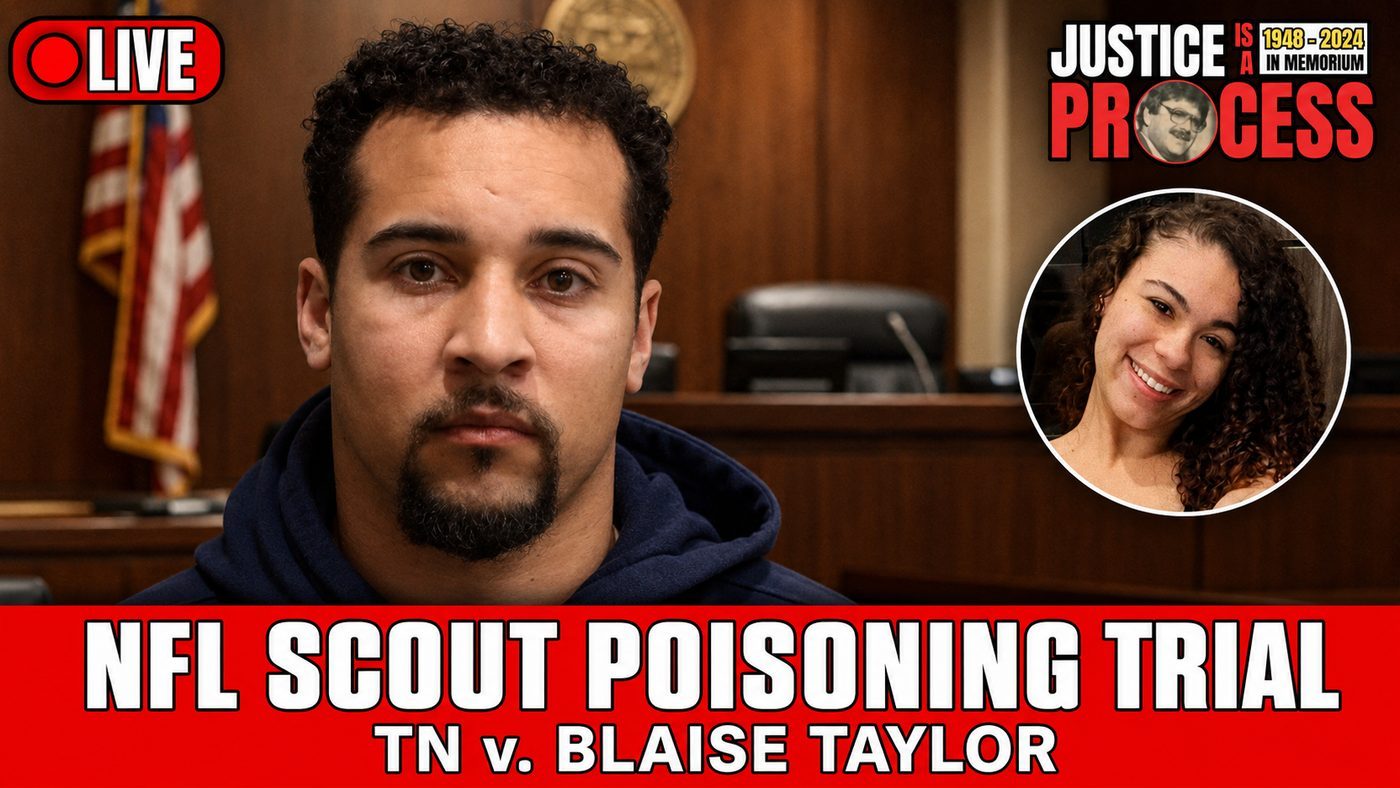
She named him as she was dying. The state's own pathologist won't call it murder. A jury will.
June 2026 | Justice Is A Process
Jade Benning spent her last good night the way she spent a lot of them. In a kitchen. She was a chef. Food was how she loved people, and the people who knew her say she was very good at it.
She was twenty-four years old. Five months pregnant with a daughter she had already named in her heart. Ivy. There is a photo of Jade holding the ultrasound strip in one hand, smiling like a woman who can already see the future. That photo exists. The future in it does not.
On the night of February 25, 2023, Jade got on the phone with her best friend. Something was wrong. Her words were coming out slurred. She said her drink tasted funny. She said she could not walk straight. And then, according to what that best friend would later tell a Nashville courtroom under oath, Jade said the thing the people who loved her cannot unhear. She accused the man in her apartment, the father of her child, of putting something in her drink.
At 9:38 that same night, that same man called 911. His name is Blaise Taylor. He told the dispatcher that Jade appeared to be having an allergic reaction, and he asked for paramedics.
Jade was rushed to Vanderbilt University Medical Center. Her condition went critical almost immediately. She never recovered enough to give police her own account of what happened in that apartment. Her daughter, Ivy, died two days later, on February 27. Jade held on for nine more days. She died on March 6, 2023. It was her twenty-fifth birthday.
The man who made that 911 call is not some stranger off the street. Blaise Taylor was, for a while, one of the most decorated young men in college football. A four-year starter and team captain. A scholar so far ahead of schedule he held two college degrees before his senior season. A pro scout for the Tennessee Titans. The son of a coach whose name has hung on staff doors at Auburn, Tennessee, and Texas A&M for thirty years. On paper, Blaise Taylor was a success story people pointed to.
Now the State of Tennessee says he is a murderer. Two counts of first-degree murder. Two counts of felony murder. One for Jade. One for Ivy.
Here is what I want you to hold onto before we go one sentence further. Blaise Taylor has pleaded not guilty. He is presumed innocent. That is not a slogan I am required to recite. It is the load-bearing wall of everything that happens in that courtroom over the next several weeks. The State has to prove what it claims, and it has to prove it beyond a reasonable doubt, with evidence, in front of twelve people who owe Blaise Taylor the benefit of every honest doubt the proof leaves open.
And this case leaves doubt open in a place that should make every one of us pay attention. The state's own forensic pathologist would not call Jade's death a homicide. She found it suspicious. She would not go further than that. The detective went further anyway. And a cup that may have held the answer was photographed in that apartment before Jade went to the hospital, then never found when investigators came to collect the evidence.
This is Justice Is A Process. We are not here to convict Blaise Taylor and we are not here to free him. We are here to watch whether the system does the one job it exists to do. Let's begin.
The charge, stripped of the legal packaging, is this. The State says Blaise Taylor poisoned Jade Benning with cocaine, on purpose, without her knowing, while he was a guest in her home. The State says he did it knowing she was carrying his child, and that the poison killed them both.
That is a hard thing to read. It is supposed to be. But an accusation is not proof, and the distance between the two is exactly what a trial is for. So let's walk the timeline the way the State has laid it out, and let's be honest about where the proof is strong and where it has holes.
February 25, 2023 was a Saturday night. Investigators say Blaise Taylor came to Jade's townhome in the 1500 block of Lebanon Pike in Nashville. By the State's account, the two of them seemed fine earlier in the evening. Jade's best friend would later testify that she stopped by the apartment that night and the couple looked happy.
Then the friend left. And later, the phone rang.
When Jade called her best friend back, the friend testified, Jade did not say hello. She did not use the friend's name. She did not sound like herself. She sounded, in the friend's words, wavy. She said her drink tasted funny. She said she could not walk. And she said the words that hang over this entire case: that Blaise had done something to her, that he had put something in her drink, that he had done something to the baby.
At 9:38 p.m., Taylor called 911. According to police, he reported that Jade appeared to be having an allergic reaction and asked for paramedics. An ambulance took Jade to Vanderbilt. Her medical condition became critical right away.
Sit with the gap there for a second. A woman on the phone is telling her best friend that the man in her home poisoned her. Minutes later, the man in her home is on the phone with 911 describing an allergic reaction. Both of those things are in the record. The trial is, in large part, about which one the jury believes, and whether the science can turn a belief into proof.
Jade never got better. Doctors could not interview her in any meaningful way before she died, which means the most important witness to what happened in that apartment, Jade herself, can only reach the jury through other people's mouths. We will come back to that, because it is one of the most important legal fights in the whole case.
Ivy died first, on February 27. Jade died on March 6, her birthday. Cause of death, according to the State, was cocaine. Not a little. The forensic pathologist who examined the case would later testify that the level of cocaine in Jade's system was so high it could only have come from ingestion, from swallowing it, rather than from the kind of recreational use the defense might point to. In plain terms, the State's science says this was not a bump that went wrong. This was a dose.
There is one more piece from this stretch that the State leans on hard. Investigators say that when Taylor called his own mother to tell her what was happening, the only thing he told her was that Jade had COVID. Not that she was unconscious. Not that she was dying in an ICU. COVID. The State will argue that a man with nothing to hide does not shrink a medical emergency down to a head cold when he calls home.
The case did not move fast. Jade died in March 2023. Blaise Taylor was not indicted until March 2024, a full year later. In between, Metro Nashville Police Homicide Detective Adam Reese ran the investigation, working with scientists from the crime lab and doctors from the Medical Examiner's Office. Reese processed Jade's apartment on February 26, 2023, the morning after the 911 call.
Here is where the case gets complicated, and where my job as a watchdog gets interesting. The investigation produced powerful pieces for the State. A comforter taken from the apartment reportedly had vomit on it that tested positive for cocaine. The toxicology came back lethal. The best friend's account gave the State a motive and a dying accusation in one phone call.
But the same investigation produced problems the defense is going to hammer. Detective Reese told the grand jury that the manner of Jade's death was premeditated homicide. The forensic pathologist would not say that. She found the death suspicious and could not conclude it was a homicide. Read that again, because it matters. The person whose entire professional job is to classify how someone died would not call this a murder. The detective did.
And then there is the cup. Investigators reviewed photos taken on Jade's own phone before she went to the hospital. Some of the items visible in those photos were not in the apartment when police came to collect evidence. One of them, according to court records, was a cup Jade had allegedly been drinking from. A pink drink was seen in the kitchen. The cup that may have carried the poison, the single most important physical object in a poisoning case, is not in evidence. It is gone.
The missing cup is not the only thing the defense will pull from that scene. At the bond hearing, defense questioning already started chipping at the edges of the State's story. A pink drink was spotted in the kitchen, but the cup tied to it was never collected. Court records indicate that Jade, a professional chef, had in the past experimented with cannabis in food, a detail the defense can use to argue that drugs were not foreign to that household and that the State is working backward from a tragedy to a murder charge. The State has an answer, and it is a strong one. Its pathologist says the cocaine level was far past anything recreational, the kind of concentration you reach by swallowing a dose, not by partying. But the fact that both sides were already fighting over what the evidence means, more than a year before trial, tells you something real. This is not a clean case for anyone.
Before she was a case number, Jade Benning was a chef. She worked for a catering company. The people who knew her describe the kind of presence that is hard to fake. One friend said that every room she walked into lit up, that to know her was to love her. Her family called her a radiant soul, a beloved daughter, granddaughter, niece, sister, cousin, and a mother who never got the chance to be one.
She was twenty-four when she was poisoned and twenty-five for the few hours she had on March 6 before she died. She was carrying a girl she had already started calling Ivy. The ultrasound photo, the one taken in February 2023, is a picture of a woman in the middle of building a life. That is who the State is in that courtroom for. Not an abstraction. A person who is not here to speak, which is exactly why the people who do speak for her carry so much weight.
We are going to keep Jade and Ivy at the center of this coverage, because the system has a way of turning victims into evidence. Jade was a person first. We are not going to forget that, and we are not going to let the proceedings make you forget it either.
Blaise Allen Taylor was born March 22, 1996. To understand why this case drew national cameras, you have to understand who he was before any of this.
At Arkansas State, from 2014 to 2017, Taylor was a four-year starting defensive back and a captain. He was a record-setting punt returner. He left as the Sun Belt Conference's all-time leader in career passes defended and a first-team all-conference pick. That is the football. The classroom is almost harder to believe. Taylor earned his bachelor's degree magna cum laude in about two and a half years, then finished a master's of business administration with a 3.82 grade point average, giving him two degrees before the start of his senior season. Record-keepers at the time could not find another major-college football player who had done it that fast. He was named the Arthur Ashe Jr. Male Sports Scholar of the Year, a Wuerffel Trophy finalist, a National Football Foundation scholar, and a finalist for the Campbell Trophy, which honors the top scholar-athlete in the sport. He started a nonprofit with his sister to work with at-risk kids.
After college he became a pro scout for the Tennessee Titans, working there from 2019 to 2023. After Jade and Ivy died, he moved to Utah and worked as a defensive analyst at Utah State. Then he was hired at Texas A&M, where his father coaches, before being suspended when the charges came down.
I am laying all of that out for a reason, and it is not to make you like him or dislike him. It is because the contrast is going to be in the courtroom whether anyone says it out loud or not. Juries look at a defendant and try to square the person in the chair with the crime on the indictment. A resume does not prove innocence. It also does not prove guilt. Blaise Taylor has not been convicted of anything. Everything you just read about his past is real, and so is the presumption that protects him until the State proves otherwise. Both of those things are true at the same time, and a serious person can hold them both.
A trial is a collection of witnesses, and a few names are going to come up again and again across our coverage.
The judge is the Honorable Steve Dozier, of the Davidson County Criminal Court in the Twentieth Judicial District. The trial is set in Courtroom 6A of the Birch Building in Nashville. The prosecution comes from the Office of the District Attorney General for the Twentieth Judicial District, which is pursuing life in prison without parole. The defense team includes attorneys Letitia Quinones-Hollins, who has urged the public to keep an open mind about her client, and Joshua Brand.
Then there are the witnesses who will carry the facts. Detective Adam Reese, the lead homicide investigator, who told the grand jury this was premeditated murder. The forensic pathologist, Dr. Erin Carney of the Center for Forensic Medicine, who testified about the lethal cocaine level but would not classify the death as a homicide. And Jade's best friend, who says she was on the phone when Jade accused Blaise. That friend may be the most important witness in the building, because she is the closest thing the jury has to hearing from Jade.
Blaise Taylor is charged under Davidson County case number 2024-A-490 with four counts of murder. Two victims, two theories for each. Let's break down what each one actually requires, because the words first-degree murder get thrown around a lot and most people have never been told what the State actually has to prove.
What it means: Under Tennessee law, first-degree murder is a premeditated and intentional killing. There is one count for Jade and one count for Ivy, because Tennessee treats the killing of a viable unborn child as a homicide.
What the State must prove: That Jade and Ivy are dead, that Blaise Taylor caused those deaths, that he did so intentionally, and that he acted with premeditation, meaning he reflected on the act after forming the intent, even briefly, rather than acting on a sudden impulse.
Potential sentence: Life in prison. The State has filed notice that it intends to seek life without the possibility of parole.
What it means: Felony murder is a different road to the same destination. It is a killing committed in the course of certain serious felonies. Again, one count for Jade and one for Ivy.
What the State must prove: That the deaths happened during the commission of a qualifying felony. Importantly, the State does not have to prove premeditation for this theory. That is why prosecutors charge it alongside premeditated murder. It gives the jury a second path to a conviction if they are not convinced the killing was planned but are convinced of the underlying crime.
Potential sentence: Life in prison, on the same track as the premeditated counts.
The State has also signaled the aggravating circumstances it believes justify life without parole. According to the notice filed by the District Attorney's office, those include that the defendant knew Jade was pregnant, that the murder was committed knowingly, and that one of the victims was a child. One thing to be clear about, because it shapes the whole trial: this is not a death penalty case. The State is not seeking execution. That is why Taylor was eligible for bond at all.
Now the part that gets lost. Blaise Taylor does not have to prove a single thing. He does not have to testify. He does not have to explain the 911 call, the COVID comment, or anything else. The entire burden sits on the State, from the first witness to the last, and it never shifts. If the State proves three of the four elements of a count and stumbles on the fourth, that count fails. That is not a loophole. That is the design.
Every case that reaches a jury is there for a reason. Somebody could not, or would not, make it go away, and underneath that there is almost always a single fault line. Find the fault line and you understand the whole trial.
Here is the fault line in State of Tennessee v. Blaise Taylor. The State's own forensic pathologist would not call Jade Benning's death a homicide. The cup Jade was allegedly drinking from was never recovered. And the defense is fighting, right now, before a single juror hears a word, over whether the forensic evidence that does exist can even be put in front of the jury in a way the Constitution allows. This case is at trial because the science is suspicious but not certain, the most important physical evidence is missing, and the State is trying to build premeditated murder out of what is left.
That is the question twelve people are going to answer. Not whether something terrible happened to Jade and Ivy. Something terrible did. The question is whether the State can prove that Blaise Taylor did it on purpose, beyond a reasonable doubt, when its own experts could not agree on what kind of death this was.
Do not mistake the doubts for a weak prosecution. The State has a story that is going to be hard to sit through, because it hangs together.
It goes like this. Blaise Taylor did not want this baby. Jade's best friend testified that when Taylor found out Jade was pregnant, he left, and that he made it clear he did not want to be part of the child's life. That is motive. The State will argue that a man who wanted out, all the way out, found a permanent way out on February 25. It will point to the lethal dose of cocaine, a level its pathologist says had to be swallowed. It will point to the 911 call describing an allergic reaction, which the State will frame as a man buying time and steering the story. It will point to the COVID comment to his mother. It will point to the fact that he moved to Utah afterward. And it will put Jade's best friend on the stand to tell the jury that Jade, in the last hours she was able to speak, named Blaise Taylor as the person who poisoned her.
That last piece is the State's hammer. A dying woman accusing the father of her child. If the jury hears it, and believes it, it is the kind of thing that can outweigh a stack of forensic uncertainty. Which is exactly why the defense is fighting so hard over what the jury gets to hear.
Even the hammer has a handle the defense can grab. The best friend was not in the apartment. She was on the phone. She is relaying what she heard from a woman who was, by every account, slurring and struggling to stay upright. The defense will ask the obvious questions. How clear was the call. What exactly was said, word for word, versus what memory has smoothed over in the years since. Whether a person that impaired can reliably narrate her own poisoning. None of that makes Jade's words meaningless, and a jury may find them devastating. But the State cannot simply play the accusation and rest. It has to convince twelve people that a dying woman in distress correctly identified what was happening to her, knowing the one person who could confirm it is gone.
Taylor's lawyers have not signaled that they will argue someone else was in that apartment. They are not, at least not yet, asking the court to throw the case out. Their public posture is simpler and, frankly, more dangerous to the State. Keep an open mind. Make the government prove it. And do not let them prove it with shortcuts.
In the days before trial, the defense filed two motions that tell you exactly where they are going to attack. Neither one asks to dismiss the charges. Both ask the court to limit the State's forensic evidence before the jury ever sees it.
The first motion goes after the chain of custody. The defense wants the court to hold a hearing forcing the State to establish who collected, who handled, who stored, and who tested the biological evidence in this case, the blood and the urine, before any lab result is allowed in front of jurors. In a case where a cup already went missing, that is not a technicality. It is a question about whether the State can account for its own evidence.
Chain of custody sounds like paperwork. It is not. It is the unbroken record of who touched a piece of evidence, when, and how it was stored, from the moment it was collected to the moment it was tested. It exists so that when the State says this blood is Jade's blood and it held this much cocaine, the defense can check whether anyone along the way could have mixed it up, contaminated it, or mishandled it. In a case where a cup already vanished from the scene, asking the State to account for every sample it did keep is not a stall. It is the most basic kind of accountability, and it is the line between trusting a result and verifying one.
The second motion is the one that should make every viewer lean in, and it is the one we are going to spend real time on. The defense, citing a recent United States Supreme Court ruling, argues that the State must call the actual analyst who performed the lab testing, not some substitute who reviewed the results afterward. If the judge agrees, the State could lose the ability to present part of its forensic evidence unless the right person is in the witness chair to be cross-examined.
As of the start of jury selection, Judge Dozier had not ruled on either motion. How he rules could shape the entire trial.
This is the part of the case that lives closest to everything this channel was built to do. Strip away the football and the headlines and this trial is a fight about evidence and the right to confront it. That fight is older than any of us, and people have gone to the mat for it for a reason.
Start with that second defense motion. The Supreme Court case behind it is Smith v. Arizona, decided on June 21, 2024. The Court ruled, unanimously, that the prosecution cannot put a forensic analyst's findings in front of a jury through a stand-in, a surrogate expert who did not do the testing, even when that stand-in dresses it up as their own independent opinion. The reasoning is plain once you hear it. The Sixth Amendment gives a defendant the right to confront the witnesses against him. A lab report is a witness against you. If the person who actually ran the test is not in the room, you cannot ask them what they did, how they did it, whether they cut a corner, or whether their results can be trusted. A substitute cannot answer for sloppy work they never witnessed.
Smith did not come out of nowhere. It sits at the end of a line of cases, Crawford, Melendez-Diaz, Bullcoming, where the Court kept telling prosecutors the same thing. Forensic evidence is not magic. The human being who produced it has to take the stand. Taylor's defense is standing on that line and saying, prove your science the honest way or do not prove it at all.
Now here is what makes this case a genuine teaching trial, because the same constitutional principle cuts in the State's direction too.
Remember Jade's accusation, the one her best friend overheard on the phone. The defense might try to keep that out as hearsay, a statement from someone who cannot be cross-examined because she is gone. But the Confrontation Clause has carve-outs that have existed for centuries, and two of them point right at this case. The first is the dying declaration. The law has long allowed the words of a person who believes they are dying, spoken about the cause of their death, to come into evidence, on the old idea that people do not waste their last breath on a lie. The second is even more pointed. It is called forfeiture by wrongdoing. If a defendant is the reason a witness cannot testify, if he silenced her himself, then he forfeits his right to complain that he cannot cross-examine her. A man cannot poison the only witness against him and then demand the right to confront her.
Whether Jade's words come in, and under which theory, is going to be one of the defining fights of this trial. And notice what is happening. The exact same constitutional right, the right to confront witnesses, is the defense's best weapon on the lab evidence and potentially the State's answer on the dying declaration. That is not a contradiction. That is what makes constitutional law worth understanding instead of just cheering.
My father spent his life on this ground. Steven M. Askin was a criminal defense attorney in West Virginia who believed, all the way down, that the rules of evidence and the right to confront the case against you were not obstacles to justice. They were justice. He went to prison once for refusing to hand over information he believed was protected. He was prosecuted again, late in his life, for teaching ordinary people their rights from a coffee shop, the kind of knowledge that lets a person stand up in a courtroom and say, you have to prove that, and you have to prove it the right way. A prosecutor told a court she feared he would disrupt the legal system by teaching people to insist on those protections.
That is the disruption. That is what we are doing right now. So as this trial unfolds, here is what we will be watching for, and what I want you watching for too. Does the judge make the State call the people who actually did the science, or does he let a substitute carry it? Can the State account for every piece of evidence it collected, including the things that went missing? Does the jury get to hear Jade, and is it through a doctrine that respects both her and the Constitution? And underneath all of it, the only question that ever really matters: did the State prove that Blaise Taylor intended to kill, beyond a reasonable doubt, or did it ask twelve people to fill in the blanks the evidence left empty?
We are going to know the answer by watching. Not by guessing.
Live broadcasts as it happens. No Breaks editions for the full day, start to finish. Trial Analysis Podcast deep dives. Key moments and testimony you can watch word for word.
Blaise Taylor is presumed innocent until proven guilty beyond a reasonable doubt. That is not a technicality. It is the foundation of everything we do here.
Let's watch the system together.
Subscribe to Justice Is A Process on YouTube for live trial coverage, No Breaks editions, and breaking news as it happens.
🔴 Subscribe on YouTube111,000+ subscribers watching the system with us
Discussion