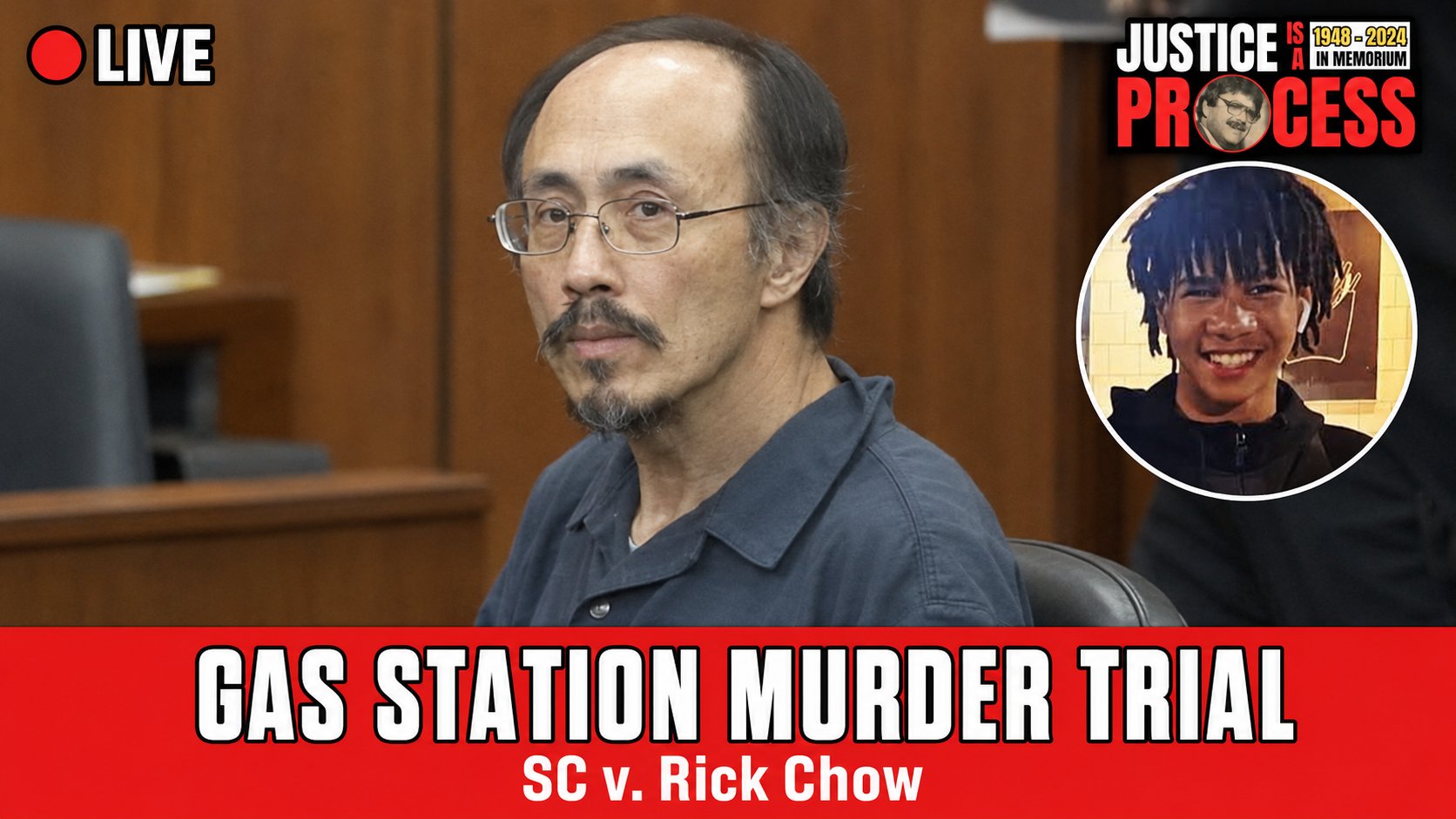
He chased a fourteen-year-old off his property and shot him in the back. The trial comes down to one question: was it self-defense?
May 2026 | Justice Is A Process
On the Sunday of Memorial Day weekend in 2023, a fourteen-year-old named Cyrus Carmack-Belton walked into a convenience store on Parklane Road in Columbia, South Carolina. He had just finished the eighth grade at Summit Parkway Middle School. His family describes a kid who loved telling jokes. A prankster. The kind of teenager who filled a room and made the people in it laugh.
He walked out of that store alive.
A few minutes later, roughly the length of a football field and then some away from the front door, Cyrus was on the ground with a single gunshot wound in his back. The bullet passed through his heart. He died that evening, on a stretch of pavement near an apartment complex, with deputies and his own blood around him.
The man charged with killing him is Rick Chow, the owner of the store. Prosecutors say Chow and his adult son chased Cyrus off the property after accusing the boy of stealing bottles of water. The Richland County Sheriff has said, in plain language and more than once, that Cyrus stole nothing. The defense says Rick Chow fired one shot to save the life of his son, who told him the fleeing teenager had a gun.
Those two stories cannot both be the whole truth. That is why there is a trial. That is why, starting now, twelve people are sitting in a jury box in Richland County being asked to decide what really happened on the evening of May 28, 2023, and whether the law calls it murder.
I want to be careful with something before we go any further, because this case is going to test it. Rick Chow is presumed innocent. Not as a slogan I say once and move past. As the actual rule that governs every minute of what happens in that courtroom. The State of South Carolina has to prove its case beyond a reasonable doubt. Rick Chow does not have to prove anything at all. He could sit silent for the entire trial and the burden would never once shift to him.
That is a hard thing to hold onto in a case like this one. A child is dead. A community has been grieving for three years. The public has opinions, loud ones, and a lot of them were formed long before a jury was ever seated. The presumption of innocence was never built for the easy cases. It was built for exactly this kind. My father spent his life on that idea. He paid for it twice. We will come back to him before this is over.
This is Justice Is A Process. Before the first witness takes the stand, let's walk through what this case actually is. What the state has to prove. What the defense is going to argue. The pretrial fights that already happened, the rulings that shaped the trial before it started, and the one question those twelve jurors are really being asked to answer.
Let's begin.
It was around eight o'clock in the evening on Sunday, May 28, 2023. The place was the Xpress Mart Shell station at 7441 Parklane Road in Columbia. Rick Chow owned it. He had owned and run that convenience store for years, and on that Memorial Day weekend evening he was there with his adult son, Andy Chow.
Cyrus Carmack-Belton was inside the store. According to Richland County Sheriff Leon Lott, who described the surveillance footage to the public in the days that followed, Cyrus took four bottles of water out of a cooler. And then, Lott said, he put them back. He took nothing. There was a verbal exchange. The Richland County Coroner later said there was no indication that Cyrus and Chow had any kind of physical fight inside the store. Cyrus walked out.
What the Chows believed in that moment is part of what the trial is about. Prosecutors say Rick Chow had accused Cyrus of shoplifting, and that the accusation was wrong. Whatever the Chows believed, here is what is not in dispute: when Cyrus left the store and started moving away, Andy Chow went after him. Rick Chow joined the chase. And Rick Chow was armed. He carried a .45 caliber Glock pistol, and he had a concealed weapons permit for it.
The chase did not stay on the store's property. It crossed it, left it, and kept going. Prosecutors say Cyrus ran roughly 130 to 139 yards from the store, toward the Springtree Apartments on Springtree Drive. Picture that distance for a second. That is well past the length of a football field. A fourteen-year-old running for that long, away from the men chasing him, is not a fourteen-year-old standing his ground. He is a fourteen-year-old trying to get away.
Somewhere along that stretch, Cyrus tripped and fell. Investigators say he had a handgun on him that night, a Taurus pistol, and the state has acknowledged he was carrying it unlawfully. A fourteen-year-old cannot legally carry a handgun in South Carolina. That is true, and it is going to matter in this trial, and we will deal with it honestly. But here is what prosecutors say happened with that gun: they believe it fell out of Cyrus's pocket when he tripped. Witness accounts described to the court have placed Cyrus on the ground, getting back up, with his hands raised.
Andy Chow told his father he saw a gun. Rick Chow fired one shot. It struck Cyrus in the lower back. The Richland County Coroner, Naida Rutherford, ruled the death a homicide and said the gunshot wound pierced the teenager's heart. A forensic pathologist who later testified in pretrial proceedings, Dr. Amy Durso, described the wound as universally fatal.
A handgun was recovered near Cyrus's body. Sheriff Lott said the investigation concluded the gun was not pointed at Rick Chow or his son, and that Cyrus was shot with his back turned, off the store's property, while running away. That is the state's account of the physical sequence. The defense disputes the meaning of those facts, hard, and we will get to exactly how. But the bones of it, the chase, the gun on the ground, the single shot, the wound in the back, are largely agreed on by both sides.
Richland County Sheriff's Department deputies responded that night. By the accounts presented in court since, the Chows did not flee and did not hide. They called 911. They stayed. They spoke with the deputies who arrived, and those conversations were recorded on body camera. That footage has become some of the most important evidence in the case, and we will come back to what is on it.
Sheriff Leon Lott did not wait long to speak publicly, and when he did, he did not hedge. He called the shooting senseless. He said Cyrus did not shoplift anything, that there was no evidence the boy had stolen a thing. And he made a point that has echoed through this case ever since. Even if Cyrus had taken four bottles of water, Lott said, that is not something you shoot anyone over.
The day after the shooting, on May 29, 2023, Rick Chow was charged with murder. He was booked into the Alvin S. Glenn Detention Center, and that is where he has been ever since. Andy Chow, the son who joined the chase and who told his father he saw a gun, was not charged with anything. He remains free. Cyrus's mother publicly demanded that Andy be charged too, arguing that he initiated the chase. The Fifth Circuit Solicitor's Office did not charge him. As this trial begins, Rick Chow stands alone as the only person facing a criminal count over the death of Cyrus Carmack-Belton.
The case was investigated by the Richland County Sheriff's Department, with a retired high-ranking investigator, James "Stan" Smith, serving as the lead investigator. Smith's interpretation of what the Chows said that night, and what they did not say, became central to a pretrial fight that the defense ultimately lost. Hold that thought. It tells you where the heart of this trial is.
Cyrus Monroe Carmack-Belton was fourteen years old. He had just graduated from the eighth grade at Summit Parkway Middle School, and the people who knew him keep returning to the same words when they describe him. Confident. Generous. Funny. A prankster with a big heart. His brother told reporters in the days after the shooting that Cyrus was a good kid, very smart, and that he did not deserve what happened to him.
His parents are Troy Belton and Nicole Carmack. His mother has also been publicly known as Nikki Cole, and she became one of the most visible voices in the case, ending her remarks at her son's funeral with three words that turned into a rallying cry across Richland County: Justice for Cyrus. His father spoke in court at a pretrial hearing two years later and described the loss in terms no parent should ever have to use. He said the Chows hunted his son down.
Cyrus was laid to rest on June 3, 2023, at Second Nazareth Baptist Church in Columbia. Hundreds of people came. A horse-drawn carriage carried the casket. Outside the gas station where he died, people left empty water bottles, a quiet and devastating kind of memorial that needed no explanation.
Now, the harder part, and I am going to say it directly because this report is not in the business of hiding facts from you. Cyrus had a gun on him that night. The state has said so. He was carrying it unlawfully, because no fourteen-year-old can legally carry a handgun. There were also references at a pretrial hearing, raised by the defense, suggesting law enforcement had some prior familiarity with Cyrus from incidents in the months before his death. The defense will likely try to make something of all of that at trial.
Here is the thing, though, and it is worth sitting with. None of that is the question. A fourteen-year-old carrying a gun he should not have is still a fourteen-year-old. The legal question in this trial is not whether Cyrus did everything right. It is whether the man who shot him in the back was legally justified in doing it. Those are two completely different questions, and a trial that confuses them is a trial that has lost its way. We are going to watch for that.
Rick Chow was fifty-eight years old when the shooting happened. He is sixty now. He owned and operated the convenience store on Parklane Road, an Asian American small business owner running a neighborhood gas station, and he held a concealed weapons permit for the pistol he carried that night.
Chow has been held at the Alvin S. Glenn Detention Center since the day after the shooting. His defense team has asked for bond three separate times. Three times it was denied. In November 2025, a judge denied bond again while also denying a much bigger motion, and ruled that Chow was both a danger to the community and a flight risk. He has now spent the better part of three years in jail without a conviction, waiting for the trial that is finally here.
I want to be precise about Rick Chow's status, because it matters. He has not been found guilty of anything. He is presumed innocent. Being denied bond is not a verdict. Being denied immunity is not a verdict. Sitting in a detention center for three years is not a verdict. The only thing that counts as a verdict is what twelve jurors say at the end of this trial, after they have heard the evidence and after the judge has instructed them on the law. Until then, the presumption of innocence belongs to Rick Chow as fully as it would belong to anyone. That is not a courtesy. That is the Constitution.
The state is represented by the Fifth Circuit Solicitor's Office, led by Solicitor Byron Gipson. The lead trial prosecutor is Dale Scott, a senior assistant solicitor who has handled the heaviest of the pretrial fights and laid out the state's theory in open court. Scott is the lawyer to watch for the prosecution. His framing of this case has been sharp and consistent, and you will hear it echoed through every state witness.
Rick Chow is represented by a deep and well-known defense team. Jack Swerling, a Columbia defense attorney with a fifty-year career, leads it, joined by Joe McCulloch, Shaun Kent, and Curtis Copeland. These are not unknown names in South Carolina criminal law. One note worth keeping straight: the lawyers who argued Chow's big pretrial immunity motion back in November 2025 were a different defense team than the one trying the case now. When we walk through what was said at that hearing, that is why we will be careful about who said what.
The trial is being heard by Circuit Court Judge Heath Taylor, who has already ruled on a stack of pretrial motions and who will instruct the jury on the law at the end of the case. The November 2025 immunity hearing, which we will get into, was heard by a different judge, Circuit Judge R. Scott Sprouse.
Rick Chow faces a single count. Murder. Not first-degree, not second-degree, because South Carolina does not divide murder into degrees the way some states do. In South Carolina there is just murder, and here is what that word actually means under the law.
What it means: South Carolina law defines murder as the killing of a person with malice aforethought, whether that malice is expressed or implied. Malice is the legal word for the state of mind that separates murder from a lawful killing or a lesser crime. It can mean a deliberate intent to kill, but it can also be implied from the circumstances, such as the use of a deadly weapon in a way that shows a hardened, reckless disregard for human life. It does not require long-term planning.
What the State must prove: That Cyrus Carmack-Belton is dead. That Rick Chow caused his death. That Chow acted with malice. And, critically, that the killing was not legally justified. If the killing was lawful self-defense or lawful defense of another, there is no malice and there is no murder.
The burden: Entirely on the State of South Carolina, and it never moves. The standard is proof beyond a reasonable doubt. Rick Chow does not have to prove he is innocent, does not have to testify, and does not have to put on a single witness.
Potential sentence: Under S.C. Code § 16-3-20, a murder conviction carries a mandatory minimum of thirty years to life in prison. The state has not filed a death penalty notice in this case, so the death penalty is not on the table. A defendant sentenced under this section is not eligible for parole or early release on that thirty-year minimum. It must be served.
Now here is the part most coverage skips, and it is the part that decides the case, so we are not going to skip it. A murder charge in a shooting like this one is really a fight about justification. Self-defense, and defense of another person, are complete defenses to murder in South Carolina. Complete means exactly what it sounds like. If the jury finds Rick Chow was acting in lawful self-defense or in lawful defense of his son, the verdict is not a lighter charge. It is not guilty. He walks.
And there is a misunderstanding about self-defense that I want to clear up right now, because you will hear it wrong all over the internet during this trial. Once self-defense is properly in the case, and it plainly will be here, the defendant does not have to prove it. The burden does not flip. The State of South Carolina has to disprove self-defense beyond a reasonable doubt. The prosecution has to convince the jury, to that very high standard, that this was not a justified killing. If the state cannot do that, the jury must acquit. Remember that. It is one of the most powerful and least understood rules in the entire trial.
There is also a likely middle option. In a case like this, the judge may instruct the jury on voluntary manslaughter under S.C. Code § 16-3-50 as a lesser included offense. Voluntary manslaughter is an unlawful killing without malice, committed in a sudden heat of passion brought on by sufficient legal provocation. It carries two to thirty years rather than the thirty-to-life of murder. Whether the jury even gets that option depends on the evidence and on what Judge Taylor decides the law allows. But it is worth knowing now, because the choice in that jury room may not be a simple guilty or not guilty. It could be three doors, not two.
Strip this case down to the studs and something becomes clear. The two sides do not really disagree about what physically happened. They agree Rick Chow and his son chased Cyrus. They agree the chase covered well over a hundred yards. They agree Cyrus had a gun on him. They agree Rick Chow fired one shot and that it hit Cyrus in the back and killed him. On the raw sequence of events, the state and the defense are closer than you would expect.
They disagree about one thing. And that one thing is the whole trial.
They disagree about who created the danger. The state says Rick Chow and Andy Chow manufactured this confrontation out of nothing, that they turned a non-event over water that was never even stolen into a deadly pursuit, and that a man who chooses to chase a fleeing child cannot then turn around and call the killing self-defense. The defense says Rick Chow was a father protecting his son's life, that Andy genuinely believed Cyrus had a gun and feared he was about to be shot, and that the law allows a parent to use force to defend his child from exactly that kind of threat.
That is the core tension of this case. It is the story every day of testimony will tell a piece of. Was Rick Chow an aggressor who hunted down a fourteen-year-old, or a father defending his son? Every witness the state calls will push that question one direction. Every witness the defense calls will push it the other. And twelve jurors have to land somewhere.
The prosecution's theory has been laid out clearly, most fully by Senior Assistant Solicitor Dale Scott during the November 2025 immunity hearing, and it rests on a single, sturdy idea. You do not get to start a deadly confrontation and then claim you were defending yourself in it.
Scott put it in a phrase that captures the entire state case. South Carolina's self-defense and Stand Your Ground protections, he argued, were intended to be a shield, not a sword. A shield protects someone who is attacked. A sword is what you carry when you go looking for the fight. The state's position is that the Chows picked up the sword the moment they decided to chase a teenager off their property over water he had not taken.
From there, the state builds. Prosecutors point out that nobody made the Chows give chase. Cyrus was leaving. He posed no threat as he walked away from that store. If the Chows genuinely thought a crime had occurred, the state argues, the answer was simple and lawful: note which direction the boy went and call the Richland County Sheriff's Department. Scott said it bluntly. Cyrus would still be alive if the Chows had just done that.
The state also goes hard at the gun. Yes, Cyrus had one. But prosecutors argue it was never a threat to anyone, and they have specific reasons. They believe the gun fell out of Cyrus's pocket when he tripped during the chase. Witness accounts have placed Cyrus on the ground with his hands up. And then there is the body camera footage, which we will get to in detail, where the state says neither Rick Chow nor Andy Chow ever told deputies that the gun was pointed at Andy. The lead investigator understood Rick Chow's own words to mean only that Andy could see a gun, not that it was aimed at him. And at no point on that footage did Rick Chow say he personally saw the gun before he fired.
Scott drove at that last point with a question he asked in open court that you should remember as the trial unfolds. Did anyone at that scene, anyone whose last name was not Chow, say they saw a gun in the victim's hand? The state's answer is no. That question is going to hang over every defense witness.
The defense answer to all of that begins and ends with a father and a son.
The core of Rick Chow's defense is that he was protecting Andy. One of Chow's attorneys put it plainly at the November hearing: Rick Chow was defending the life of his son. The defense says Andy Chow genuinely saw a gun, genuinely believed the fleeing teenager was armed and dangerous, and genuinely feared for his life. Andy testified to that fear under oath at the immunity hearing. South Carolina law allows a person to use deadly force not only to defend himself but to defend another person who is in imminent danger. The defense will argue Rick Chow stepped into exactly that role. A parent acting to keep his child alive.
The defense also leans on a fact the state cannot wish away. Cyrus did have a gun. That is not a defense invention. The state has acknowledged it. The defense will argue that this changes everything about what was reasonable to believe in that chaotic, fast-moving moment, and that you cannot judge a father's split-second decision with the calm hindsight of a courtroom three years later. They have signaled they intend to explore the history of that gun, where it came from, how Cyrus got it, treating those questions as critical to the case.
The defense has also fought, repeatedly, about the conditions of the trial itself. They argued this case should not even be tried in Richland County, given the protests, the national coverage, and what they called improper comments by elected officials. Jack Swerling told the court that in a fifty-year career, he has sought to move a trial out of its county only a handful of times. He believed this was one of those times. He did not win that argument, and we will get to why, but the fact that a defense lawyer with that much experience felt he had to make it tells you something real about the environment this trial is walking into.
By the time a jury was seated, a great deal had already been decided. And almost all of it went against the defense.
The biggest ruling came in November 2025. Chow's lawyers asked a judge to dismiss the murder charge entirely under South Carolina's Stand Your Ground law, which allows a judge, before trial, to grant immunity from prosecution if the defendant shows he acted in lawful self-defense. This is decided at a hearing, by a judge, under a lower standard of proof than a trial. Andy Chow testified. The body camera footage was played in open court for the first time. And Circuit Judge R. Scott Sprouse denied the motion. He found that Chow's lawyers had failed to prove Cyrus pointed a gun at Andy, and he cited conflicting testimony. That ruling cleared the way for the case to go to a jury.
I want to be careful here, because this is where a lot of people are going to get the law wrong. Losing the immunity motion is not the same as losing the trial. The immunity hearing used a lower standard and put the question to a judge. The trial puts it to twelve jurors under the highest standard our system has, beyond a reasonable doubt, and the burden at trial is on the state. Self-defense is not gone. If the evidence supports it, and it will, Judge Taylor will instruct this jury on self-defense and defense of others, and the jury will weigh it fresh. The November ruling opened the courthouse door. It did not decide what happens inside.
The defense lost other fights too. In April 2026, Judge Taylor denied a request to delay the trial, noting the case was already 886 days old and that older cases need to move. He denied a request to have prospective jurors fill out written questionnaires and to question them individually about pretrial publicity. In May 2026, he denied the motion to move the trial out of Richland County, choosing instead to screen jurors carefully for impartiality. Jury selection went forward in Columbia, and on May 26, 2026, after an hours-long process, a panel of twelve jurors and four alternates was seated. The judge had the prospective jurors questioned in groups of ten rather than one at a time, a compromise the defense did not get everything it wanted from.
The defense did not lose everything. In one significant evidentiary ruling, they won. The judge agreed to let the jury see a video of Cyrus with a gun, recorded the night before the shooting, in which he is wearing the same clothing he wore the day he died. The state objected to that video and argued it was not relevant to the shooting. The judge allowed it. That single ruling is going to matter, because it hands the defense a piece of evidence aimed straight at the question of whether Cyrus was armed and whether a fear of that gun was reasonable.
Other channels are going to cover this trial as a recap. A witness said this, a lawyer objected to that. We do something different here. We watch whether the system does its job. So here is the framework we will be carrying into that courtroom every single day.
First, the aggressor doctrine. This is the legal hinge, so watch it close. The state has to convince the jury that the chase made the Chows the aggressors and slammed the door on any self-defense claim. The defense has to do something harder and more interesting. They have to try to separate the chase from the shooting. They will argue that even if the pursuit was a bad decision, the moment Andy saw a gun, a brand new and genuine danger appeared, and that Rick Chow's response should be judged against that instant, not against the decision to give chase a hundred yards earlier. Whether the law and the evidence let the defense make that cut is going to be the central legal battle of the trial. Listen for it in the cross-examinations. Listen for it in the closing arguments. Listen for it in the jury instructions.
Second, the body camera footage. We live in a moment where almost every serious police encounter is recorded, and that recording often becomes the most honest witness in the building. In this case the state says the footage shows Rick Chow's own words working against him, that he never told deputies the gun was pointed at his son, never said he saw the gun himself before firing. The defense will say those recordings also show two men who did not run, who called 911, who stayed and cooperated. Same footage. Two stories. Watch how each side uses it, because juries tend to believe video, and both sides know it.
Third, and this is the one I care about most, the presumption of innocence in a case where the public has already reached a verdict. Let's be honest about the environment. This case drew protests. It drew vigils. It drew a statement from a sitting member of Congress. It drew comparisons to the 1991 killing of Latasha Harlins in Los Angeles. Across South Carolina and well beyond it, a lot of people decided what they think about Rick Chow a long time ago. That is exactly why the defense fought so hard to move the trial.
And here is what I need you to understand. The presumption of innocence is not a weather report that only applies on sunny days. It does not get suspended because a case is emotional, or because the defendant is unpopular, or because the public is angry, or even because that anger is understandable. It applies hardest precisely when all of those things are true. A jury that can convict an unpopular man only after the state actually proves its case beyond a reasonable doubt is a jury doing its job. A jury that convicts because the community wants a conviction is not a jury at all. It is a mob with a verdict form. We will be watching, every day, for which one shows up in that room.
This is where I told you we would come back to my father, and we are going to, because this is his ground.
Steven M. Askin was a criminal defense attorney in West Virginia for twenty-three years. He believed, all the way down, that due process and the presumption of innocence were not luxuries and were not for the popular defendants only. He believed they were for everyone, including the people the system and the public most wanted to crush. He taught ordinary people their constitutional rights, sometimes from a coffee shop in Martinsburg, for free, because he thought everyone deserved to understand the protections the Constitution gave them. The system came for him twice for standing on those principles. The second time, they criminally convicted him for teaching people the law. He never stopped. He passed in 2024.
I am telling you that here, in the Rick Chow report, on purpose. Because if you only believe in due process for the defendants you like, you do not believe in due process. You believe in something else, something a lot smaller and a lot more dangerous. Rick Chow gets the same presumption of innocence Cyrus's family would want for anyone they loved. The same burden of proof. The same fair trial. Watching the system extend that to a deeply unpopular defendant, and hold the state to its proof anyway, is not us going soft on a case. It is the entire reason this channel exists.
Fourth, watch the burden of proof itself. We already covered this, but it bears repeating because it is going to be the most misunderstood thing about the trial. Rick Chow does not have to prove self-defense. The state has to disprove it beyond a reasonable doubt. Every time you hear someone say the defense failed to prove this or that, check it against the actual law. The defense does not carry that weight. The state does. A trial where the jury forgets that is a trial that has gone off the rails, and we will say so if it happens.
And last, the question of race, handled honestly. Many people in the community saw this case through the lens of race, a Black child killed by a non-Black store owner who wrongly suspected him of a petty theft. That perception is real, it is part of why this case became national news, and pretending it is not there would be its own kind of dishonesty. But here is the precise legal reality. Rick Chow is not charged with a hate crime. He is charged with murder. The question in front of this jury is the law of self-defense and whether the state can disprove it. The watchdog question for us is whether the courtroom stays disciplined and focused on the evidence and the law, while the larger conversation about how this case fits into a longer and painful American history happens, as it should, out where the public can have it.
Three years. That is how long the family of Cyrus Carmack-Belton, and Rick Chow himself, have waited for this. Here is how the case got from a gas station parking lot to a Richland County jury.
What to expect from here: opening statements that lay out the two competing stories, then the state's case, built on responding deputies, the lead investigator, the coroner and the forensic pathologist, scene witnesses, and that body camera footage. Then, if the defense puts on a case, the focus is likely to shift to the Chows themselves and to the night a son says he saw a gun. Somewhere in there, the jury will hear the law from Judge Taylor. And then twelve people will go into a room and decide.
Starting with Day One, Justice Is A Process will be following this trial through to the verdict. Live broadcasts as it happens. No Breaks editions for uninterrupted viewing. Trial Analysis Podcast episodes that go deeper. Key moments and testimony segments so you can hear the words for yourself.
We are not here to convict Rick Chow and we are not here to acquit him. We are here to watch whether the State of South Carolina proves its case, and whether the process treats everyone the way the Constitution says it must.
Rick Chow is presumed innocent until proven guilty beyond a reasonable doubt. That is not a technicality. It is the foundation of everything we do here.
Let's watch the system together.
Subscribe to Justice Is A Process on YouTube for live trial coverage, No Breaks editions, and breaking news as it happens.
🔴 Subscribe on YouTube111,000+ subscribers watching the system with us
Discussion