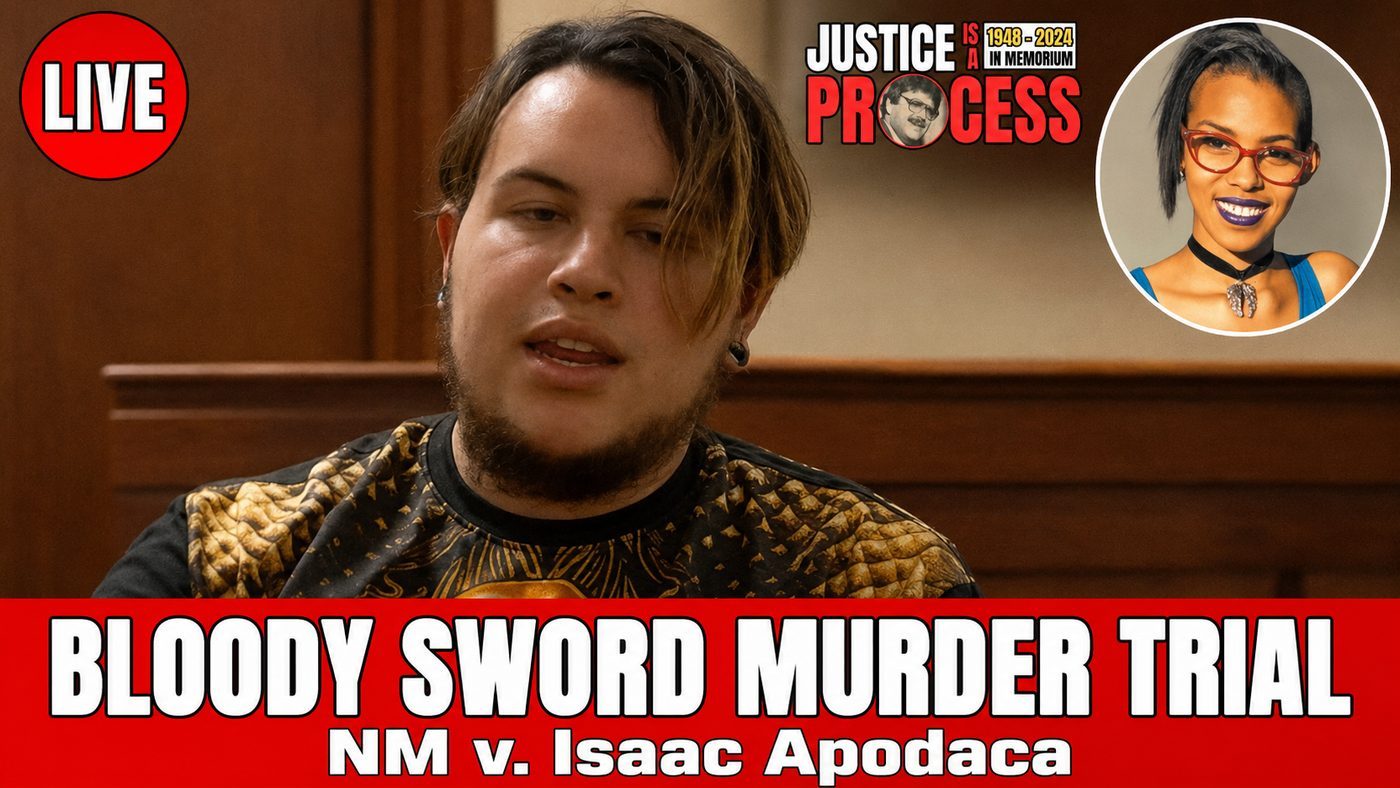
Can text messages make you a murderer? Everything you need to know before New Mexico v. Isaac Apodaca.
July 2026 | Justice Is A Process
August 22, 2022. Meow Wolf, Santa Fe. Grace Jennings had just turned 21, and she spent the celebration surrounded by the people who loved her. Somewhere in the middle of that day, her boyfriend of two months got down and asked her to marry him. She said yes. A few days later she posted on Facebook that it was the best day she'd had in a long time, an amazing day that ended with a beautiful gesture.
Sixty-eight days later, police found her body in a detached garage on the south side of Santa Fe. She had been stabbed with a three-foot metal sword. The wounds were so severe that the criminal complaint describes injuries consistent with an attempt to decapitate her.
The two people arrested were not strangers. One was Kiara McCulley, a young woman Grace had known since they were kids at Kearny Elementary School. The other was Isaac Apodaca, McCulley's boyfriend, a man prosecutors say Grace had also once dated, though her own mother disputes that to this day.
Here is where this case stops being a tragedy and becomes one of the strangest murder trials in the country.
Kiara McCulley swung the sword. Nobody disputes that anymore. She pleaded guilty and admitted it. But the man going on trial this week never touched the weapon. The State of New Mexico says he didn't have to. Prosecutors allege Isaac Apodaca built the murder with words: hours of text messages, sent while Grace slept in the same bed, pushing his girlfriend to kill her. Promising her she would rise in the ranks of a secret society called Ghost. A society that, as far as police could ever determine, exists nowhere outside the story he allegedly told her.
One of those messages, quoted in the criminal complaint, reads: "I am wanting you to kill her, you have to end your suffering by ending her joy."
So the jury being seated in Santa Fe is not really being asked who killed Grace Jennings. They are being asked something harder. Can the words you type make you a murderer? And can the state prove it through a star witness who has already pleaded guilty, who says she cannot remember the killing, and whose 30-year sentence does not get finalized until after she testifies the way prosecutors need her to?
Today, as this trial begins, we're not here to convict or acquit. We're here to watch whether the system does what it's supposed to do: prove its case beyond a reasonable doubt while protecting the rights of everyone involved. Including a defendant accused of something monstrous. Especially him. Because that is exactly when due process matters most.
This is Justice Is A Process. Let's begin.
On October 28, 2022, Grace Jennings sent Isaac Apodaca a text message asking if she could spend the night. That detail comes straight from the criminal complaint, and it matters, because according to prosecutors, the invitation is what set everything in motion. Apodaca and McCulley lived together in a converted detached garage behind McCulley's mother's home on the 5000 block of Jaguar Drive in southern Santa Fe. Grace came over. The three of them, by Apodaca's own account to police, shared the same bed that night.
What the state says happened next is the heart of this entire case. According to a motion filed by Deputy District Attorney Haley Murphy, from October 28 into October 29, Apodaca and McCulley messaged each other extensively, over multiple hours, about killing Grace. Not in another room. Not in another city. The state's theory is that two people typed out a young woman's death while she slept beside them.
Sit with that image for a second, because every juror will.
According to court records, the messages were not vague. Prosecutors say that at several points McCulley hesitated, and Apodaca pressed her to go through with it. That he gave her guidance about how to stab Grace. That he offered to help clean up afterward, with prosecutors pointing to messages about hydrogen peroxide. That when she wavered and asked him to do it or start it, he encouraged her to complete the act herself.
On the afternoon of Saturday, October 29, 2022, at about 1:44 p.m., Santa Fe police were dispatched to the Jaguar Drive residence for a possible homicide. The call came from Isaac Apodaca's mother, who told police her son said he had found his girlfriend killing another woman. Apodaca also reported the killing himself, telling authorities McCulley was attacking someone with a sword; he made his report from a nearby wireless store rather than the house.
In police body camera footage, Apodaca described the moment of discovery in his own words. McCulley told him "I did it," he said, and then he found Grace's body. Keep that sequence in mind when the state builds its timeline, because in Apodaca's telling, he learned about the killing after it was over. In the state's telling, he had been scripting it for hours.
When officers arrived, McCulley ran from them, into the back entrance of the home, and shut the door.
Inside the garage, officers found Grace Jennings dead. The complaint describes several puncture wounds consistent with being stabbed by a sword, and injuries consistent with attempts to decapitate her. Near the body, they found the weapon: a three-foot metal sword, covered in blood.
Both McCulley, then 19, and Apodaca, then 25, were taken into custody within a day. Each was charged with first-degree murder and conspiracy to commit first-degree murder. McCulley picked up an additional charge of tampering with evidence.
What happened next is the reason Isaac Apodaca is standing trial for murder despite never holding the sword. He consented to a search of his phone.
On it, according to the criminal complaint, investigators found the text messages. The ones urging McCulley to kill Grace. The ones promising she would move up in the ranks. The message telling her to end her suffering by ending Grace's joy. Police videos later showed a detective sitting with Apodaca, walking through message after message in which he appeared to encourage the killing.
And when detectives confronted him with what he wrote, the complaint says Apodaca did not deny it. He told them "I do mean what it says in that text," and stated that he wanted McCulley to kill Jennings. He also told police that McCulley had been planning to kill Grace since 2020, two years before it happened.
But the interviews were not one clean confession, and the defense knows it. In police footage, Apodaca also framed the exchange the other way: that McCulley was the one messaging him about her plan to kill Grace, and that he was replying to her messages because he wanted to get to sleep. Was he the architect, or a man passively texting back a dangerous partner in the middle of the night? Both versions came out of his own mouth. The jury is going to have to decide which one they believe.
Kiara McCulley's police interviews took the case somewhere no one expected. She told officers she was not sure whether she had committed the murder. She said she struggles with her mental health, described blackout periods where she could not remember what happened, and claimed an undiagnosed multiple personality disorder. She also told police she was, in her words, partially hopeful that Grace was dead.
Then came the motive she offered, and I want to handle this part carefully, because Grace Jennings is not here to answer it. McCulley told police she had been the victim of a gang rape years earlier, an assault she has dated to 2016, and she claimed Grace witnessed it, collected money during it, and helped circulate a recording of it. Those are McCulley's claims. A Santa Fe police captain confirmed that a sexual assault had been reported in 2020, but said the report did not contain the details McCulley described in her interview. No public record has ever substantiated the accusation against Grace, and her family has had to grieve her while that claim floats through coverage of her death. Remember that when you hear it repeated at trial.
McCulley also told police about Ghost. She described a secret society that Apodaca led, an organization she said gets rid of people involved in sex trafficking or hurting children. She said Apodaca told her that killing Grace would move her up in its ranks. One text from Apodaca, quoted in reporting on the complaint, told her she would move up in perks since this was her first. Apodaca himself described the organization to detectives in similar terms.
Police said they had no evidence any such organization exists.
Understand what Ghost does to this trial, because it cuts both directions at once. For the state, Ghost is the manipulation mechanism made visible: proof that Apodaca did not just encourage a killing, he built a reward system around it, a fake hierarchy where murder earned rank. For the defense, Ghost is something else entirely. It is evidence that Kiara McCulley inhabited a fantasy world, and an invitation to ask the jury a corrosive question: if she believed she was a soldier in a secret society that punishes traffickers, what else in her account is invention? The same bizarre detail that makes this case a national story is going to be fought over, witness by witness, as either the leash he held or the delusion she lived in.
So build the state's theory in your head the way prosecutors will build it for the jury: a 25-year-old man, allegedly holding total psychological control over a mentally fragile 19-year-old, feeding her a fantasy world where murdering her childhood friend was a promotion. That is the story the State of New Mexico intends to tell. Whether they can prove it beyond a reasonable doubt is the entire trial.
Before she was a case name, Grace Jennings was a 21-year-old Santa Fe kid with a big heart and a complicated life. She grew up in the city, went to Santa Fe High School, and had the kind of openness her family both loved and worried about. Her aunt said Grace could be friends with any type of person, sometimes to her own detriment. Read that sentence again after you learn how she died.
The summer before her death was, by her own account, a good one. She met a young man named Jackson Sparks in June of 2022. They moved fast, the way you do at that age, and by her 21st birthday celebration at Meow Wolf in August, they were engaged. Sparks later told the Santa Fe New Mexican that early in their relationship, Grace shared painful things about her life she had never been comfortable telling anyone else, and that his answer was simple: she needed love, and she needed to be happy, and he was going to try to give her both.
Sparks was 20, and he knew they were young, but he said he treated the relationship like a marriage. For a stretch, Grace lived with him at his apartment in Albuquerque. She would get up with him before work every morning and kiss him goodbye, and when he walked out to his car he would look back up at the apartment window and see her there, watching over him. Small stuff. The kind of ordinary tenderness that never makes it into a criminal complaint. He also said something that should stop you cold given how this case has been framed: Grace never once mentioned the two people who would later be arrested for her death, and he had no idea she was going to stay with anyone in Santa Fe that weekend. He found out where she had been the same way the rest of the city did.
Her aunt, Katherine Jennings, described her in the days after the killing as the laughter and the joy of the family, the friend, the sister, the daughter. "Just a beautiful soul," she said. In the days after Grace died, the family went back through the photos from that Meow Wolf birthday, and her aunt described how unbearable it was to look at those faces, so recently full of hope. She said something else, too, that anyone covering this trial should carry with them: this was not a death the family can make peace with the way you eventually make peace with illness or an accident. Grace was torn out of their lives by deliberate human violence, and the family has to live inside the specific horror of how it happened, forever. Grace left behind her mother, Roma Rezendes, and her sibling, Arlo, and a family that has now waited more than three and a half years for this trial.
One more thing about Grace, and it matters. Prosecutors have said both Apodaca and McCulley previously dated her, and that framing has driven years of love triangle headlines. Grace's mother has vehemently denied her daughter ever had a relationship with Apodaca. The truth about what connected these three people is one of the open questions this trial may finally answer. Do not assume the tabloid version is the real one.
Kiara McCulley was 19 years old on the day Grace died. She had known Grace since elementary school. She had no criminal history in New Mexico. And by her own admission, entered in open court, she killed her.
Her path from arrest to the witness stand tells you a lot about what the defense will attack. In November 2022, a judge found McCulley not competent to stand trial and sent her to the New Mexico Behavioral Health Institute in Las Vegas, New Mexico, for treatment. She was reevaluated, deemed competent in a December 2022 evaluation, and returned to the Santa Fe County jail in January 2023.
In February 2025, she took a deal. McCulley pleaded guilty to second-degree murder, and under the agreement she will be sentenced to 30 years in prison. Because the murder qualifies as a serious violent offense under New Mexico law, she must serve at least 85 percent of that time. But read the fine print, because it is the single most important structural fact in this trial: her sentencing comes after she testifies against Isaac Apodaca. If prosecutors decide she did not testify truthfully, they can pull the deal and put her original first-degree murder exposure, a life sentence, right back on the table.
She is now 23 years old. When she takes the stand, she will be a confessed killer testifying against her former fiance with her own future hanging on how the state grades her performance. That is not me editorializing. That is the architecture of the deal.
Isaac Apodaca was 25 when Grace died. He is 29 now, and he has spent the years since his arrest in the Santa Fe County jail. He and McCulley had been together about three years; by April of 2022, she was describing him to police as her fiance. He is presumed innocent of every charge against him, and nothing in this report changes that.
His case has taken its own strange turns. Like McCulley, he went through a competency evaluation early on, after his first defense attorney halted a preliminary hearing in November 2022 to question whether he could participate in his own defense. He was later found competent, and a judge ruled there was sufficient evidence to send the case to trial.
Then, in November 2024, came the moment that guaranteed this trial would happen. Apodaca had negotiated a plea agreement with the state. He had signed it. And then, at the hearing where it was to be entered, he refused it, with his attorney tearing up the document in court. Whatever you make of that decision, understand what it means: Isaac Apodaca looked at a negotiated resolution, with the certainty it offered, and chose a jury instead. He wanted his day in court. Starting this week, he gets it.
The trial will be heard in New Mexico's First Judicial District Court in Santa Fe before Judge T. Glenn Ellington, who has handled the case through its heaviest pretrial fights and whose June rulings, as you'll see below, shaped the battlefield the jury will now walk onto. The prosecution is led by Deputy District Attorney Haley Murphy under First Judicial District Attorney Mary Carmack-Altwies. The defense belongs to attorney Jay Nair, who has spent the past year throwing everything he has at the state's case: motions to exclude experts, motions to dismiss outright, and objections that will echo through this trial and, if it comes to it, any appeal.
One more thing before we get to the charges, because it shapes everything you have already read about this case somewhere else. From the beginning, news accounts and podcasts framed this killing as a love triangle turned deadly: two former lovers of the same woman, dating each other, consumed by toxic jealousy. It is a clean story. It is also a story built almost entirely on a single prosecutorial assertion, that both defendants previously dated Grace, and half of that assertion is disputed by the person who knew Grace longest. Her own mother.
Maybe trial testimony proves the triangle. Maybe it proves something stranger and sadder: a young woman who could be friends with any type of person, walking back into the orbit of a childhood friend whose grievance against her had been growing, allegedly fed and shaped by the man that friend loved. The jealousy narrative is convenient because it makes the case make sense. Watchdogs do not get to choose convenient. We will report what the evidence actually shows about how these three lives were tangled, and where the record is silent, we will say it is silent.
Isaac Apodaca faces two charges. Both require the state to answer the same uncomfortable question: how do you convict a man of a killing everyone agrees he did not physically commit? New Mexico law has an answer, and every viewer following this trial needs to understand it.
What it means: First-degree murder in New Mexico is a killing that is willful, deliberate, and premeditated. Not rage in the moment. A decision, made with time to think about it. It is the most serious crime on the books in this state.
How he can be charged without wielding the sword: New Mexico law does not distinguish between the hand that commits a crime and the person who brings it about. Under the state's accessory liability law, a person who procures, counsels, aids, or abets a crime can be charged with and convicted of that crime as if they committed it themselves. The state's theory is that Apodaca counseled and procured Grace's murder through his messages and his control over McCulley.
What the State must prove beyond a reasonable doubt: That Grace Jennings was killed. That the killing was willful, deliberate, and premeditated. And that Apodaca, intending for Grace to die, helped cause it: that his encouragement, direction, and pressure were part of what made this murder happen, not just ugly words that happened to precede it.
Potential sentence: Life imprisonment. In New Mexico, a life sentence means parole eligibility only after 30 years served. New Mexico abolished the death penalty in 2009.
The burden: Entirely on the State. Apodaca does not have to prove anything, testify, or explain a single text message.
What it means: An agreement between two or more people to commit a felony, combined with the intent to commit it. The crime is the agreement itself. The state says the hours of messages between Apodaca and McCulley on October 28 and 29 are that agreement, written down in real time.
What the State must prove beyond a reasonable doubt: That Apodaca and McCulley reached a mutual understanding to kill Grace Jennings, and that Apodaca intended the murder to be carried out. Talk alone is not enough; the state must prove a real meeting of the minds aimed at a real killing.
Potential sentence: Conspiracy to commit a first-degree felony is a second-degree felony in New Mexico. Where the underlying crime resulted in a death, the basic sentence runs up to 15 years, and it can stack on top of Count 1.
The burden: On the State, on every element, all the way through.
Notice something about how these two counts fit together. Count 2 is the safety net. Even a juror who is not convinced Apodaca's words actually caused the killing could still find that he agreed to it. The defense has to fight both fronts at once: no causation on the murder count, and no true agreement on the conspiracy count. That is a narrow path, and it runs directly through Kiara McCulley's credibility.
A word about the standard, because it decides everything and almost nobody explains it. Beyond a reasonable doubt is the highest burden in American law. It does not mean beyond all doubt, and it does not mean the jurors think he probably did it. Probably is not enough. Probably is an acquittal. The jurors must be firmly convinced, on the evidence, of every element of the charge. When you watch this trial, do not ask yourself whether Isaac Apodaca seems guilty. Ask whether the state has closed every reasonable alternative, including the one the defense will hammer from the first minute: that Kiara McCulley did this on her own.
And notice the asymmetry the plea deal created, because it should sit uneasily with you no matter which side you favor. The person who swung the sword has a negotiated ceiling: 30 years, 85 percent served. The person who allegedly typed the messages faces life. If the jury convicts Apodaca of first-degree murder, the man who never touched the weapon will carry a heavier sentence than the woman who nearly took Grace's head off with it. Prosecutors will tell you that is how you catch the more culpable party. Maybe. It is also what it looks like when the state buys its case from one killer to spend on another, and both of those things can be true at the same time. Twelve jurors are about to live inside that tension.
Strip everything else away and this case is at trial because the state is asking a jury to convict a man of murder for what he typed, not for what his hands did, and its proof runs through a plea-deal witness with a documented mental health history who needs him guilty to keep her own deal alive. That is the surface tension, and it is genuinely one of the most unusual questions a New Mexico jury has faced.
But underneath it sits a second fight, and for anyone who watches trials the way we do, the second fight is the real one. For two years, the defense has been arguing that the state cannot win this case on the murder evidence alone, so it is winning it another way: by putting Isaac Apodaca's character on trial. A judge just ruled prosecutors can tell the jury about a domestic violence incident and about allegations Apodaca profited from McCulley's sex work, none of which is about the night Grace died. The state disclosed a key witness weeks before trial, so late the defense could not even interview her before the original trial date. And the prosecution itself told the court it was worried about finding impartial jurors because footage from the police interviews has gone viral. The question in that courtroom is whether words can make a murderer. The question we will be asking every single day is whether this man can get a fair trial on that question.
The prosecution's theory is coercion as murder. In their telling, Isaac Apodaca knew exactly how unstable Kiara McCulley was, knew her triggers, knew what she believed about Grace, and weaponized all of it. The texts are the spine of the case: hours of documented, timestamped messages in which prosecutors say he pushed her past every hesitation, coached the method, dangled the Ghost promotion, and promised cleanup. His own recorded statement to detectives, that he meant what the texts said and wanted McCulley to kill Grace, may be the single most damaging piece of evidence he faces.
Around that spine, the state will build the control story. The 2022 domestic violence incident, in which McCulley described an April altercation with Apodaca that left her badly bruised, and for which she filed for an arrest warrant that spring. The allegation that he benefited from sex work she performed, down to the cigarettes and pizza it bought. The state has also fought to bring in a forensic psychiatrist, Dr. Michael Welner, who testified at a pretrial hearing that Apodaca knew McCulley so well he was uniquely empowered to influence her. Every one of those pieces serves a single argument: this man had the kind of control over this woman that turns text messages into a murder weapon.
And then there is McCulley herself, the confessed killer, telling the jury who put the sword in her hand.
Jay Nair's counter is as simple as the state's theory is elaborate: Kiara McCulley killed Grace Jennings, by herself, for her own reasons, and everything else is a story built after the fact. He has publicly called the case sensationalized, and he has a foundation to build on.
Start with motive. McCulley did not need Isaac Apodaca to hate Grace. By her own statements to police, she carried a years-old, deeply personal grievance against her, one she connected to the worst thing that ever happened to her. She admitted she had fantasized about killing Grace multiple times. Apodaca told police she had been planning it since 2020. If the jury believes the rage was already hers, the texts start to look less like the cause of a murder and more like a man responding to one already in motion, which is close to exactly what Apodaca told detectives: that she was messaging him about her plan, and he was texting back so he could sleep.
Apodaca gave investigators one more piece the defense can work with. He told them McCulley was being violent with him the night before Grace was killed. Set that against the state's portrait and you see the fight coming: prosecutors will paint a man in total command of a fragile woman. The defense will paint a man sharing a converted garage with a volatile, unwell partner he could not control at all, on the very night the state says he was controlling her perfectly. Same night. Same two people. Two irreconcilable stories about who held the power, and the verdict may turn on which one the jury believes.
Then aim at the storyteller. McCulley says she cannot remember the killing. She claimed an undiagnosed multiple personality disorder. A judge found her incompetent to stand trial before treatment restored her. And now she arrives at this trial with a 30-year deal that has not been finalized, that requires testimony the state deems truthful, and that dissolves back into a potential life sentence if she disappoints. The defense will hand the jury one question and repeat it for days: how much would you trust the memory of a woman who cannot remember the crime, offered by a witness who gets sentenced only after the state approves of her testimony?
The defense does not have to prove Apodaca is a good man. The prior bad acts ruling guarantees the jury will hear he may not be. Nair's job is narrower and harder: convince twelve people that being cruel, controlling, and even encouraging in text messages is not the same thing, under the law, as causing a murder.
Three pretrial fights defined this case before a single juror was sworn, and every one of them cuts in the state's favor.
First, the prior bad acts ruling. On June 11, 2026, Judge Ellington ruled prosecutors may present evidence of the 2022 domestic violence incident and of Apodaca allegedly benefiting from McCulley's sex work. Evidence of a defendant's past wrongdoing is normally kept out of trials, for a reason as old as the jury system itself: defendants are supposed to be judged on the facts of the case, not on whether they seem like a bad person. Ellington held the evidence is relevant to the state's theory that Apodaca exercised enough control over McCulley to make her act against her own interests. Nair objected that it was propensity evidence smuggled through a back door. He lost. The jury will hear it all.
Second, the expert fight. The state intends to call Dr. Michael Welner, a forensic psychiatrist, to explain the relationship dynamics between Apodaca and McCulley. At a pretrial hearing, testifying remotely from Palm Beach, Florida, Welner offered the thesis the state built its case around: that Apodaca knew McCulley so intimately he was uniquely empowered to influence her. Nair fought to keep him out entirely, and his argument deserves attention even though he lost the larger war. Welner never treated either person. His opinions, Nair argued, are assembled from case files, police interviews, and conversations he conducted himself, including with family members, and they offer the jury no real probative value on the facts of October 29. What they offer instead, in the defense's words, is a credentialed way to inflame the jury and cast Apodaca in a bad light, the exact harm the rules against propensity evidence exist to prevent. An expert witness as a delivery vehicle. That challenge ran alongside a bigger one.
Third, the late witness. Less than a month before the original March trial date, the state disclosed a new witness, one identified by Welner himself, expected to give important testimony on premeditation, the exact element that separates first-degree murder from everything below it. She failed to show for a pretrial interview. Nair moved to dismiss the entire case over it, arguing the state violated the rules of evidence and left him unable to prepare. The witness was eventually arrested on a material witness warrant just to get her into an interview room. The case survived, but file that episode away. Premeditation is the state's heaviest burden in this trial, and their key witness on it had to be brought in under warrant.
One more thing happened in that stretch, and it tells you about the randomness that shapes real trials: the March trial date collapsed not because of any of these fights, but because Nair's wife went into labor. Ellington charged that delay against the defense for speedy trial purposes. Four months later, here we are.
Every trial we cover, we watch through the same lens: is the system doing what the Constitution requires, for everyone in that room? This case puts more pressure on that question than most. Five things we will be tracking every single day.
The prosecution told the court it was worried about seating an impartial jury because footage of the police interviews with both defendants has gone viral, along with body camera video from the garage itself. Think about what that means. The state's own evidence has been circulating as content, algorithmically served to the very community the jury pool comes from, for months. The court called two panels of 70 potential jurors, 140 people, to find twelve who can promise to judge this case on what happens inside the courtroom. The Sixth Amendment guarantees an impartial jury. In 2026, with bodycam clips doing numbers on social media before opening statements, that guarantee is under a kind of pressure the Founders never imagined. We will be watching how honestly the system deals with it.
My father spent his career defending people the community had already decided were guilty, and he paid for that principle twice. He would tell you this: the presumption of innocence is not for sympathetic defendants. It exists precisely for the man accused of texting his girlfriend into nearly beheading her childhood friend. If the presumption holds for Isaac Apodaca, it holds for everyone. If it quietly evaporates because the allegations are grotesque, then it was never a right, just a courtesy. The state wrote these charges. The state carries the burden. Apodaca owes that jury nothing, and the moment coverage of this trial starts treating his silence or his refusal of a plea deal as evidence, you will hear about it from us.
The prior bad acts ruling is the most consequential decision Judge Ellington has made, and it walks a constitutional tightrope. The rule against propensity evidence exists because juries are human. Tell twelve people a defendant beat his girlfriend and profited from her sex work, and some part of them stops asking did he cause this murder and starts asking is he the kind of man who would. The state has a legitimate theory that makes this evidence relevant: control is the mechanism of the alleged crime, so the pattern of control matters. But relevance is the doorway, not the destination. Watch how much of this trial is spent proving Isaac Apodaca caused a murder, and how much is spent proving he is a bad man. If the ratio tips the wrong way, that is not a technicality. That is the difference between a conviction that holds and one that gets built on a foundation the Constitution forbids.
Kiara McCulley will testify with her sentencing still in front of her, under a deal the state can revoke if it decides her testimony was not truthful. Be honest about the incentive structure that creates. Truthful, in practice, gets graded by the same office that needs her to deliver a conviction. Accomplice plea deals are legal, common, and sometimes the only way to prosecute the person who ordered a crime. They are also one of the most dangerous instruments in the system, because they manufacture exactly the testimony they purchase. The Confrontation Clause gives the defense one tool against that danger: cross-examination. Watch how far the court lets Nair go into her memory gaps, her diagnoses, her incompetency finding, and the terms of her deal. The jury's ability to weigh her honestly depends entirely on it.
And then the question at the center of everything. American law has always been able to punish words when they are the machinery of a crime: solicitation, conspiracy, the boss who orders a hit and never leaves his chair. Nobody credible argues text messages can never make you a murderer. The real question is proof. The state must show Apodaca's words were not just vile but operative, that they carried the intent Grace would die and helped make it happen. A conviction on that theory, proven properly, is the system working. A conviction built on disgust at what he typed, without proof it caused anything, would be something else. Twelve people are about to draw that line, and their answer will echo into every future case where the accused killer's weapon was a phone.
Both defendants in this case went through competency proceedings, and coverage of this trial is going to throw that word around for weeks, so get the legal reality straight now. Competency is not insanity. Insanity is about a defendant's mental state at the moment of the crime. Competency asks something narrower and entirely about the present: does this person, right now, understand the proceedings against them and can they assist in their own defense? McCulley was found incompetent in late 2022, spent time at the state's Behavioral Health Institute, and was restored to competency through treatment. Apodaca was evaluated after his own attorney raised the question, and was found competent. Neither finding says anything about guilt, and McCulley's history does not invalidate her plea or her testimony. What it does do is hand the defense a legitimate line of cross-examination about her memory and her reliability, and hand the state a tightrope: the same fragility that makes her coercible in their theory makes her questionable as their star witness. Watch both sides try to blur the line between incompetent then and unreliable now. When they do, you will know why.
It has taken three years and eight months to get from that garage to a jury. Competency proceedings for both defendants, a DNA backlog at the state crime lab, plea negotiations that collapsed in dramatic fashion, a dismissal motion, a baby, and a viral video problem. This is the road:
The jury selection hearing itself told you what this trial is up against. Roughly half a dozen potential jurors said flatly that they distrust police in general and would not automatically believe an officer's testimony; one said police make her nervous, another observed that officers are human beings capable of corruption like anyone else, while a third acknowledged possible bias in the other direction because her husband is a retired Albuquerque police captain. One woman described a visceral physical reaction to blood and gore so strong she leaves the room when it appears on television, and said what really terrifies her is knowing a world exists where things like this happen. One man said his spirituality prevents him from viewing any crime content at all. Out of 140 people, the court has to find twelve who can look at what was done to Grace Jennings, hear what may have been typed about her, and still hold the state to its burden. That is the machine working under maximum strain, and it is worth respecting how hard it is.
Watch for the rhythm of this trial to change the moment Kiara McCulley is sworn in. Everything before her is foundation: the scene, the phone, the pattern. Everything after her is reaction. The state's case rises or falls on whether twelve strangers believe a confessed killer with a broken memory and a pending sentence, and both sides know it.
Starting this week, we are in that courtroom. Every day. Live broadcasts as it happens. No Breaks Editions for uninterrupted viewing. The Trial Analysis Podcast for the deep dive. Key moments and testimony segments so you can hear every word for yourself, and daily analysis right here on justiceisaprocess.com.
This is not about speculation. It is about watching the system answer one of the strangest questions it has ever been asked, and holding it to the standard the Constitution demands while it does.
Isaac Apodaca is presumed innocent until proven guilty beyond a reasonable doubt. That is not a technicality. That is the foundation of everything we do here.
Let's watch together.
Subscribe to Justice Is A Process on YouTube for live trial coverage, No Breaks editions, and breaking news as it happens.
🔴 Subscribe on YouTube111,000+ subscribers watching the system with us
Discussion