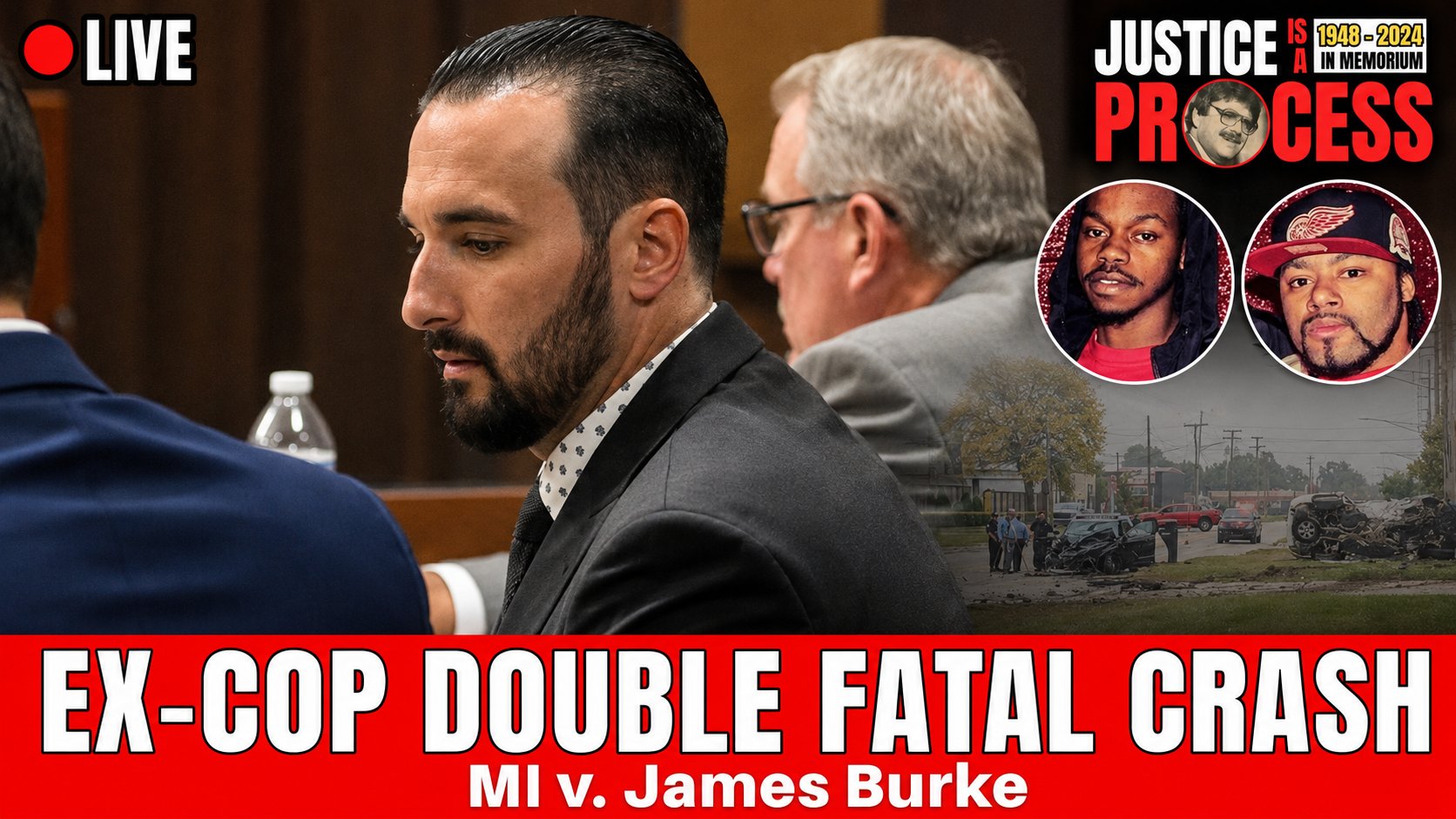
A former Warren officer, a 100-mph crash, and the fight over who is to blame for two deaths.
June 2026 | Justice Is A Process
Cedric Hayden Jr. and DeJuan Pettis had known each other most of their lives. Two friends. Two fathers, with two children each. Two men who built cars for a living, one at Chrysler and one at General Motors, the kind of work that built this part of Michigan and kept their families going.
On the morning of September 30, 2024, they were in a white Dodge Durango, heading home. It was just before 5 a.m. The streets of Warren were nearly empty. Hayden was driving. Pettis rode beside him. They reached Schoenherr Road, near Prospect Avenue, and started a left turn.
They never finished it.
A Warren police Ford Explorer came down Schoenherr at a speed most of us will never touch in our lives. The exact number is one of the things this trial will sort out, but every account of it is staggering. Well over 100 miles an hour, on a road posted for 40. No emergency lights. No siren. By the time anyone in that Durango could have understood what was bearing down on them, there was nothing left to do about it.
Both men died at the scene of a wreck that, by any measure, should never have been survivable for the people in the smaller vehicle.
Behind the wheel of that patrol SUV was Officer James Burke. He was on duty. He was responding to a call about a stolen vehicle that license plate readers had flagged minutes earlier. And he was not alone. Another Warren officer was riding with him, and both of them were seriously hurt in the same crash that killed Hayden and Pettis.
That is where this story starts. It is nowhere near where it ends.
Because more than a year and a half later, James Burke is not a witness to a tragedy. He is a defendant. The State of Michigan has charged him with manslaughter, twice, once for each man who died. And twelve people in a Macomb County courtroom are now being asked a question that has no comfortable answer: when a police officer doing his job drives like that and people die, is it a crime, or is it the worst kind of accident?
Let me say something plainly before we go one line further. James Burke has not been convicted of anything. He is presumed innocent. I am not writing that to be polite or to cover myself. It is the floor this entire case stands on. The State has to prove its charges beyond a reasonable doubt, and the badge Burke used to carry does not lower that bar. It does not raise it either.
Two men are dead. Their families have waited a long, painful time to get here. A former officer is staring down more than thirty years in prison. Every single person in that courtroom is owed the same thing, and it is the only thing we are here to protect: a fair process that follows the evidence wherever it actually leads.
That is what we are watching for. Not a conviction. Not an acquittal. We are watching to see whether the system does the job it claims to do.
This is Justice Is A Process. Let's begin.
Here is what the public record tells us about that morning, with the reminder that an allegation is not a finding and that some of these details will be contested in front of the jury.
It was Monday, September 30, 2024, around 5 a.m. James Burke was on patrol in Warren, a Detroit suburb in Macomb County. License plate readers in the area had picked up the plate of a stolen vehicle a short time earlier. Burke, driving a marked Warren police Ford Explorer with another officer in the passenger seat, started moving toward where that vehicle was believed to be.
He picked up speed on Schoenherr Road. A lot of it. The State's accident reconstruction expert, a Macomb County Sheriff's deputy, testified at the preliminary exam that Burke reached around 110 miles an hour in the seconds before the crash and was traveling close to 94 miles an hour at the moment of impact. Other figures discussed in court and in the reporting have run as high as 114 to 117 miles an hour just before the collision. The prosecutor put it to the jury that the patrol vehicle covered nearly the length of three football fields in a matter of seconds. The posted limit on that stretch is 40.
His emergency lights were off. His siren was off. That is not in dispute. What it means is the heart of the case, and we will get to that.
Ahead of him, the Durango carrying Hayden and Pettis began a left turn from Schoenherr onto Prospect. The patrol SUV slammed into it. The two men in the Durango were killed. Burke and his partner were both seriously injured.
That is the event. Two competing explanations of why it turned deadly are what this trial is really about, and both sides have been telegraphing them since long before opening statements.
The Macomb County Sheriff's Office handled the crash reconstruction, and the case went to the Macomb County Prosecutor's Office. In November 2024, prosecutors charged James Burke. He was placed on administrative leave the day of the collision and was later fired by the Warren Police Department after the charges came down.
The charges are serious, and they are specific. Two felony counts of manslaughter with a motor vehicle, one for Hayden and one for Pettis, each carrying up to 15 years. A misdemeanor count of a moving violation causing serious impairment of a body function, tied to the injuries his partner suffered. And a misdemeanor count of willful neglect of duty by a public officer. Stacked together, the exposure is just over 31 years if he is convicted on everything.
From the start, the families of the two men did not believe those charges went far enough. We will come back to that, because it is part of the air around this case and you deserve the full picture. But the legal fight in that courtroom is built on the charges the State actually brought, and those charges turn on a single, demanding word: negligence. Not ordinary negligence. Gross negligence. Hold onto that. It is the difference between a conviction and an acquittal.
It would be easy, in a case named after the man on trial, to let Cedric Hayden Jr. and DeJuan Pettis become two words. The victims. I am not going to do that, and neither should anyone covering this honestly.
Hayden was 34. Pettis was 33. They were close friends who had known each other for years, and they were both autoworkers, one building for Chrysler and one for General Motors. They were both fathers. Between them, four children no longer have their dads. Their families have shown up to the courthouse again and again, through the preliminary exam and now through the trial, and they have sat through video of the crash that took the two men from them. You do not have to imagine what that costs a family. You can see it.
There is one fact about that morning that the defense intends to put squarely in front of the jury, and I am going to address it the way I address everything here: directly, and without using it to strip a dead man of his humanity. The defense told jurors in opening statements that Hayden, who was driving, had a blood alcohol level of .198, more than twice Michigan's legal limit, and that he turned in front of the cruiser without a signal. That is the defense's evidence and the defense's argument. The State will argue the opposite causation story, that Burke's speed was the reason two men are dead and that nothing the men in that Durango did could have saved them at that velocity. Cedric Hayden cannot stand up and tell his side. The jury will weigh the toxicology along with everything else, and it is their job, not ours, to decide what it means. What I will not do is let a number on a lab report erase the fact that he was a father and a friend who was trying to get home.
James Burke was a Warren police officer at the time of the crash. He was in his late twenties, 28 when he was charged and 29 by the time he was bound over for trial. By his attorney's account, he had about eight years in law enforcement, including time at the Macomb County Sheriff's Office before he joined the Warren force, where he had served for close to three years. Warren police described him as coming from a law enforcement family, with a record that included a 2024 Medal of Valor for heroism in the line of duty and, in the department's words, no history of problematic driving.
None of that decides this case. A clean record and a medal are not a defense to manslaughter, and the State is not required to prove Burke is a bad person. By the same token, the fact that two men died does not make him a criminal. Those are exactly the kinds of shortcuts that a fair trial is built to resist. What matters is what he did in those few seconds on Schoenherr Road, why he did it, and whether the law calls it a crime. He is presumed innocent. The burden of proving otherwise sits entirely with the State, and it never shifts to him.
The case is being prosecuted by the Macomb County Prosecutor's Office under Prosecutor Peter J. Lucido. The assistant prosecutor trying the case in front of the jury is Cory Newman. Representing James Burke is defense attorney Marc Curtis. Presiding over the trial in Macomb County Circuit Court in Mount Clemens is Judge Jennifer M. Faunce.
There is one more set of names you should know, because they have been the loudest public voice in this story. The families of Hayden and Pettis are represented in civil litigation by Fieger Law, the Southfield firm built on the late Geoffrey Fieger's reputation for high-profile plaintiff's work. Attorneys James Harrington and Greg Wix have spoken for the families throughout, and in October 2024 the firm filed a 100 million dollar lawsuit against the Warren Police Department. The civil case is separate from the criminal trial, but the family's position has shaped how this case is talked about, and we will deal with that head on.
Four counts. Let me walk through each one in plain English, including what the State actually has to prove and what is on the line. The burden, on every count, belongs entirely to the prosecution.
What it means: Two counts, one for Cedric Hayden Jr. and one for DeJuan Pettis. Under Michigan law, killing someone with a vehicle becomes manslaughter when the driving rises to gross negligence. Not a simple mistake. Not ordinary carelessness. Gross negligence means a level of recklessness so far over the line that it shows a disregard for whether other people get hurt.
What the State must prove: That each man died, that Burke's conduct caused the death, and that Burke acted with gross negligence, meaning he knew of a danger to others, had the power to avoid it, and failed to use ordinary care to do so. The driving has to be the thing that caused the deaths.
Potential sentence: Each count is a felony carrying up to 15 years in prison.
What it means: This count is tied to the officer who was riding in Burke's patrol vehicle and was seriously injured in the crash. It alleges that a moving violation by Burke caused another person a serious, lasting injury.
What the State must prove: That Burke committed a moving violation, and that the violation caused serious impairment of a body function to another person.
Potential sentence: A misdemeanor punishable by up to 93 days.
What it means: This is a charge that exists because Burke was a public officer on duty. It alleges that he willfully failed to perform a duty his office required of him.
What the State must prove: That Burke held a public office, that the office carried a clear duty, and that he willfully neglected it.
Potential sentence: A misdemeanor punishable by up to one year.
Add it all up and Burke faces a maximum of just over 31 years. But the misdemeanors are not where this trial lives. The manslaughter counts are. And those counts rise or fall on that one word the jury will hear over and over: gross negligence. The State has to prove Burke's driving was grossly negligent and that it was the cause of two deaths. The defense only has to give the jury a reasonable doubt about either piece.
Every case that reaches a jury is there because something is genuinely in dispute. Here, the dispute is unusually clean, and it comes down to two questions. Was Burke's driving criminally reckless, or was he doing his job the way he was trained to do it? And whose conduct actually caused the crash, the officer's speed or the other driver's turn?
This is not a case where one side has the facts and the other side is reaching. Both sides have real material. That is exactly why twelve people are sitting in that box.
The prosecution's story is about the speed and the silence. Assistant Prosecutor Cory Newman told the jury they would hear that Burke's patrol vehicle hit speeds as high as 114 miles an hour in the seconds before impact, on a road posted for 40, in the dark, with no lights and no siren to warn anyone he was coming. The State's reconstruction expert laid out the physics at the preliminary exam, including that the vehicle was covering well over 100 feet every second in the moments before the crash. And the prosecution has emphasized that, by its account, Burke was not in a formal pursuit when this happened. He was responding to a plate reader hit, not chasing a fleeing car with a suspect in sight.
The State's argument is that those choices, that speed, that road, that hour, no warning, add up to gross negligence, and that the result was the death of two men who had no chance to react. The family's civil attorney put the causation point bluntly outside court: at that speed, he argued, there was nothing the men in the Durango could have done to avoid the crash.
Marc Curtis has signaled a defense with two legs, and both of them matter.
The first is training. Curtis has argued that Burke was doing exactly what officers are taught to do. His point, made through his questioning of witnesses, is that when an officer is trying to catch up to a suspect and there is no one between the patrol car and that suspect, officers are trained not to light up their emergency equipment, so they do not announce themselves and give the suspect a reason to run. This is not just the defense talking. At the preliminary exam, a Macomb County Sheriff's detective testified that he too would have kept his lights and siren off until he caught up to a vehicle he was pursuing. On the trial's first day of testimony, the officer who was riding with Burke described Burke as a good driver who usually drove when the two of them worked together.
The second leg is causation, and it is where the defense gets pointed. Curtis told the jury that the crash was set off by the Durango itself. In his telling, a vehicle with no turn signal, driven by a man with a .198 blood alcohol level, turned abruptly and unexpectedly into the path of the cruiser. The defense frames the morning as a tragedy produced by actions on both sides, not a crime committed by one man. If the jury believes the other driver's impaired, unsignaled turn was the real cause, that goes to the heart of whether the State can prove Burke caused these deaths.
One phrase you are going to hear over and over in this trial is "lights and sirens," and another is "pursuit." They are not the same thing, and the gap between them is doing a lot of work for both sides.
Michigan treats an active pursuit, a chase of a fleeing vehicle, differently than a routine response to a call. Pursuits come with their own rules and their own risk calculations. A response to a be-on-the-lookout alert, like a plate reader flagging a stolen car somewhere in the area, is a different animal. The State has stressed that Burke was not in a pursuit when the crash happened. There was no fleeing car directly in front of him that he was running down. In the prosecution's framing, that removes the one justification that might explain driving at triple the speed limit with no warning to anyone else on the road.
The defense takes the same facts and turns them over. Curtis has argued that officers are trained, early in their careers, not to activate lights and sirens while closing distance on a suspect, so the suspect does not know police are coming and bolt. By that logic, the dark and silent approach was not recklessness. It was technique. And the defense got help on this point from an unexpected place. A Macomb County Sheriff's detective testified at the preliminary exam that he would have done the same thing, keeping his equipment off until he caught up to the vehicle he was after.
So watch how every officer on that stand gets questioned about it. Was this a pursuit, a response, or something the policy never cleanly named? Did Warren's own rules permit what Burke did, forbid it, or stay silent? The label is not a technicality. It shapes whether that speed reads to the jury as doing the job or breaking the law.
This whole case sits on a spectrum, and it helps to see the entire thing laid out before the testimony buries you in pieces of it.
At one end is ordinary negligence. A careless mistake. The kind of thing that makes you liable in a civil lawsuit and brings your insurance company into it, but is not a crime. Most car crashes, even fatal ones, live right here.
In the middle is gross negligence, and this is where the manslaughter charges live. Gross negligence is more than a mistake. The law describes it as knowing your conduct puts others in danger, having a chance to avoid that danger, and failing to use even ordinary care to do it. Recklessness that crosses into criminal territory.
Further along is malice, the mental state behind murder, where a person acts with intent to kill or with a disregard for human life so extreme the law treats it like intent. The families argued this case belonged there, as second-degree murder. The prosecutor charged manslaughter instead.
And here is the catch that makes this trial genuinely close. The judge who sent it forward found enough evidence of gross negligence by Burke to bind him over. In the same ruling, he said the other driver's conduct may have amounted to ordinary negligence. Two drivers. Two possible levels of fault. And a jury that has to decide whose negligence, if anyone's, actually caused these deaths, and whether it reaches the line where a tragedy becomes a crime.
Here is the part most coverage will skip, so I want to sit on it for a second. When this case was bound over, the district court judge did not just rubber stamp it. He worked through the testimony piece by piece. He found enough evidence of gross negligence to send Burke to trial. And in the same breath, he acknowledged there were reasons to believe the Durango driver's own conduct amounted to ordinary negligence. He bound the case over anyway, and he made a point of saying a jury of twelve, not a single judge, should be the one to decide it.
That is not a slam dunk for anybody. That is a genuine reasonable doubt case, with two negligence stories competing for the jury's belief. The State says the badge does not excuse driving that fast with no warning. The defense says a trained officer responding to a call cannot be a criminal because a drunk driver turned in front of him. Twelve people get to decide which story the evidence actually supports, and whether the State has closed the distance from "tragic" to "criminal" beyond a reasonable doubt.
There is something about this situation that confuses a lot of people, and it is worth slowing down on, because clearing it up is exactly the kind of work this channel exists to do.
There are two separate legal fights going on over the same crash. One is the criminal case, the trial in front of Judge Faunce, where the State of Michigan is trying to prove Burke committed manslaughter and the only thing on the table is his freedom. The other is the civil case, the 100 million dollar lawsuit Fieger Law filed against the Warren Police Department, where the families are seeking money and a public accounting, and where the target is the department as much as the man.
These two cases run on different rules, and the difference is enormous. The criminal case demands proof beyond a reasonable doubt, the highest standard our law has, because the government is trying to take a person's liberty. The civil case runs on a much lower standard, more likely than not. That is why the same conduct can lose in criminal court and win in civil court. It happens more than people realize. A jury can hold a reasonable doubt about a crime and still find it more likely than not that someone owes for the harm.
That gap is a big part of why the families have been so frustrated. They have argued from the beginning that Burke was undercharged, that this should have been murder, that he caught a break an ordinary person would never get. Their loss is real and their anger is earned. But the criminal jury is not being asked to settle that grievance. It is being asked one narrow question, and only that question: did the State prove these specific charges beyond a reasonable doubt? Hold the two cases apart in your mind, and most of the noise around this trial gets a lot quieter.
This is where Justice Is A Process does the thing other channels do not. We are not here to recap testimony. We are here to ask whether the system is working, and this case puts that question under a bright light, because James Burke is an unpopular defendant in a story full of grief and anger.
Watch the burden of proof. It belongs to the State, start to finish, on every count. Burke does not have to prove he was driving safely. He does not have to prove the other driver caused the crash. He does not have to prove anything at all. The prosecution has to prove gross negligence and causation beyond a reasonable doubt, and if it falls short, the verdict has to reflect that, no matter how badly anyone wants a different outcome. A man being acquitted is not the system failing. A man being convicted on anything less than proof beyond a reasonable doubt is.
Watch causation. This is the battleground. The State has to connect Burke's driving to the deaths in a way that survives the defense's argument about the other driver. Intervening causes, foreseeability, the difference between "a factor" and "the cause," these sound like law school words, but in this courtroom they are the difference between fifteen years and freedom. We will break them down in plain English every step of the way.
Watch the jury's role, because the bind-over judge named it for us. A jury in a case like this is not just deciding what happened. It is deciding, on behalf of a whole community, where the line sits between a deadly mistake and a crime when the person behind the wheel was wearing a badge. That is an enormous responsibility, and it belongs to twelve ordinary people. Watch whether they get to do that job free of the pressure swirling around the case.
Now, the pressure. You should know about it. From the day Burke was charged, the families and their attorneys have argued that manslaughter was a gross undercharge, that the case should have been second-degree murder, and that Burke received favorable treatment because of who he is and what he did for a living. The prosecutor's office responded that its commitment is to hold everyone accountable under the law, no matter their profession or background. I am not here to tell you who is right about the charging decision. That is a real debate, and the people who lost Cedric Hayden and DeJuan Pettis have every right to make their case in the loudest terms. But here is the line I will hold all the way through this trial: the question in that courtroom is not whether the charges should have been bigger. It is whether the State can prove the charges it brought. A jury cannot convict a man of manslaughter to satisfy people who wanted murder, and it cannot acquit him to protect one of its own. It can only follow the evidence. Our job is to watch and make sure that is what happens.
Step back for a second and notice how rare this even is. Officers almost never face criminal charges for conduct on the job, and when they do, the cases are hard to prove and harder to try, because the same act can look like duty or look like a crime depending on where you stand. Some people will watch this trial wanting it to send a message about policing. Others will watch it wanting Burke protected because he wore the uniform. Both of those instincts are dangerous in a courtroom, because a verdict built on a message instead of the evidence is not justice. It is just a different kind of shortcut.
If you have followed this channel, you know why I care about this so much, and why my father cared before me. Steven M. Askin spent his life on the principle that the protections in our Constitution are not favors handed out to sympathetic people. They are the rules, and they apply to everyone, including the defendants the public has already judged. He was prosecuted twice for insisting on that. The presumption of innocence does not get suspended because a defendant used to carry a badge, any more than it gets suspended because a defendant is poor, or unpopular, or accused of something terrible. Either it covers James Burke the same way it would cover you, or it does not really mean anything. We are going to find out which, in real time, on the record.
This is shaping up to be a relatively short, intense trial rather than a sprawling one. Expect the State to build its case through the officers who were there, the department's own policies on pursuits and emergency equipment, and the accident reconstruction that puts hard numbers on the speed. Expect the defense to press training at every turn and to keep the other driver's impairment and turn in front of the jury. And expect the real fight to arrive when the State rests and the defense opens its own case, because that is when the whole frame flips from "how reckless was he" to "this was the job, and a drunk driver turned into his path." That transition is the moment the two stories collide directly, and it is the moment to watch closest.
Live broadcasts as it happens. No Breaks editions for uninterrupted viewing. Justice Breakdowns with deep analysis. Key moments and testimony segments so you can hear every word for yourself.
James Burke is presumed innocent until proven guilty beyond a reasonable doubt. That is not a technicality. It is the foundation of everything we do here.
Let's watch the system together.
Subscribe to Justice Is A Process on YouTube for live trial coverage, No Breaks editions, and breaking news as it happens.
🔴 Subscribe on YouTube111,000+ subscribers watching the system with us
Discussion