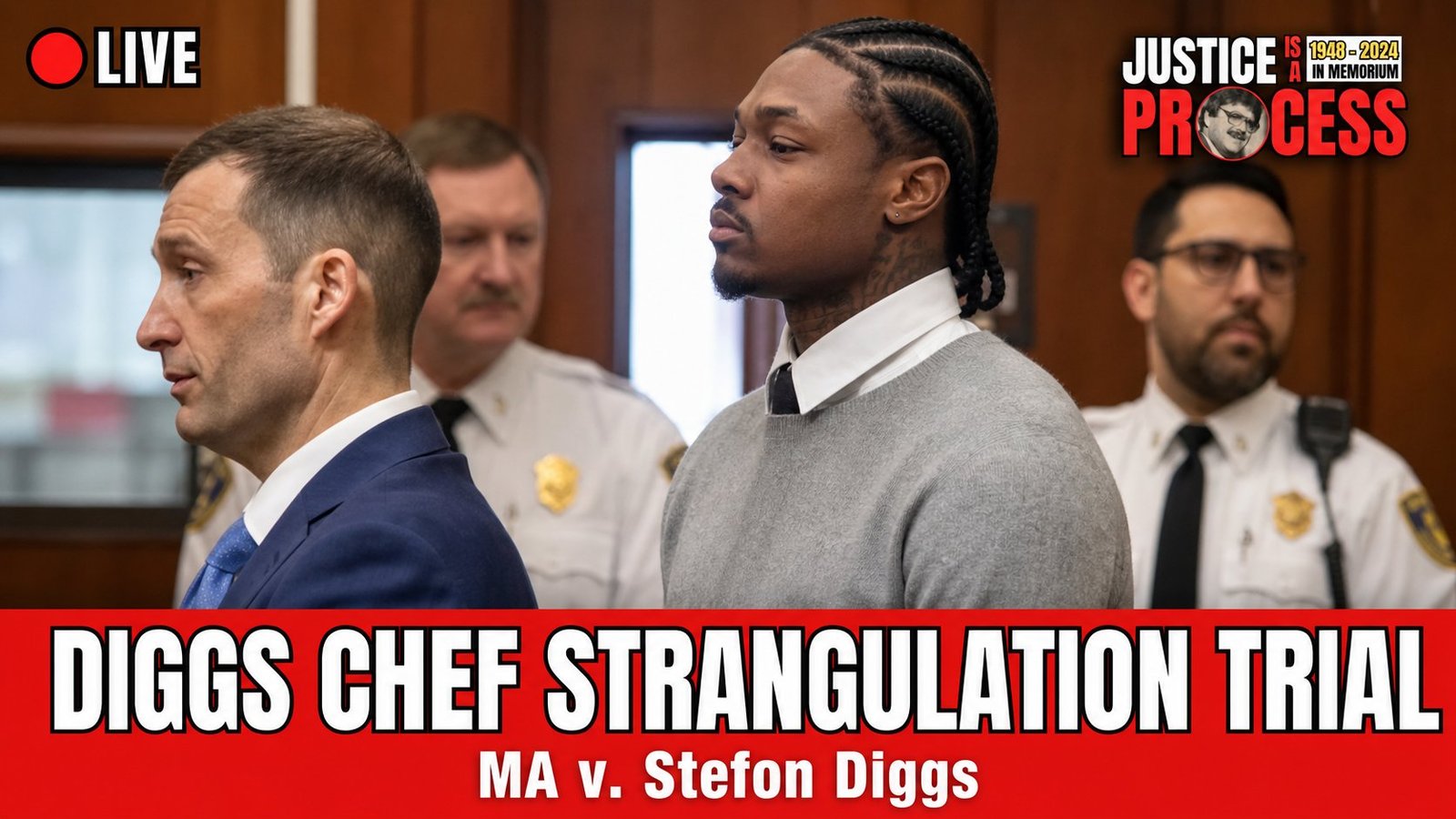
She says he strangled her. He says she wanted money. The trial begins.
May 2026 | Justice Is A Process
On December 16th, 2025, a woman walked into the Dedham Police Department and reported that an NFL wide receiver had strangled her at his home two weeks earlier.
That same day, in another part of the country, an email landed in the inboxes of Stefon Diggs's representatives. It came from a business associate of the woman who had just walked into Dedham PD. The email demanded payment of money on her behalf.
Two events. Same date. Different rooms. One question that a Massachusetts jury is now being asked to answer.
This is the case. Strip away the celebrity, the seven-figure salary, the Patriots release, the Super Bowl appearance, the social media noise. What is left is a he-said, she-said with no photographs of injuries, no medical records, no third-party witnesses, and a payment demand sitting in the timeline right next to the police report.
Tomorrow morning, jury selection begins in Dedham District Court. Six jurors. Two days, maybe three. About ten witnesses on the lists. One judge already telling the accuser she cannot mention any prior altercations during her testimony. One defense team that has spent five months telling the public this is a financial dispute repackaged as a criminal complaint. One prosecution that has to convince twelve eyes and ears in a courtroom that a woman's word, on its own, is enough.
I am Justice. My father was Steven M. Askin, a West Virginia criminal defense attorney who spent his life teaching people that the system only works when we make it work. When we watch. When we question. When we refuse to let an accusation, by itself, become a conviction.
The defendant in this case is presumed innocent. That phrase gets repeated so often that it can start to feel like a formality. It is not. In a trial where there is almost no evidence beyond competing testimony, the presumption of innocence is not a technicality. It is the whole game. The state has to prove every element of every charge beyond a reasonable doubt. The defense has to prove nothing. That is not a loophole. That is the rule the founders wrote into the Constitution because they had seen what happens when accusations are enough.
This is Justice Is A Process. Let's begin.
December 2nd, 2025. A Tuesday. The New England Patriots had beaten the New York Giants the previous Sunday. According to the Dedham police report, that afternoon a private chef who had been hired to cook for Stefon Diggs through the entire NFL season was inside his home in Dedham, Massachusetts, the home where she had been given a room to live in for the duration of her employment.
According to the criminal complaint, there had been an ongoing back-and-forth over text messages about money. The chef told police she believed Diggs owed her for work she had done. The complaint says they began discussing the dispute, and that the conversation, in her telling, escalated.
The chef told Dedham officers that Diggs slapped her across the face. She said she pushed back. According to her account, Diggs then placed his arm around her neck, bringing the inside of his elbow into contact with her throat, and applied pressure. She told police she had trouble breathing during the encounter. She said she felt like she could have lost consciousness.
She told officers that afterward, she had redness on her upper chest from the alleged contact. She did not photograph the area. She did not seek medical treatment. She did not call 911. She left.
She did not go to the police that day. Or the next day. Or the day after that.
Two weeks passed.
During those two weeks, Diggs continued playing for the Patriots. The chef did not tell police what she says happened. She did not, according to anything in the public record, go to a hospital. She did not document any physical evidence of the alleged choking. She did not text or email anyone in law enforcement.
What she did do, eventually, on December 16th, was walk into the Dedham Police Department and tell officers that on December 2nd, Stefon Diggs had assaulted and strangled her.
She told them she had hesitated to report because of his fame. That was the explanation she initially gave. Later, in a Zoom meeting with her own attorney before trial, she told prosecutors there was another reason she had waited. She said she had once seen Diggs in a prior altercation with another person, and that this prior incident factored into her fear about coming forward.
That second reason will not be told to the jury. Judge Jeanmarie Carroll ruled at the final pretrial hearing on May 1st that any reference to prior bad acts is excluded. The accuser will be specifically instructed that the prior altercation is not to be mentioned from the witness stand. If it slips out, the jury will be told to disregard it.
Which leaves the prosecution, on Day One of trial, with one stated reason for a fourteen-day delay: she was scared because he was famous.
Here is the part of the case that most outlets have buried in the seventh paragraph.
On the same day she walked into the Dedham Police Department, December 16th, 2025, a business associate of the chef sent an email to Stefon Diggs's representatives. The email demanded payment of money on her behalf.
That detail does not come from the defense alone. It comes from the public record. Diggs's lawyers disclosed it in a court filing. They say it will be used at trial to demonstrate the chef's bias and motivation.
That is the spine of this case. That is the question every juror is going to be sitting with whether they say it out loud or not. Did the strangulation happen, and the email was just a separate civil matter pursued the same day? Or did the email come first, in some form, and when payment was not produced, did the police report follow as a pressure mechanism?
Six people on a Norfolk County jury are about to be asked to sort that out using only the words of human beings on a witness stand.
The accuser's name has not been made public, and out of respect for the protections she is entitled to under Massachusetts law, we are not naming her here either. What we know about her professionally is enough.
She was hired as Stefon Diggs's personal chef for the duration of the 2025 NFL season. That is a real industry. Professional athletes routinely hire private chefs to manage nutrition, meal timing, dietary restrictions, and the absurd caloric demands of an in-season schedule. It is a high-pressure, high-trust position. The chef typically lives or stays with the family, has access to the kitchen, manages food sourcing, and coordinates with strength and conditioning staff. The relationship is intimate by definition. You are inside someone's home. You are feeding their body. You are part of the household.
According to police records, she was given a bedroom in Diggs's Dedham home for the season. She was not a casual contractor. She was a live-in employee, and that detail matters because it shapes the texture of the alleged dispute. Money disputes between an employer and a live-in employee carry a different dynamic than money disputes between strangers. There is no clean exit. The disagreement is happening in the place where the employee sleeps.
She is the prosecution's case. There is no co-victim. There is no eyewitness. No one else, according to the public record, was in the room when the alleged strangulation took place. Without her, the state has nothing.
Stefon Diggs is 32 years old. A native of Maryland. He was drafted in the fifth round of the 2015 NFL Draft by the Minnesota Vikings out of the University of Maryland. He played for the Vikings, the Buffalo Bills, the Houston Texans, and most recently the New England Patriots. He is a four-time Pro Bowler, a former First-Team All-Pro, and over the course of his career has caught more than ten thousand receiving yards.
In the 2025 season, he caught 85 passes for 1,013 yards and four touchdowns. He played in Super Bowl LX, his first Super Bowl appearance, in early February 2026. The Patriots lost 29-13 to the Seattle Seahawks.
About a month after that loss, the Patriots released him. Cap savings of approximately 16.8 million dollars. He was in the first year of a three-year, 63.5 million dollar contract. He has not signed with another team since.
That is the public-figure resume. None of it is evidence in this case. None of it tells us whether he assaulted his chef on December 2nd, 2025. It is context for who is sitting at the defense table, and it is context for the level of public attention this trial is going to draw, but it has no probative value on the actual question the jury has to decide.
Diggs has pleaded not guilty. He has denied the allegations from the day they were made public. He is currently free on personal recognizance bail and is under court order to stay away from the chef. He is not on the defense witness list. He will not be testifying in his own defense, which is his right under the Fifth Amendment, and the jury will be instructed that his decision not to testify cannot be held against him.
The lead attorney representing Diggs at trial is Mitchell Schuster. He has been on the case since the February arraignment. Working with him is co-counsel Andrew Kettlewell, who handled jury selection issues and witness sequestration motions at the May 1st pretrial hearing.
An earlier attorney, David Meier, originally on the case, withdrew before trial. Meier was the one who issued the first public statements after the charges were filed in December, characterizing the chef's allegations as unsubstantiated and uncorroborated, and framing the case as the byproduct of a financial dispute that did not resolve in the chef's favor.
The defense has signaled that they will call an expert witness on the authentication of text messages. The prosecution does not plan to call a rebuttal expert on that issue, because the dispute is over authentication, not interpretation. Both sides expect texts to be in evidence. The fight will be over what those texts show, not whether they are real.
The case is being prosecuted by the Norfolk County District Attorney's Office. The assistant district attorney who appeared at the final pretrial hearing on May 1st is Drew Virtue. Whether Virtue is the lead trial attorney or part of a trial team has not been publicly confirmed, but he is the named prosecutor in the public record going into Day One.
Judge Jeanmarie Carroll is presiding. She has handled every significant pretrial issue in the case, including the recent ruling excluding any reference to prior bad acts and the agreement to remove Diggs's mother from the witness list.
This is being tried in district court, which under Massachusetts law has jurisdiction over the strangulation charge even though it carries a potential state prison sentence. District court juries in Massachusetts are six-juror panels rather than the twelve-juror panels you see in superior court. That is a structural detail that matters. A unanimous verdict from six is the bar, and that bar applies to a credibility contest with no physical evidence.
Two charges. One a felony, one a misdemeanor. They cover overlapping conduct but require different proof.
Statute: Massachusetts General Laws, Chapter 265, Section 15D.
What it means in plain English: Massachusetts treats strangulation as its own felony, separate from general assault. The law was created to give prosecutors a more serious charging option in cases where one person grabs another by the throat or neck in a way that cuts off air or blood flow.
What the Commonwealth must prove beyond a reasonable doubt:
1. That Stefon Diggs applied substantial pressure to the throat or neck of the alleged victim.
2. That the pressure interfered with her normal breathing or her circulation of blood, without legal right or excuse.
3. That he acted intentionally.
One important wrinkle: This is what Massachusetts courts call a general intent crime. The state does not have to prove that Diggs specifically intended to interfere with the chef's breathing. Only that he intentionally committed an act that resulted in that interference. That is a lower bar than specific intent, and the defense will be working to make sure the jury understands the difference.
Potential sentence on conviction: Up to 5 years in state prison, or up to 2.5 years in the house of correction, or a fine of up to 5,000 dollars, or some combination. A conviction also requires completion of a certified intimate partner abuse education program unless the court makes specific written findings exempting the defendant.
Statute: Massachusetts General Laws, Chapter 265, Section 13A.
What it means in plain English: The basic offensive-touching charge. Any intentional, unjustified physical contact that is harmful or offensive can support an assault and battery conviction in Massachusetts. This count covers the alleged slap to the face, separate from the alleged choking.
What the Commonwealth must prove beyond a reasonable doubt:
1. That Diggs touched the alleged victim, however slightly.
2. That the touching was either intentional and unjustified, or reckless and resulted in physical harm.
3. That the alleged victim did not consent.
Potential sentence on conviction: Up to 2.5 years in the house of correction, or a fine of up to 1,000 dollars, or both.
Why charge both? Because the alleged conduct, if the chef's account is believed, includes two distinct acts. A slap to the face is its own offensive touching. The alleged subsequent choking is its own crime under the strangulation statute. The state can charge both and ask the jury to convict on either or both.
Theoretically, a jury could acquit on the strangulation count and convict on the assault and battery, or vice versa. They will be instructed on each count separately and will reach a verdict on each.
Most criminal cases never see a jury. They plead. They settle. They get diverted, dismissed, continued without a finding. The cases that go to trial go to trial because something is unresolved that only twelve people, or in this case six, can resolve.
Here is the unresolved thing in Massachusetts v. Stefon Diggs.
There are no photographs of injury. The chef herself told police there was redness on her upper chest from the alleged choking, but she did not document it. She did not seek medical treatment. There is no medical record. There is no nurse's note. There is no emergency room intake form. There is no third-party witness. No one else, according to the public record, was in the room.
What there is, on the prosecution's side, is the chef's word. Her account to Dedham police on December 16th. Her testimony at trial. Her credibility on the stand under cross-examination.
What there is, on the defense's side, is fourteen days of silence followed by a walk-in to the police station on the same day a business associate emailed Diggs's representatives demanding money. The defense has also told the court that their investigation has uncovered what they describe as multiple false statements made by the accuser. They have not detailed those statements publicly. They will at trial.
That is why it is going to trial. Because the prosecution's case is one person's testimony, and the defense has a documented, contemporaneous financial demand that they say undermines the credibility of that testimony. There is no DNA to argue about. No surveillance video. No 911 call from the moment of alleged assault. There is testimony, and there is doubt about that testimony, and the jury has to decide which side carries the day.
The Commonwealth will tell the jury this is a domestic violence case in everything but the literal definition of household member. A live-in employee was assaulted by her employer over a money dispute. The fact that she did not photograph her injuries, did not seek medical treatment, and did not immediately call police is not unusual. Delayed reporting, the prosecution will argue, is normal in cases involving an alleged victim who is afraid of the person who hurt her, especially when that person is famous, wealthy, and represented by a team of attorneys.
The state will lean on the police report. They will lean on the chef's account of feeling unable to breathe and feeling like she could have blacked out. They will lean on her describing redness in detail to officers. They will lean on the contemporaneous text messages between her and Diggs about money owed, which they will argue corroborate that there was a real dispute that could plausibly turn physical.
And they will lean on her, on the witness stand, telling the jury what happened in her own words.
The defense will tell the jury something different. That this was not a strangulation. That this was a private chef who was unhappy with how an employment dispute had resolved, and who, with the help of a business associate, attempted to extract a payment from a famous and wealthy employer. That when the payment was not produced, a police report became the next step. That the absence of photographs, medical records, and witnesses is not coincidental. It is consistent with an event that did not happen the way the chef has described.
They will draw the jury's attention to December 16th. The same day she walked into Dedham PD, the same day a demand for money was emailed to Diggs's representatives. They will ask the jury to consider whether those two events can plausibly be unrelated.
They will offer a text-message authentication expert to walk the jury through the messages between Diggs and the chef. The defense believes those messages show the financial dispute, not an assault.
And they will remind the jury, repeatedly, that Diggs is presumed innocent, that he has no obligation to prove anything, and that the state's case is based entirely on the testimony of one person whose financial motivation is documented in the same week she went to the police.
Three pretrial rulings are going to shape how this trial unfolds.
The first is the exclusion of any reference to prior bad acts. The chef told prosecutors before trial that part of why she waited fourteen days to report was that she had previously witnessed Diggs in some kind of altercation with an unnamed third party. Judge Carroll ruled that the chef cannot mention this from the stand. The jury will not hear it. If it slips out, the chef will be rebuked and the jury will be instructed to disregard it. That ruling matters because it strips the prosecution of one of the contextual hooks they had to explain the reporting delay.
The second is the removal of Diggs's mother from the witness list. She was originally listed by the defense, who said she had been at the Dedham house at various times during the relevant period and that her name might come up. The defense decided in the days before trial that they would not call her. Judge Carroll agreed. She is no longer a witness for either side.
The third is the protective order around discovery. Both sides have been ordered to produce mandatory discovery on a defined schedule, and certain text messages and emails the defense sought access to have been addressed. The fight over what the jury sees has, at least on paper, been resolved.
What remains is the trial itself.
If you want to understand how Mitchell Schuster and Andrew Kettlewell are going to try this case, look at the questions they asked Judge Carroll to put to potential jurors during selection. The questionnaire reads like an X-ray of the defense strategy.
One category of questions probes for jurors with healthcare, psychology, therapy, or counseling backgrounds. The defense wants to know which jurors might be predisposed to interpret a delayed report as trauma rather than as motivation.
A second category asks whether jurors have ever felt unfairly treated by an employer. That question is targeted directly. The defense wants jurors who can imagine an employee being unhappy with how a money dispute was handled, because that is the frame they are going to ask the jury to apply to the chef.
A third category asks whether jurors have ever felt that they were not believed or taken seriously when raising a legitimate grievance. Different kind of bias-check. The defense wants to know which jurors are walking in with a chip on their shoulder about not being heard, because those jurors will be predisposed to side with the chef regardless of what the evidence shows.
A fourth category asks about jurors who have considered making a report or claim of crime or misconduct but ultimately did not follow through. That one cuts directly at the fourteen-day silence. The defense wants jurors to understand that the act of not reporting can be a deliberate choice, not just paralysis.
And then the last two: have you heard of Stefon Diggs or this case before today, and have you ever closely followed a criminal trial through social media. Standard celebrity-defendant protections, but worth noting. The defense wants jurors who have not already absorbed a narrative.
The questionnaire tells you what the defense thinks the jury needs to be primed to do. They are going to argue that delayed reporting is meaningful, that employer-employee disputes can produce false claims, and that a jury that approaches this case with media-formed assumptions will not see what the evidence actually shows.
Every case that reaches a jury reaches a jury for a reason. In this one, the reason is that the prosecution is asking six people to convict Stefon Diggs of a felony based almost entirely on the testimony of one person, in a case where the documented financial timeline raises real and serious questions about credibility.
That is not me declaring innocence. That is me describing the structure of the case. The presumption of innocence is the law. The burden of proof beyond a reasonable doubt is the law. The Sixth Amendment right to confront witnesses, to have an impartial jury, to compel testimony in your favor, those are the law. None of that means Stefon Diggs did not assault his chef. It means the state has to prove it. With evidence. To a unanimous jury. Beyond a reasonable doubt.
Here is what the team and I will be watching for, day by day.
How does the prosecution explain the fourteen-day delay without the prior-bad-acts evidence Judge Carroll has now excluded? They have one stated reason left, that the chef was scared because of Diggs's fame. Is that going to be enough to satisfy a juror who is also being asked to consider the email demanding payment that went out the same day she walked into the police station?
How does the chef hold up on cross-examination? She is the entire prosecution case. Schuster has signaled that the defense investigation has uncovered what they call multiple false statements made by her. We do not yet know what those statements are. We will. Whatever they are, they are going to be put to her in front of the jury, on the record, under oath. How she answers will tell us a lot.
What do the text messages actually show? Both sides have agreed they are coming in. The defense expert will authenticate them. The dispute is over interpretation. Do the texts show a routine money dispute that turned physical, as the prosecution will argue? Or do they show a buildup of financial pressure that the chef escalated when payment did not come, as the defense will argue?
How does the prosecution handle the email? They have to. They cannot pretend it does not exist. Every juror is going to know about it before the second day of testimony is over. The prosecution has to give the jury a credible explanation for why a payment demand on the same day as the police report does not undermine the credibility of the criminal complaint.
And the bigger question, the one I will be returning to in every breakdown for the life of this trial. What does this case show us about how the system handles allegations against famous defendants when the only evidence is one person's word?
My father was Steven M. Askin. In 1994, the federal government held him in contempt and eventually indicted him because he refused to testify against his own clients in drug cases. Conversations he believed were protected by attorney-client privilege. He went to prison. He was disbarred. He never practiced law in a courtroom again.
What he did for the rest of his life was teach. From a coffee shop in Martinsburg, West Virginia. He taught people their constitutional rights. He helped them understand that the burden of proof is on the state. That presumption of innocence is not a phrase, it is the foundation. That an accusation, on its own, is not evidence.
In 2009, on the morning he was supposed to get his law license back, he was indicted on eleven counts of unauthorized practice of law. Eleven counts of helping people understand the rules the system uses against them. The prosecutor on that case said publicly that she feared he would disrupt the legal system by training young lawyers to demand due process.
I was twelve years old when the first indictment came down. I have spent my life watching what the system can do when an accusation is allowed to function as a conviction. That is why this channel exists. That is why we cover trials like this one.
Stefon Diggs is not Steven M. Askin. Their stories are not the same. A wealthy NFL receiver has resources my father did not have, attorneys my father did not have, public attention my father could only have wished for. None of that is the point.
The point is the principle. The principle does not change based on whose face is on the receiving end. The state has to prove its case. The accused does not have to prove anything. That rule applies to a famous receiver in a Dedham courtroom. It applies to a defense attorney indicted for refusing to testify against his clients. It applies to a man helping people in a coffee shop and getting prosecuted for it. It applies to whoever is sitting in the defendant's chair, whoever is sitting in the alleged victim's chair, in any case in any courtroom in this country.
If we let the system convict on accusation alone when we like the accuser, we have nothing to say when the system convicts on accusation alone against someone we don't.
That is why we watch.
Starting Monday, May 4th, we are in that courtroom. Every day. Every minute of testimony. Every ruling.
You will get LIVE BROADCASTS as it happens, NO BREAKS EDITIONS for clean uninterrupted viewing, JUSTICE BREAKDOWNS with deep legal analysis after each day, and KEY MOMENTS clips so you can see exactly what was said when it mattered most.
This is not speculation. This is not punditry. This is the system doing what the system does, watched in real time, broken down in plain English.
The defendant is presumed innocent until proven guilty beyond a reasonable doubt. That is not a technicality. That is the foundation of everything we do here.
Let's watch the system together.
Subscribe to Justice Is A Process on YouTube for live trial coverage, No Breaks editions, and breaking news as it happens.
🔴 Subscribe on YouTube111,000+ subscribers watching the system with us
Discussion