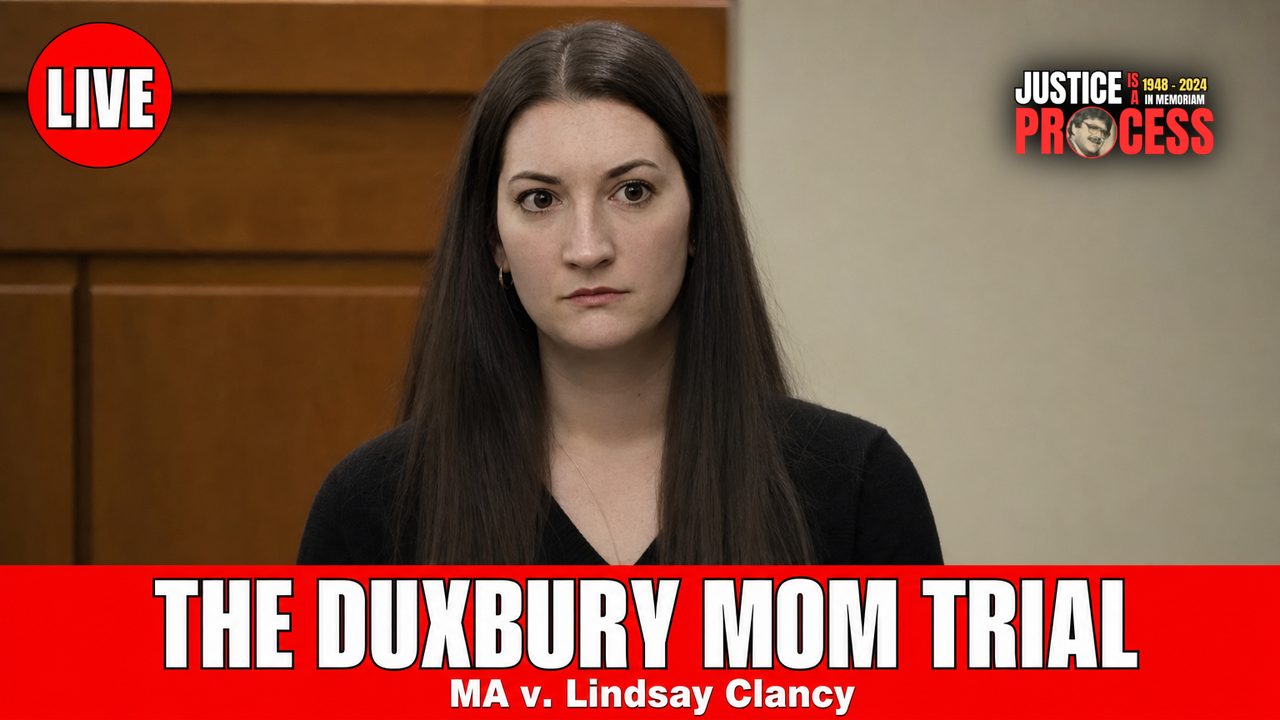
The Duxbury Mom Trial. Three children, a labor and delivery nurse, and the question of whether her mind was her own.
July 2026 | Justice Is A Process
On the evening of January 24th, 2023, Patrick Clancy left his house in Duxbury, Massachusetts, to pick up dinner. His wife, Lindsay, had suggested a restaurant in Plymouth, about twenty-five minutes away. Their three children stayed home with her: Cora, who was five. Dawson, who was three. Callan, who was eight months old.
When Patrick came home, the world he had left less than an hour earlier no longer existed.
Prosecutors say he found his wife outside, gravely injured, having gone out of a second-story window. Inside, in the basement, he found his children. All three had been strangled, according to the Commonwealth, with exercise bands. Cora and Dawson were pronounced dead that night. Callan, the baby, fought for three more days at Boston Children's Hospital before he died too.
Lindsay Clancy survived the fall. It left her paralyzed from the waist down. She was arraigned from a hospital bed two weeks later, and she has been held in a secure state hospital ever since, awaiting the trial that begins now, three and a half years after the worst night in Duxbury's memory.
Here is what makes this case unlike almost any murder trial you have ever watched: the defense is not expected to argue that someone else did this. There is no alternate suspect, no whodunit, no mystery about whose hands were on those bands. The question this jury will be asked is harder, and older, and it cuts to something the law has wrestled with for centuries. Was the woman in that house that night criminally responsible for what she did? Or had her mind, by that point, stopped being her own?
The Commonwealth says Lindsay Clancy planned the murders of her own children, that she was cold and calculating, that she researched what she was going to do and timed her husband's errand to give herself the window to do it. The defense says she was a mother drowning in postpartum illness, hearing voices, prescribed more than a dozen psychiatric medications in the space of a few months, a woman who begged the medical system for help and was handed another prescription instead.
And here is the fact that hangs over everything: the person who lost the most, the father of those three children, has publicly asked the world to forgive her.
Duxbury is not a place that knew how to hold this. In the days after January 24th, thousands of people stood in the winter cold at vigils for three children most of them had never met. The town's grief made national news, then international news, and the case has never really left the headlines since: the arraignment from a hospital bed, the unsealed warrants, the interviews, the lawsuits, the three and a half years of hearings that all led here. When the jury pool walks into Plymouth County Superior Court on Monday morning, the court's first task will be finding eighteen people in Plymouth County who can set all of that aside. It may be the hardest thing anyone is asked to do in this entire trial.
Today, as jury selection begins, we are not here to convict or acquit. We are here to watch whether the system does what it is supposed to do: prove its case beyond a reasonable doubt while protecting the rights of everyone involved, in a case where the stakes could not be higher and the answers could not be less simple.
This is Justice Is A Process. Let's begin.
The Clancys lived in Duxbury, a coastal town of about 16,000 people on Massachusetts' South Shore, the kind of place that shows up on lists of the best towns in New England to raise a family. Lindsay Clancy, then 32, was a labor and delivery nurse at Massachusetts General Hospital, one of the most respected hospitals in the country. She had trained through an accelerated nursing program and spent her working life helping other women bring children into the world. Patrick Clancy worked in tech. They had three young children and, from the outside, a life many people would recognize as the goal.
According to prosecutors, at some point that evening Lindsay Clancy sent her husband out of the house on an errand: takeout from a restaurant in Plymouth. Court documents later unsealed in the case allege that her phone had been used to run an Apple Maps query calculating how long it would take to travel between the family's home in Duxbury and that restaurant. The Commonwealth's theory is blunt: she was not ordering dinner. She was measuring a window of time.
Prosecutors allege that while Patrick was gone, Lindsay Clancy strangled all three children with exercise bands in the basement of the home, then went out of a second-story window in an apparent attempt to take her own life. Patrick returned, discovered the scene, and called 911. That call, which a judge has cleared prosecutors to play for the jury, is expected to be one of the most difficult pieces of evidence in the entire trial.
Cora, age five, and Dawson, age three, were pronounced dead that same day. Callan, the eight-month-old, was transported to Boston Children's Hospital, where doctors fought for him for three days. He died on or about January 27th, 2023.
Lindsay Clancy survived. The fall broke her spine, and she has been paralyzed from the waist down since that night. Every court appearance she has made in three and a half years has been made in a wheelchair or, at the beginning, from a hospital bed. On February 7th, 2023, she was arraigned remotely from that bed on three counts each of murder, strangulation, and assault and battery with a dangerous weapon. Judge John Canavan ordered her held at a medical facility without cash bail. She pleaded not guilty.
The February 7th, 2023 arraignment was held remotely, with Lindsay Clancy appearing from her hospital bed, and it is worth understanding what happened at that hearing, because the two stories that will collide at this trial were both told, in miniature, on that very first day.
Assistant District Attorney Jennifer Sprague laid out the Commonwealth's account of the evening: the errand that took Patrick Clancy out of the house, the timeline it created, and the deliberateness the State says it sees in every step. The prosecution's framing was unambiguous from the first hearing forward. In the Commonwealth's telling, this was not a snap. It was planned, and the details of the plan are the proof.
Kevin Reddington answered with the story he has told ever since. His client, he said, was a woman consumed by postpartum illness who had been prescribed a staggering number of psychiatric medications in the months before that night, medications he would go on to list by name in the months that followed. Reporting at the time captured something else that mattered: members of the family had been worried about Lindsay's medications well before January 24th. Her husband, according to that reporting, believed she was struggling with dependence on benzodiazepines and had the worst side effects imaginable. The defense was not inventing a theory after the fact. The alarm about her treatment predates the deaths.
Judge John Canavan ordered her held without cash bail at a medical facility. Nobody argued she was going anywhere. She could not walk.
Hold both of those opening statements in your head, because in three and a half years, neither side has moved an inch. The trial that begins on July 20th is the same argument that was had over a hospital video feed in February 2023, finally put to a jury with the evidence behind it.
In September 2023, a Plymouth County grand jury returned indictments, moving the case to Plymouth County Superior Court, where first-degree murder cases in Massachusetts are tried. The following month, a court unsealed more than 200 pages of search warrant materials, and the public got its first real look at the Commonwealth's premeditation theory.
The most explosive allegation in those documents: that Lindsay Clancy used her phone to research, in the words attributed to the investigation, ways to kill. It is worth being precise here, because precision is what this channel does. Reporters who reviewed the unsealed records noted that the documents asserted the research happened but did not lay out the underlying searches themselves or explain in detail how investigators reached that conclusion. What the phone actually shows, and what the forensic witnesses say it shows under oath and under cross-examination, will be one of the central evidentiary battles of this trial. An allegation in a warrant affidavit is a starting point. It is not a verdict.
The same documents described the Apple Maps travel-time query between the home and the Plymouth restaurant. Together, those two data points are the spine of the Commonwealth's case that this was not a psychotic break that arrived out of nowhere. In the State's telling, it was a plan.
Here is what makes this case structurally different from nearly every murder trial we have covered. The defense, led by veteran Massachusetts attorney Kevin Reddington, has never built this case around the question of who caused the children's deaths. From the earliest hearings, the defense has pointed toward a different question entirely: Lindsay Clancy's mental state. This trial is not expected to be a contest over what happened in that basement. It is a contest over what was happening inside her mind, and whether the law can hold her responsible for it.
She remains presumed innocent of every charge. That presumption does not evaporate because the defense is focused on criminal responsibility rather than identity. It means the Commonwealth must still prove every element of first-degree murder beyond a reasonable doubt, and in Massachusetts, once a defendant's criminal responsibility is genuinely in play, the burden lands on the Commonwealth to prove she was criminally responsible too. Keep that in your pocket. It is the single most important legal fact in this entire case, and we will come back to it.
Three children died in that house. Cora Clancy was five years old. Dawson Clancy was three. Callan Clancy was eight months old, a baby who had been alive for less than a year.
We are not going to pretend to have known them, and we are not going to dress their memory up in borrowed details. The truest public record of who they were comes from their father, in the statement he released days after their deaths: "Cora, Dawson, and Callan were the essence of my life." He said he dreams about them on repeat. Whatever this trial becomes, whatever the lawyers argue and the experts diagnose, those three children are the reason everyone is in that courtroom. This coverage will not lose sight of them, and it will not exploit them. That is the line, and we will hold it for the life of this trial.
Every trial happens somewhere, and where it happens matters. Duxbury is an old coastal town, settled in the 1600s, the kind of South Shore community where the schools are the civic religion and everyone is separated from everyone else by at most two degrees. The Clancy family was woven into it. When the news broke, the town did what towns do: it gathered. Vigils drew enormous crowds. Ribbons went up. A GoFundMe for Patrick Clancy raised roughly a million dollars in days, a number that tells you how deep the shock ran and how instinctively the community rallied around the surviving father.
But Duxbury's grief also carried a second current that complicates this case to this day. From almost the first week, alongside the horror, there was an outpouring of public sympathy for Lindsay Clancy herself, driven by mothers who recognized pieces of their own postpartum experience in the reporting and were willing to say so out loud. The public conversation about this case has never been one-sided, and that is rare in a child homicide. The jury pool being summoned on Monday comes from that same public. Both sides know it, and both sides will be probing for it in voir dire.
Lindsay Clancy is now 35. She grew up in Wallingford, Connecticut, became a nurse through an accelerated program at Mass General, and worked in labor and delivery, the ward where life begins. By every public account, before the fall of 2022 she was a devoted mother. Her husband described her as "generously loving and caring towards everyone," her patients included.
What is alleged to have changed is her mind. In the months after Callan's birth, according to reporting and to filings in related civil litigation, she was treated for anxiety, depression, and insomnia, and the treatment escalated fast. Her attorney has said she was prescribed more than a dozen psychiatric medications between October 2022 and January 2023, a list reported to include Klonopin, Valium, Prozac, Zoloft, and Ativan, taking as many as four different medications a day, as prescribed. Around New Year's, weeks before the killings, her husband took her to a hospital after she reported wanting to die and having intrusive thoughts of harming her children. She spent five days at McLean Hospital, the renowned psychiatric facility, and was discharged into a day program. Twenty-some days later, her children were dead.
Since October 2023 she has been held without bail at Tewksbury State Hospital, a secure state facility. She is paraplegic. She has pleaded not guilty. And under the law of the Commonwealth of Massachusetts, she is presumed innocent of every count unless and until a jury says otherwise.
Patrick Clancy is the father of Cora, Dawson, and Callan, the man who made the 911 call, and very possibly the most consequential witness on the Commonwealth's list of roughly 200 names. He is also the author of one of the most extraordinary public statements ever made by a victim's family member in an American murder case. Days after his children died, he wrote: "I want to ask all of you that you find it deep within yourselves to forgive Lindsay, as I have." He described the real Lindsay as loving to the fibers of her soul, and drew a line between the wife he knew and the person in that house on January 24th.
He has since spoken at length to The New Yorker, and he has pursued civil litigation against the medical providers who treated his wife, a wrongful-death claim built on the same theory the criminal defense will argue: that the system that was supposed to help Lindsay Clancy failed her. Recent coverage of the case refers to Patrick as Lindsay Clancy's ex-husband, and we will confirm the formal status of the marriage from the record at trial rather than assume it. What matters for this courtroom: prosecutors have signaled they view his 911 call as evidence of premeditation, while his public words have done more for the defense's story than almost anything a lawyer has said. Both sides need him, and both sides have to be careful with him. Watch how each side handles this man. It will tell you everything about their theories.
Judge William F. Sullivan of Plymouth County Superior Court presides. He has already shaped this trial in significant ways at the final pretrial hearing, and he will shape it every day from here.
The Commonwealth is represented by the office of Plymouth County District Attorney Timothy J. Cruz, with Assistant District Attorney Jennifer Sprague in the leading courtroom role through the pretrial phase. Sprague has been the public voice of the premeditation theory since the earliest hearings.
The defense is led by Kevin Reddington, one of the most experienced criminal defense attorneys in Massachusetts, with decades of high-profile trials behind him and a long record of taking the cases other lawyers turn down. Reddington has been unambiguous about his theory from the start: postpartum illness, catastrophic overmedication, and a client who was not, in the eyes of the law, responsible for her actions. He is a trial lawyer of the old school, and a defense built on lack of criminal responsibility, where the defense concedes the facts and stakes everything on the experts and the story, is exactly the kind of case that lives or dies on the advocate. Watch his cross-examinations of the Commonwealth's forensic witnesses. That is where the defense's trial will actually be fought long before its own case opens.
The experts may end up mattering more than anyone. A trial about criminal responsibility is a trial of psychiatrists. Both sides are expected to call mental health experts to testify about Lindsay Clancy's state of mind. Their names have not yet been confirmed on the public record, and we will not guess at them. When they take the stand, their testimony will be the whole ballgame, and our coverage will treat it that way.
It is worth understanding what these witnesses actually do, because it is stranger than television makes it look. A forensic psychiatric evaluation in a case like this is retrospective: the expert is asked to reconstruct the state of a mind on a specific night years in the past, using medical records, medication histories, witness accounts, the physical evidence, and hours of clinical interviews conducted long after the fact, with a subject who has every reason, conscious or not, to remember the night in a particular way. Two honest, qualified experts can walk through that same material and land in different places, which is exactly what you should expect to see here. The jury's job is not to count credentials. It is to test which reconstruction survives contact with all of the evidence, including the pieces that expert would rather not talk about. Cross-examination of the experts will be the summit of this trial, and we will cover every minute of it.
The case goes to trial on three counts of murder in the first degree, one for each child. In Massachusetts, that is the most serious charge that exists.
What it means: The Commonwealth must prove beyond a reasonable doubt that Lindsay Clancy unlawfully killed each child, and that each killing qualifies as first-degree murder under at least one theory the law recognizes. The two theories in play here are deliberate premeditation, meaning she decided to kill and acted on that decision after reflection, and extreme atrocity or cruelty, which looks at the manner of the killing itself. Prosecutors have invoked both concepts in describing their case.
What the State must prove: That each child is dead; that Lindsay Clancy caused each death unlawfully; and that she acted with deliberate premeditation, or with extreme atrocity or cruelty, or both. Because the defense has raised her mental state, the Commonwealth must also prove she was criminally responsible: that she did not lack, by reason of mental disease or defect, the substantial capacity to appreciate the wrongfulness of her conduct or to conform her conduct to the law.
Potential sentence: A first-degree murder conviction in Massachusetts carries a mandatory sentence of life in prison without the possibility of parole. Massachusetts has no death penalty. Three convictions would mean three life sentences.
The burden: Entirely on the Commonwealth. On every element, and on criminal responsibility itself. The defendant does not have to prove anything.
Massachusetts gives the Commonwealth more than one road to a first-degree conviction, and in this case the two that matter could not be more different in character.
Deliberate premeditation is about the decision. The law does not require days of planning or a written scheme; it requires that the defendant decided to kill after a period of reflection, even a brief one, rather than acting on a spontaneous impulse. This is where the phone evidence, the maps query, and the timed errand live. If the jury believes those facts show a decision made and carried out, the premeditation theory is satisfied. But notice what that theory quietly assumes: a mind capable of deciding. The defense will attack the assumption, not the timeline.
Extreme atrocity or cruelty is about the manner of the killing rather than the planning of it. Massachusetts juries weighing this theory are instructed to consider factors like the victim's consciousness and suffering, the degree of force, and the disproportion between the means used and what would cause death. The Commonwealth will argue that strangulation, an act that takes sustained physical effort over a period of time, carried out on three children of five years, three years, and eight months, speaks for itself. It is the theory that forces the jury to sit inside the worst minutes of this case. Expect the defense to fight hard, through motions and instructions, over how that evidence comes in and how long the trial dwells there.
One more piece of plain English the coverage will keep coming back to: second-degree murder is the lesser included offense sitting underneath every first-degree count. If the jury finds an unlawful intentional killing but is not convinced beyond a reasonable doubt of premeditation or extreme atrocity or cruelty, second-degree murder is available, and it carries life with the possibility of parole rather than life without. In a case with a live criminal responsibility defense, the verdict slip for each child will offer the jury a genuine range: first-degree murder, second-degree murder, or not guilty by reason of lack of criminal responsibility. Three children, three counts, and no requirement that the answers match. Juries in cases like this have split before. Remember that when the deliberation days start to stretch.
Lindsay Clancy was originally arraigned on nine counts: three each of murder, strangulation or suffocation, and assault and battery with a dangerous weapon. In July 2026, days before trial, prosecutors dropped the three strangulation counts as redundant of the murder charges. That is housekeeping, not weakness: the strangulation allegation lives on inside the murder counts as the alleged method. As for the assault and battery with a dangerous weapon counts, their status heading into trial has not been confirmed on the public record we have reviewed, and rather than guess, we will report their disposition from the courtroom when the indictments are read.
Massachusetts does not use the phrase "insanity defense" in its courtrooms. The term is lack of criminal responsibility, and the standard comes from a case called Commonwealth v. McHoul: a defendant is not criminally responsible if, at the time of the offense, she suffered from a mental disease or defect that left her without substantial capacity either to appreciate the wrongfulness of her conduct or to conform her conduct to the requirements of the law.
Read that carefully, because it is two separate doors. The defense does not have to prove Lindsay Clancy did not know what she was doing. It can also prevail if her illness destroyed her capacity to control what she was doing, even if some part of her understood it. Postpartum psychosis, the condition at the center of the defense theory, is a recognized and severe psychiatric emergency that can involve hallucinations, delusions, and commands the sufferer experiences as real. Whether Lindsay Clancy had it, whether it reached the McHoul threshold on January 24th, 2023, and whether a plan-shaped paper trail can coexist with a broken mind: that is the entire trial.
Strip away the filings and the hearings and ask the only question that matters: why are eighteen jurors about to give up a month or more of their lives for this case?
Because the two sides are telling irreconcilable stories about the same night, and both stories have real evidence behind them. This case is at trial because the Commonwealth's own facts cut in both directions. The paper trail says planning: a researched method, a timed errand, a house emptied of its only other adult. The medical trail says catastrophe: a woman reporting intrusive thoughts about harming her children weeks earlier, a five-day psychiatric hospitalization, more than a dozen medications in four months, a family begging the system for help and watching her get worse. The State reads the first trail and calls the second one cover. The defense reads the second trail and calls the first one symptom. A jury has to decide which story the evidence actually tells, and the law gives them no middle option on a murder count.
That is the core tension, and every day of this trial will be a chapter of it: killer, or a mother the system failed? Cold, calculating murder, or postpartum psychosis that nobody stopped?
District Attorney Cruz's office has described the killings as planned, cold, and calculating, and its case will be built to make premeditation feel undeniable. Expect the forensic evidence from the phone, the Apple Maps query, the mechanics of the errand and its timing, the 911 call, and testimony about the deliberate physical acts involved in strangulation, an act that takes sustained time and effort, repeated three times. Expect the Commonwealth's psychiatric experts to concede she was ill, because the treatment record makes illness impossible to deny, and then to draw the line that matters legally: ill is not the same as lacking criminal responsibility. Depression, even severe depression, does not automatically open the McHoul doors. The State will argue she appreciated exactly what she was doing, wrongfulness included, and did it anyway.
One more thing to watch: at the final pretrial hearing, prosecutor Jennifer Sprague told the court that members of Lindsay Clancy's own family had declined to meet with her team before trial. Where the family's loyalties sit, and who they testify for, is going to be one of the quiet human dramas of this case.
Kevin Reddington's theory has been consistent for three and a half years: Lindsay Clancy was suffering from severe postpartum illness, escalating toward psychosis, and the medical system responded by burying her in prescriptions. More than a dozen medications. Benzodiazepines her husband reportedly believed she had become dependent on. A rejected treatment program, a short hospitalization, a ten-minute follow-up call, another prescription. The defense will argue that by January 24th her capacity was gone, that the apparent planning was the machinery of a psychotic mind executing a delusion, and that the Commonwealth is prosecuting the last failure in a chain of failures that belonged to the system, not to her.
The defense's story has an unusual amount of outside corroboration for a criminal case. Patrick Clancy's public forgiveness and his civil suit against her medical providers put the father of the victims closer to the defense's theory than to the State's. In early 2026, Lindsay Clancy herself filed a malpractice suit against providers involved in her care. None of that is evidence of what her mind could or could not do that night. All of it shapes the story the jury will inevitably absorb.
No one will say her name in front of the jury, but one case hangs over every trial like this one, and it is worth understanding why lawyers on both sides have studied it: Andrea Yates.
In 2001, Yates, a Texas mother with a long documented history of postpartum psychosis, drowned her five children in the family bathtub after her husband left for work. The parallels to the allegations here, a brief window alone with the children, a documented psychiatric collapse in the months beforehand, a method that takes time and deliberate effort, are the reason her case is the reference point for every postpartum homicide prosecution since. At her first trial in 2002, a Texas jury convicted her of capital murder in under four hours. That verdict was later thrown out on appeal after a State expert witness gave testimony that turned out to be false. At her retrial in 2006, a second jury heard substantially the same evidence and found her not guilty by reason of insanity. She has been in a state mental hospital ever since.
Same facts. Two juries. Two opposite verdicts. That is the honest lesson of Yates, and it is why nobody who tells you they know how the Clancy case ends should be trusted. But there is a second lesson buried in the comparison, and it favors the defense here in a way few people appreciate: Texas uses one of the narrowest insanity standards in the country, asking only whether the defendant knew her conduct was wrong. Massachusetts uses the McHoul standard, which is one of the broadest, adding the second door: whether disease destroyed her substantial capacity to conform her conduct to the law, even if she knew. Andrea Yates was ultimately acquitted under the hard standard. Lindsay Clancy will be judged under the generous one, and unlike Texas, Massachusetts puts the burden of proving criminal responsibility on the government. Those two structural facts are the quiet foundation of the defense's confidence, and the quiet reason the Commonwealth's premeditation evidence has to do so much work.
Three and a half years of pretrial litigation left marks on this case beyond the headline rulings, and several of them will echo at trial.
The defense at one point moved to split the trial into two parts, an unusual request reported in coverage of the pretrial phase, which would have separated the question of what happened from the question of criminal responsibility. The trial going forward is a single proceeding, which means the jury will absorb the premeditation evidence and the psychiatric evidence side by side, each side hoping its story frames the other's.
Patrick Clancy's 2024 interview with The New Yorker, an extended and intimate account of his marriage, his children, and his view of what the medical system did to his wife, itself became a point of friction between the District Attorney's office and the press, a reminder that in a case this prominent, the battle over the public narrative runs parallel to the battle over the evidence. A trial date near January 2026 came and went as litigation continued, hearings ran through the fall of 2025, and the case finally hardened toward the July 2026 date that is now here.
And in the last two weeks before trial, the board was set: the strangulation counts dropped, the postpartum lay witnesses excluded, sequestration denied, the 911 call cleared, and eighteen seats waiting in a Brockton courtroom.
Judge Sullivan's decisions at the July 13th, 2026 final pretrial hearing set the field. He denied the defense's motion to call other women to testify about their own experiences of postpartum mental illness, ruling that expert witnesses can adequately educate the jury; prosecutors had objected that the proposed witnesses were identified only by initials, with no statements disclosed. That is a real loss for the defense, which wanted the jury to hear lived experience alongside clinical testimony. He denied jury sequestration. He cleared the 911 call to be played. And he set the structure: eighteen jurors seated, including six alternates, drawn from a pool that will be screened by questionnaire against a witness list of roughly 200 names, with a possible jury visit to the Duxbury home itself. Every one of those rulings will echo through the weeks ahead.
This is where we tell you how to watch this trial like a lawyer instead of a spectator, because this case is going to test the system in ways most murder trials never do.
The burden of proof on criminal responsibility. This is the heart of it. In Massachusetts, once lack of criminal responsibility is fairly raised, the Commonwealth must prove beyond a reasonable doubt that the defendant WAS criminally responsible. Not the defense proving she was insane. The State proving she was sane. That allocation of the burden is a due process choice the Commonwealth has made, and it is the highest wall the prosecution has to climb. When the experts collide, ask yourself the only question the law asks: has the State eliminated reasonable doubt about her capacity? A jury that convicts because "she must pay" rather than because the Commonwealth carried that burden is a jury that broke the machine. We will be watching for exactly that.
Can a jury actually presume her innocent? Three dead children, including an infant. There is no more emotionally radioactive fact pattern in criminal law. Eighteen human beings will be asked to feel the full horror of what happened and still hold the Commonwealth to its burden. Voir dire, the questioning of prospective jurors, is where that battle is fought first, and with no sequestration and a case this saturated in coverage, Judge Sullivan's screening questions are carrying enormous weight. Jury selection is not the boring part of this trial. In a case like this, it may be the decisive part.
The medicalization of guilt, and its limits. This trial sits on a fault line running through American law and American life: what happens when psychiatry and criminal responsibility collide? The law's categories are old and binary. The medicine is modern and gradient. Postpartum psychosis is real, documented, and rare; most sufferers harm no one. The jury will have to locate one woman's mind, on one night, inside that gray zone, using testimony from experts who never met her before the fact. Watch whether the experts on both sides testify like scientists or like advocates. The integrity of this verdict depends on the difference.
The paper trail versus the diagnosis. The Commonwealth's strongest cards are digital: the alleged research, the maps query, the timing. The defense's strongest cards are medical: the records, the medications, the hospitalization. Here is the analytical trap to avoid, and we will help you avoid it all trial: planning and psychosis are not automatically exclusive. The legal question is not whether she took organized steps. It is whether, at the time, disease had stripped her substantial capacity to appreciate wrongfulness or to conform her conduct. Some of the most severe psychotic episodes on record involved methodical behavior in service of a delusion. The State will say the organization proves the mind was working. The defense will say the organization proves nothing about what the mind was working toward, or why. Listen for which expert deals with the other side's best facts honestly. That witness is the one to trust.
Whether the system itself ends up on trial. There is a shadow defendant in this courtroom: the mental health system that treated Lindsay Clancy for four months and did not stop this. A wrongful-death suit and a malpractice suit are already pending against providers. The criminal jury is not being asked to judge the system, and the judge will police that line hard. But you cannot un-ask the question the defense will plant: if a dozen clinicians could not see this coming, how was she supposed to? Watch how much of that story Judge Sullivan lets in, and watch the Commonwealth try to keep this trial about one person's choices rather than an institution's failures.
Pretrial publicity and the unsequestered jury. Judge Sullivan denied sequestration, which means eighteen jurors will go home every night of a four-to-six week trial to households, phones, and feeds saturated with this case. The law handles that with admonishments: instructions not to read, watch, or discuss. Whether admonishments can actually hold against a case this famous, for this long, is one of the live constitutional questions of the modern era, and this trial is about to run the experiment at full scale. A single juror who researches postpartum psychosis on their own, or reads a hot take about the verdict slip, can poison weeks of work and force it all to start again. Watch how often Sullivan repeats his warnings, and watch what happens the first time a juror is questioned about exposure mid-trial. It may happen. It usually does.
Why verdicts like the one the defense wants are so rare. Here is a piece of context the trial itself will never give you. Insanity defenses are raised in a small fraction of felony cases and succeed in a small fraction of those, and the reason is not that the law is stingy. It is that jurors distrust the defense instinctively. It asks them to accept that a person can do a terrible thing and not be punishable for it, and it collides with a deep human need for someone to answer when children die. The research on juries says most of them decide these cases on their gut theory of the defendant, then filter the expert testimony through it. That is exactly the failure mode the process is designed to prevent, and exactly what our coverage will be watching the lawyers fight over. The defense's real adversary in this courtroom is not Jennifer Sprague. It is the gravitational pull of three small caskets, and the entire structure of the trial, the instructions, the burden, the verdict slip, exists to make the jury decide with the law instead of the pull.
The defendant is presumed innocent. The Commonwealth's allegations are allegations. And the process, not the outrage, is what separates a verdict from a verdict-shaped opinion. That is why we watch.
Expect jury selection itself to take real time, and do not treat it as the wait before the show. Here is how it will work. Prospective jurors will first complete a written questionnaire and review the witness list of roughly 200 names, screening for connections in a county where connections are everywhere. Then comes voir dire, where jurors are questioned individually about what they have seen, heard, and already believe about this case. In a first-degree murder case with a mental health defense, expect questioning to probe attitudes toward psychiatry, medication, and the insanity defense itself, because a juror who says "I could never accept that defense no matter the evidence" is a juror who cannot follow the law, and each side will be hunting for its version of that person in the other side's favorites. Judge Sullivan has said he will ask jurors directly about their exposure to the case. With no sequestration, who survives that screening will quietly shape everything that follows.
Once openings arrive, expect the Commonwealth's case to lean on first responders, investigators, and digital forensics, with the defense case built around the medical record and the psychiatric experts, and the whole trial funneling toward the collision of the experts at the end. Two wild cards to hold onto: whether the jury is taken to view the Duxbury home, which the court has floated as a possibility, and what happens when Patrick Clancy takes the stand, whichever side calls him. There will be days of this trial that are procedural and days that are unbearable, and we will cover both with the same discipline.
We will be watching every day of this trial, and we will cover it at every depth. LIVE BROADCASTS as court happens, every session. NO BREAKS EDITIONS of the full day with the recesses removed, so you can watch the day the jury saw. CASE STORY breakdowns of every block of testimony, with the analysis of what it meant and where it fits. TRIAL ANALYSIS PODCAST episodes for the deep dives. KEY MOMENTS AND TESTIMONY preserved so you can hear every word for yourself and check our work.
This case demands something extra from everyone who covers it, and everyone who watches it: gravity. Three children are gone. A family is destroyed. Nothing about this coverage will treat that as content. We are here to watch the system answer the hardest question it can be asked, and to watch it answer under the rules.
Lindsay Clancy is presumed innocent until proven guilty beyond a reasonable doubt. That is not a technicality. That is the foundation of everything we do here.
Let's watch the system together.
Subscribe to Justice Is A Process on YouTube for live trial coverage, No Breaks editions, and breaking news as it happens.
🔴 Subscribe on YouTube111,000+ subscribers watching the system with us
Discussion