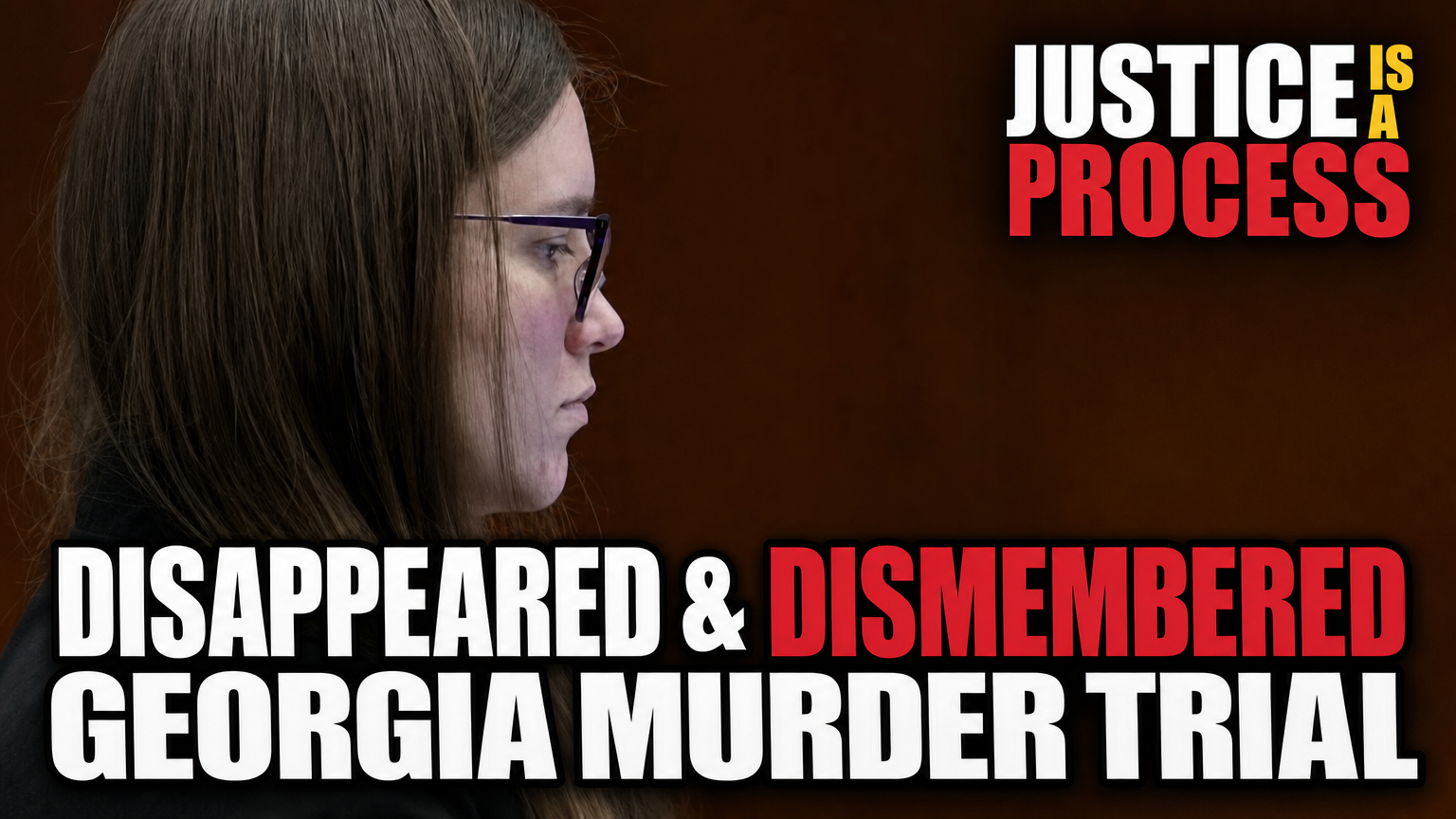
For seven years, the only person who knew where Morgan Bauer was is the woman now on trial for her murder.
August 2026 | Justice Is A Process
Before she got on the plane, Morgan Bauer made her best friend a promise.
The two of them met in the first grade. They drifted apart when Morgan moved to another small town, found each other again in high school in Aberdeen, South Dakota, and after graduation worked a catering job together nearly every day for about a year and a half. Close enough that the friend would later tell a Newton County jury, under oath, "I was with her pretty much at all times."
The friend had lost people before. Morgan knew that. So before Morgan left for Atlanta in February 2016, she promised she would check in every single day, so that her friend would never have to sit and wonder. That was the deal. A daily call.
They talked on a video call on the morning of February 25, 2016. Nothing was wrong. Nothing stood out. Morgan was nineteen years old, two weeks into a brand new city, chasing what she had described to a stranger online a few days before she flew out as, simply, "a new beginning."
"I told her to call me when she was safe and at home. And I never got the call."
Then came the messages that never got answered. Hey, are you okay? Did your phone break? Did you make it home? Her friend had paid for thirty days of phone minutes on February 11, good through March 11, so she knew the phone worked. Nothing came back. On March 2 she reached out to Morgan's sister. She called the Atlanta club where Morgan had auditioned. She called the Atlanta Police Department herself.
For the next seven years, that was the story the world had: a nineteen-year-old free spirit who flew to a big city and disappeared into it. Her mother filed a missing person report with Atlanta police on March 12, 2016, then came to Georgia herself. She handed out thousands of flyers. She called news stations. She worked with missing-persons organizations. She paid for a billboard with her daughter's face on it, the kind of billboard you drive past on the interstate at seventy miles an hour without ever knowing what it costs a family to put up. Volunteers searched wooded areas. Podcasts covered the case. An online community formed around the single question of where Morgan Bauer went.
Morgan Bauer had not been missing since the first week.
Prosecutors in Newton County, Georgia say that the young woman who gave police the last account of Morgan's movements, the young woman who told an Atlanta detective that Morgan had left the house on a date and taken everything she owned with her, the young woman who gave three different versions of that night to three different people in the same week of March 2016, knew exactly where Morgan was the entire time.
They say she knew because she helped put her there.
Her name is Katelyn Grace Goble. She is thirty years old. She is on trial right now in Newton County Superior Court in Covington, Georgia, on a five-count indictment that includes malice murder, and she has pleaded not guilty to every count.
And here is the fact that makes this trial unlike almost any murder trial you have watched us cover: Morgan Bauer's remains were recovered from a wood line behind a house in Porterdale in the summer of 2023 because Katelyn Goble told investigators where to look. An investigator showed her an aerial photograph of the property and asked her if she knew where Morgan was. She picked up a pen. She did not hesitate. She circled a spot.
That single fact is this whole case, and both sides own a piece of it.
The State says it is the conduct of a woman who had finally run out of road, cornered by an ex-husband who had started talking, a documentary producer who bluffed her into believing witnesses were lining up, and a warning that cadaver dogs were being scheduled for the property within weeks. The defense says it is the conduct of a woman who was never a killer, who came forward when nobody could have made her, and who handed a grieving family the only answer anyone was ever going to get.
Both of those readings fit the same fact. That is exactly what a jury is for.
We are not here to convict Katelyn Goble and we are not here to acquit her. We are here to watch whether the State of Georgia can prove, beyond a reasonable doubt, that a nineteen-year-old girl who was inside that house was a party to a killing, and not just a terrified witness to one. The burden is entirely on the State. It never shifts. She does not have to prove a single thing.
This is Justice Is A Process. Let's begin.
Everything in this section is an allegation. Katelyn Goble has pleaded not guilty, and the presumption of innocence is the operating rule of the entire proceeding, not a formality we recite and then forget. Where the State's account rests on her own recorded statements, we say so, and we tell you what she has consistently denied.
Morgan Aryn Bauer was born in 1996 and graduated from high school in Aberdeen, South Dakota, in 2014. Her childhood best friend put it about as well as anyone could from a witness stand: "Morgan in herself, she was much bigger than what Aberdeen had to offer. She had a personality too bright for that small town."
By early 2016 her roommates were moving to Michigan and she had nowhere to land. So she did something that sounds reckless until you remember she was nineteen: she posted a roommate ad in a handful of big cities. Atlanta. Miami. Chicago. Los Angeles. Denver. Atlanta answered.
Her own messages from February 9, 2016, read into evidence at this trial from certified Facebook business records, are the closest thing this case has to Morgan speaking for herself:
"I leave in two days."
"Are you going out there for school or for work?" "Both. And a new beginning."
"So you must have family out there?" "I'm going alone. I'm a free spirit."
"What are some of your life goals?" "Not sure yet. Haven't found myself or where I want to be. That's why I'm a ghost searching."
She flew out on February 12, 2016. Certified Verizon phone records put her phone at the Minneapolis airport around four in the morning and at Hartsfield-Jackson in Atlanta by about three that afternoon.
What happened next is the ordinary, grinding arithmetic of being nineteen and broke in a city where you know nobody. An arrangement with a man she found online fell through in a couple of days. She moved between motels. She started auditioning at clubs, first around Atlanta, then a daily run out toward Gainesville. By February 22 her phone sits at a motel in Gainesville, and that is where she was living.
At 2:52 in the morning on February 25, 2016, Morgan Bauer called 911 from that motel. The jury heard the recording this week. Somebody was banging on her door. She had woken up to them slamming on it. She gave the room number.
After that night, the records show, she never stayed there again.
Here is the fact the State built its week around, and it comes from Verizon, not from any witness: the first contact of any kind between Morgan Bauer's phone and Katelyn Goble's phone happened at 4:24 in the afternoon on February 24, 2016. Before that, nothing. Not one call, not one text, in the twelve days Morgan had been in Georgia.
Sixteen voice calls and a run of texts followed, all inside a single window. Roughly thirty-six hours later, Morgan Bauer's phone stopped talking to anyone forever.
The State's account of that window is this. Katelyn Goble, then also nineteen, had come down from Illinois a few months earlier to be with a twenty-six-year-old man named Jonathan Alexander Warren, who went by Alex. The two of them were living in a first-floor guest bedroom at his adoptive parents' restored historic home on South Broad Street in Porterdale, a small Newton County town. That bedroom had its own private outside entrance off an alcove on the porch, and its own attached bathroom. The parents slept upstairs, on the other side of the house. The back of the property runs down into deep woods toward the Yellow River.
Prosecutors say Goble met Morgan in the Atlanta club scene, that the two auditioned together, that Morgan's motel had stopped being safe, and that Goble offered her a place to stay. Assistant District Attorney Bailey Wilkinson put it to the jury in the first minute of her opening statement:
"The defendant, Katelyn Goble, befriended Morgan Bauer. She befriended her, and then she lured her back to her home so that the defendant and her boyfriend, Alex Warren, could kill her."
Wilkinson told the jury what the State says the offer really was: "A safe place for Morgan. But what you're gonna learn is it wasn't safe for Morgan."
The State's timeline has them driving back to Porterdale in the overnight hours of February 25 into February 26. The phone records track that drive, from towers around Gainesville to towers within reach of the Warren property. Prosecutors say Morgan Bauer was strangled shortly after they arrived.
Morgan's phone made its last outbound contact in the early morning hours of February 26. After that, out of more than three thousand messages in the record set, every single call and message is inbound, and every one of them goes unanswered. The detective who mapped the records called it the only complete drop of outbound communication anywhere in Morgan's phone life. The phone goes silent in Porterdale, and it never comes back.
What the State says happened over the next several days is the reason this case carries the weight it does, and we are going to state it plainly, once, without performing it.
Prosecutors allege that Morgan Bauer's body remained in that bedroom and its attached bathroom for about three days. That she was beheaded and dismembered there. That Warren sexually abused her remains during that period. That the remains were then put into a suitcase, carried down a short trail to a small fire pit just inside the wood line behind the house, and burned, and that the two of them returned to that spot more than once over the following weeks.
We will not repeat the detail of that material in this report. The court record contains it, our live coverage carries the court record as recorded, and that is where it stops. What matters for the jury is narrower and it is this: whose hands, and whose will.
Prosecutors say Katelyn Goble took Morgan's phone apart, pulled the battery, and put it down a storm drain so it could not be located. They say she went to the kitchen and got the knives. They say she held the body while it was cut. They say she carried branches to the fire and sat beside it while it burned.
Katelyn Goble has said many of those same things about herself, on tape, to police. What she has never said, in four recorded police interviews across 2023, according to the State's own lead investigator on cross-examination, is that she killed Morgan Bauer. She has consistently maintained that Alex Warren killed her, and that everything she did, she did afterward and under his control.
The State's case is not really about three days in February. It is about seven years in which the answer existed and nobody could reach it.
Within about two weeks of Morgan's disappearance, Katelyn Goble gave three separate accounts of that night, and the jury has now heard all three side by side.
To an Atlanta homicide detective on the phone in mid-March 2016, she said Morgan came into the house, showered, sat around texting a man on a dating app, and left on a date around one or two in the morning, taking everything she owned with her. The detective caught it in real time on the recording. "So she took all, even her dirty clothes, on a date with her?"
To a Porterdale officer on the street a week later, she said Morgan never came inside at all. Morgan waited in the truck while she and Warren went in to shower, and then they dropped Morgan at a gas station in Covington where she got into a green car with a man they could not describe.
To Morgan's own mother, in a club office in Atlanta on March 15, 2016, she said Morgan passed out in the truck, woke up excited about a man she had matched with, and asked to be dropped off to meet him.
Three accounts in one week. Three different Morgans. Prosecutors say the reason those stories do not line up is that none of them are true, and that Morgan Bauer never left 2 South Broad Street.
Then, according to the State's theory, life simply went on. The jury has spent hours this week looking at Katelyn Goble's own social media from the weeks and months that followed: photographs of the couple together, affectionate posts tagging Warren, a video of him dancing in that same bedroom, a wedding-cake image captioned "till death do us part." They lived in that house from February until mid-May of 2016. They left Georgia together.
And on the other side of the country, on the other side of that seven years, Morgan's mother was still handing out flyers.
The case that had gone nowhere for seven years came apart in about seventy-two hours in July 2023, and it came apart because of four people who had no badges between them.
The first was Katelyn Goble's ex-husband. The State's account is that during their marriage she confessed to him, and that when the marriage ended in the spring of 2023 he no longer had a reason to hold it.
The second was a documentary filmmaker named Terry Feely, a semi-retired firefighter and paramedic who had never made a documentary before. He found Morgan Bauer's missing-person listing in 2019 while looking for a story, started calling everyone in the file, and reached Katelyn Goble on or about July 1, 2019. He then exchanged messages with her, on and off, for four years.
The third was Ashley Durham, a licensed Tennessee private investigator who came in as a volunteer and worked the background while Feely worked the front. The fourth was Morgan's mother, who never stopped.
On July 10, 2023, Feely called Katelyn Goble and recorded it. He told her, in a bluff he later admitted to from the witness stand, that people had come forward describing exactly what happened. He told her cadaver dogs were coming to search the Porterdale property within weeks and that they were going to find something. Durham called her the same day.
The next day, July 11, 2023, Katelyn Goble walked into the Peoria, Illinois police department on her own and asked to give a statement about a missing-persons case out of state. She was not detained, not under arrest, and free to leave, and the detective who took it had been given about fifteen or twenty minutes of notice and had no file at all.
That statement went to Georgia. On July 27, 2023, roughly forty to fifty officers, FBI evidence teams and three cadaver dogs converged on 2 South Broad Street in Porterdale. Late in the day, the Porterdale lieutenant running the grid noticed an orange flag and a ring of stones stacked deliberately at the base of a tree. Nobody knew who had put them there. They took the circle apart layer by layer.
"When we got to the last layer of the rocks, and I swept my hand, I found a vertebra popped up out of the ground."
What was recovered was not much: part of a skull, several vertebrae, some rib bones, and nearby the remains of a burned suitcase, broken shovel heads, a pair of glasses and a shoe. A second search warrant on August 7, 2023 recovered more.
Seven years and about five months after she promised her best friend she would call every day, Morgan Bauer was found, about a hundred yards from the bedroom where she was last alive.
She is nineteen forever now, which is the cruelest thing about any case like this, and it is very easy for a trial to turn a person into a set of exhibit numbers. So before anything else: Morgan Aryn Bauer was funny, she was restless, she was loyal enough to promise a daily phone call to a friend who had known loss, and she was brave in the specific, underrated way that a teenager who buys a one-way plane ticket to a city where she knows nobody is brave.
She described herself as a free spirit and as "a ghost searching," and she wrote that before anyone had any idea what those words would come to mean. She had a retainer. She had tattoos, one of which came up in evidence this week in a context her family should never have had to hear. She had a mother who filed the report, flew to Atlanta, printed the flyers, bought the billboard, and kept going for seven years while the answer sat in the ground behind a house in Porterdale.
In this report we use the role rather than the name for Morgan's mother, her sister, her best friend, and other private people pulled into this by circumstance rather than choice. They are named in the court record, and we cover the court record, but we are not going to make headlines out of them.
She was nineteen years old in February 2016. She is thirty now.
What is undisputed about her background is thin and comes mostly from her own recorded statements: she is from the Peoria, Illinois area, she went through Army basic training and left with a broken hand and separation papers, she met Alex Warren on Facebook, and she bought a bus ticket to Georgia to be with him. She had no family and no friends in the state. She started dancing because, in her telling, she was the only one earning. She married after the relationship with Warren ended, and she has two children. In the summer of 2023 she was in the middle of a divorce and a custody dispute when the phone calls started coming.
Her online life is going to be a large part of this trial, argued in both directions. On Facebook in 2016 she posted under the name Lilith Chaos. In 2021 she posted more than a hundred TikTok videos on themes of death, bodies and killing, in costume and makeup. The State calls that a pattern. The defense calls it cosplay. A judge has ruled the jury gets to see it and decide, which we will get to.
She has pleaded not guilty to all five counts. She has never told police she killed Morgan Bauer. Whether she is guilty of anything at all is the question twelve people in Covington are being asked to answer, and nothing in this report answers it for them.
Warren, now thirty-three, of Porterdale, was arrested in Los Angeles in the fall of 2023. In January 2024 he pleaded guilty in Newton County to malice murder and related counts in Morgan Bauer's death. He is serving life in prison without the possibility of parole.
He is the single largest absence in this courtroom. He is the only other living person who was in that bedroom. He has already been convicted and sentenced, and he has nothing left to lose by talking.
And the State told the jury in opening that it is not calling him.
Wilkinson explained the choice in plain terms: "We are not going to give him a platform to talk about the things that he did to Morgan, that he enjoyed, that they did together. We're not going to turn this into a circus."
That is a defensible prosecutorial instinct and it also has enormous legal consequences, which we will explain below.
Judge Joe Bishop presides in Newton County Superior Court in Covington, part of Georgia's Alcovy Judicial Circuit. On the record he has been thorough about the basics in a way we want to highlight, because it is not universal. He read the entire indictment aloud to the jury before swearing them in, and then he gave them a preliminary charge that spelled out the presumption of innocence, the burden of proof and the definition of reasonable doubt in plain language:
"The defendant begins the trial with a presumption of innocence in her favor. You may not convict the defendant of any crime unless each element of the crime is proved beyond a reasonable doubt. The defendant has no burden of proof at all, and the burden never shifts to the defendant to prove her innocence."
And on doubt: "A doubt that a fair-minded, impartial juror who's honestly seeking the truth finds. If your minds are wavering, unsettled, or unsatisfied, then that's a doubt of the law, and you must find the defendant not guilty."
He also gave the internet warning twice, and the second time he made it exhaustive: do not go on TikTok, Snapchat or Facebook looking for anything about this case, "and if there's one that I failed to mention, do not go on that one either." In a trial whose central evidence is social media, that instruction is doing real work.
Assistant District Attorney Bailey Wilkinson gave the State's opening and is trying the case for Newton County. Attorney Mide Olaloye gave the defense opening.
A Newton County grand jury indicted Katelyn Goble in October 2023 on five counts. She was initially arrested in Illinois that summer on only the two cover-up charges. The grand jury added the murder counts.
What it means: Unlawfully causing the death of another human being with malice aforethought. In Georgia, malice can be express, meaning a deliberate intention to take a life, or implied from circumstances showing no serious provocation and what the statute calls an abandoned and malignant heart. That is Georgia's language, not ours.
What the State must prove: That Morgan Bauer is dead, that her death was unlawfully caused, that Katelyn Goble caused it or was a party to causing it, and that it was done with malice.
Note on timing: There is no statute of limitations on murder in Georgia. A 2016 killing can be charged in 2023 or in 2043.
Potential sentence: Georgia punishes malice murder with death, life without parole, or life in prison. We have seen nothing in the public record of this case indicating the State has filed notice of intent to seek a death sentence, and we are not going to assert one way or the other until we see it.
What it means: Causing a death while committing a felony, whether or not you meant to kill anyone. The underlying felony here is Count 3, the aggravated assault.
What the State must prove: That the aggravated assault happened, that Goble committed it or was a party to it, and that Morgan Bauer died as a result. The State does not have to prove any intent to kill on this count at all.
Why it matters: Wilkinson told the jury felony murder is "just a different way of charging murder," which is fair enough as a plain-English summary. But understand what it does practically. If the jury believes Goble meant to help kill Morgan Bauer, that is malice murder. If the jury believes she helped in a strangling but is not sure she wanted anyone to die, that is still murder in Georgia. This count is the State's safety net.
What it means: An assault made more serious by the manner in which it is committed. Here it is charged on the strangulation, on the theory that strangling a person is likely to cause serious bodily injury.
What the State must prove: That the assault occurred and that Goble committed it or was a party to it.
A note on precision: We have not been able to confirm from public records which specific subsection of the aggravated assault statute the indictment charges, so we are not going to put a number on it. When we can confirm it, we will say so.
Why it matters: This count is the engine of Count 2. Knock it out and the felony murder count goes with it.
What it means: Knowingly destroying, altering, concealing or disguising physical evidence, with the intent to prevent someone's apprehension or to obstruct a prosecution.
What the State must prove: The act, and the intent behind it. Two acts fit the State's theory: taking Morgan Bauer's phone apart and disposing of it, and the burning of the body and the suitcase.
Where the fight is: The defense has effectively conceded from opening statement that Katelyn Goble helped dispose of the body. The live question on this count is not what happened. It is why.
What it means: Concealing a death in a way that hinders the discovery of whether the person was unlawfully killed.
What the State must prove: The concealment, and that it had that effect.
Potential sentence: One to ten years.
If you understand one legal concept before you watch a minute of this trial, make it this one, because the prosecutor said it in her opening and she will say it again in closing.
"She doesn't have to be the one that put hands on Morgan. If she aided, abetted, conspired with Alex Warren, she is just as guilty as him. She doesn't have to cut off Morgan's airway. She doesn't have to cut off the blood to Morgan's brain. If she helped do that."
That is Georgia's party-to-a-crime statute, O.C.G.A. § 16-2-20. Every person concerned in the commission of a crime is a party to it and can be charged with and convicted of that crime. You are concerned in it if you directly commit it, if you intentionally aid or abet it, or if you intentionally advise, encourage, hire, counsel or procure someone else to commit it. Under that statute, a person who never touched the victim can be convicted of murder.
But here is the other half, and it is the defense's entire legal foothold on the murder counts. Georgia law is equally clear that mere presence at the scene of a crime is not enough. Neither is approval of what happened, if that approval does not rise to encouragement. The State has to prove she shared the criminal intent and did something to further it.
Every case that reaches a jury exists for a reason. Something in it could not be resolved. Naming that reason is the most useful thing we can do for you at the start of a trial, because it is the story every single day of coverage will tell a chapter of.
Here is the reason this one is at trial.
That is why nobody could plead this out and that is why twelve people are sitting in a box in Covington. The State cannot prove her state of mind with a document. The defense cannot prove her fear with a document. Both sides have to build it out of the same pile of material: her own words, her own social media, her own conduct over seven years, and the testimony of everyone who watched her from the outside.
The State's theory has three legs.
One: the friendship was the lure. Prosecutors say the offer of a safe place to sleep was not kindness, it was setup. The phone records are what make this argument possible. If the two women had really been friends for weeks, texting back and forth, that reads as an ordinary act of generosity. The records show the two phones first touched thirty-six hours before Morgan died and never before. Expect the State to say in closing that the friendship itself was the instrument.
Two: the timeline is a confession she did not mean to give. On the night of February 25, 2016, at 10:03 in the evening Eastern time, roughly an hour or two before Goble left to collect Morgan, her account posted a cartoon ghost meme reading "This is Bob. Bob likes to kill people for fun," with Jonathan Alexander Warren tagged in it. The prosecutor's phrase for it in opening was "this is greenlight go." And at roughly 3:16 the following morning, in the same window in which the State says Morgan Bauer was dying, that account posted a death-metal band graphic. Then, hours after Morgan was dead, Goble's phone texted Morgan's phone at 11:58 in the morning and called it at 12:46 in the afternoon.
Three: she was never afraid of him. This is the leg the State spent the most time on, and it is the smartest thing the prosecution has done in this trial. Rather than trying to prove Katelyn Goble is a killer, which is hard, the State has spent days trying to prove she was not frightened, which is much easier and which lands on the only defense in the room. Every civilian witness who dealt with her in 2016 was asked the same two questions on direct. Did she ever ask you for help? Did she ever appear afraid of him? The answers were all no. The anti-trafficking outreach worker who sat with her in a club office for forty-five minutes was asked who was in control of the conversation. Her answer was Goble. Asked if Goble seemed scared of Warren: "Absolutely not."
And then the jury saw the months that followed the killing, in Goble's own timeline: living with him until mid-May, tagging him, calling him "my weirdo," posting "till death do us part," publicly worrying about him after they broke up, and then in April 2017 messaging strangers on Facebook asking where in Venice Beach she could find him, and two weeks later posting "Found him."
The defense opening was short, calm, and built on one idea. "A lot of things you just saw was smoke and mirrors."
The defense theory, as delivered to the jury, is this. Katelyn Goble was nineteen. Alex Warren was twenty-six. She had left her family, her friends and her entire life in Illinois for him and had nobody else in the state of Georgia. On the night in question, Warren wanted a threesome, both women declined, and she left the room. When she came back, Warren was on top of Morgan. She panicked and left again. When she came back the second time and actually looked, Morgan was dead. She said call the police. He said no, we handle it ourselves. And from that moment on, in the defense's account, everything she did she did because the only person she knew and the only person she trusted in the state of Georgia was the man she had just watched kill someone.
On the social media, the defense went straight at it rather than around it. Attorney Olaloye gave the jury a primer on cosplay and then made his point: you may look at it and think it is dark, or weird. But "there's nothing in those videos that's gonna directly tie" his client to the killing, and "you're not gonna see a TikTok video where she's mentioning Morgan."
He also conceded, deliberately and twice, the thing the State was going to prove anyway: yes, there were inconsistencies in her statements. "We're not hiding that." But the one thing that never changed, he told the jury, was that she did not kill Morgan Bauer.
And then the risk-and-reward line that is the defense's whole case in one breath: she is the reason Morgan was found. She came forward. She told police where she was.
Here is something almost nobody covering this case has explained, and it changes how you should watch every minute of it.
The defense's story is, emotionally, a duress story. Legally, in Georgia, duress runs into a wall, and you need to know exactly where the wall is.
Georgia's coercion statute, O.C.G.A. § 16-3-26, says a person is not guilty of a crime, except murder, if the act was performed under such coercion that the person reasonably believed doing it was the only way to prevent their own imminent death or great bodily injury. Georgia courts read "imminent" strictly. A general fear of future violence is not enough.
That produces two consequences, and they run in opposite directions.
Coercion is a complete defense to Counts 4 and 5. If the jury believes she got the knives, held the body, and burned the suitcase because she reasonably believed she would be killed otherwise, the tampering and concealment counts fail.
Coercion is not a defense to murder in Georgia. Full stop. It is written into the statute. If the jury concludes she was a party to the strangulation, the fact that she was terrified of Alex Warren does not excuse it as a matter of law.
So the defense is not actually running coercion on the murder counts. It cannot. What it is running on Counts 1 through 3 is something simpler and, honestly, cleaner: mere presence. She did not do it, did not intend it, did not encourage it, and was not concerned in it. On those counts, all the fear evidence in this trial is not a legal excuse. It is an explanation for her behavior afterward, offered to defuse the State's consciousness-of-guilt argument. Why she lied. Why she stayed. Why she posted. Why it took seven years.
That distinction is subtle, it is going to be fought over at the charge conference at the end of this trial, and it matters enormously. Watch whether the defense asks for a coercion instruction and which counts the judge attaches it to. If Judge Bishop charges coercion only as to Counts 4 and 5, which is what the statute says, then this jury will be told, in the judge's own voice, that fear is not an answer to murder.
One more piece, and it is a significant one that we confirmed in the pretrial reporting: on Friday, August 21, 2026, the defense announced it would not pursue a battered person syndrome defense or an insanity defense. That is a deliberate strategic choice and it tells you the defense knows exactly where that wall is. They are not asking the jury to excuse her participation in a killing. They are telling the jury there was no participation in a killing to excuse.
On August 21, 2026, four days before opening statements, Judge Bishop ruled on the State's motion to admit years of Katelyn Goble's social media: posts about death, decay, serial killers, the occult and Satanism, including the "Bob" post.
He let it in.
Here is the rule in plain English. Under O.C.G.A. § 24-4-404(b), Georgia's version of the familiar Rule 404(b), the State is not allowed to prove that a defendant is the kind of person who does bad things and then ask a jury to conclude she did this bad thing. Character is off limits as a route to guilt. But the same rule lets that evidence in for some other purpose: motive, intent, plan, knowledge, identity, absence of mistake. And even when evidence clears that hurdle, § 24-4-403 lets a judge exclude it anyway if the unfair prejudice substantially outweighs its value as proof.
Judge Bishop found the evidence cleared both hurdles. He also granted the defense two significant redactions at the same time: all character evidence about Jonathan Warren's past came out, and references to Goble's drug use in the police interview videos came out.
That one ruling is why roughly three of the eight hours of the first trial day were the State reading Katelyn Goble's internet back to her.
And here is the part your average recap will not tell you. When the State tendered the TikTok videos, defense counsel stood up and put on the record that this was their continuing motion, previously objected to and overruled. That is a small, procedural, almost invisible moment, and it is the single most consequential thing that has happened in this trial so far.
We are going to be fair to both sides on that question, because neither position is frivolous.
The defense's best version: none of these posts name Morgan Bauer. Not one. The strongest items by date are a cartoon ghost meme and a metal band logo. Most of the Facebook material is reposted content that someone else created, which was never removed by the platform and was never a crime. The TikToks are five years after the fact, are lip-synced to other people's audio, and are on their face performances with costumes and props. The defense's cosplay framing is not a dodge. It is the § 24-4-403 argument, delivered to a jury instead of to a judge.
The State's best version: this is not one post. It is a pattern across years, and several items line up with the killing on the clock to the minute. Rule 404(b) expressly permits proof of motive and plan, and a post tagging your co-defendant an hour before you leave to collect the victim is offered as a plan, not as character. Other items are offered as knowledge, not character: she posted a graphic of the five stages of decomposition, and she separately told investigators what Morgan's body looked like after three days.
A jury can go either way on that, and reasonable people will.
This trial started on Tuesday, August 25, 2026, and ran four full days before recessing for the weekend. Our own daily coverage begins Monday, but you are not walking in cold, because here is what those four days held.
After the openings, the State put on seven witnesses: the Atlanta detective who accidentally took Katelyn Goble's first-ever police statement in March 2016, played on tape for the jury; the Porterdale officer who took the contradictory second one a week later; the anti-trafficking outreach worker who sat in a club office with Goble and with Morgan's mother; Alex Warren's adoptive mother and father, who walked the jury through the layout of that house on video and both said they had no idea; Morgan's childhood best friend, who told the jury about the promise and the call that never came; and the retired Porterdale lieutenant, Randy Downs, who ran the 2023 search, found the vertebra under the stones, and then spent well over two hours reading Katelyn Goble's Facebook and TikTok into evidence.
The defense cross-examinations that day were short, disciplined, and all pointed the same direction. Every "she never asked for help" answer the State collected came with a follow-up establishing that Alex Warren was present or possibly present. The Atlanta detective had no idea who was standing next to her on the phone. The Porterdale officers separated her from Warren by an unmeasured distance on a public street. The outreach worker only ever spoke to her in a dark office with Warren sitting beside her, and heard him yell at her to hang up the phone during a call in which her story changed within minutes.
That last one is the best single piece of evidence anyone got all week, and both sides own it. The State means it as proof that she was caught in a lie and smoothly repaired it. The defense means it as proof of a controlling man supervising her speech in real time.
Day two opened with the cross of Downs, and it produced the exchange that made the wire services:
Q: She never at any point in time stated that she killed Morgan.
A: No, she didn't.
Q: She always maintained that it was Alex that committed this crime.
A: She did.
Be careful with that, and we are going to be careful with it every day. Some coverage has run it as the lead investigator saying Goble "didn't kill" Morgan Bauer. What the record actually holds is narrower and more precise: the State's own lead investigator agreed that in four recorded interviews she never confessed to killing and always blamed Warren. That is a fact about her statements. It is not an opinion about her guilt.
The rest of the day was the documentary filmmaker, Terry Feely, and four years of Facebook messages read into the record. The State framed all of it with one question before the reading began: the entire time these conversations were happening, she knew Morgan Bauer was dead. "That's correct, yes."
What follows is hard to hear in either direction. She threatened repeatedly to sue for defamation, at one point contemplating suing both Morgan and Morgan's mother. When Feely said he had a good lead and was going to look for Morgan, she wrote back: "Please give Morgan an earful for me." When he tested her by claiming someone posing as Morgan had contacted him, she engaged with complete ease and offered to call the woman herself. And then, from the same threads, the passages that cut the other way: "Feeling like if I made an actual effort to be an actual friend, she may not have left at all." She told him she was discussing Morgan in therapy.
The day ended with the recorded July 2023 call from the private investigator, in which Goble tells the whole story to a sympathetic ear for the first time, and in which she also says the things that are the strongest duress evidence in the case: that Warren told her at the fire he could still do the same to her, that he knew where her grandmother lived, that "that's why I kept my mouth shut," and that she has two small children.
Day three is where this case stopped being a case about one woman's word.
A Peoria detective, an Illinois-certified lead homicide investigator trained in call detail records, put Morgan Bauer's certified Verizon records in front of the jury and mapped them. February 1 through March 16, 2016. The flight from Minneapolis. The arrival at Hartsfield-Jackson. The audition circuit. The motel in Gainesville. The 911 call at 2:52 in the morning on February 25. The overnight drive to Porterdale. And the phone going permanently silent, in Porterdale, in the early morning hours of February 26. And the thirty-six hours: first contact between the two phones ever, February 24, at 4:24 in the afternoon.
Then the jury spent most of the day watching Katelyn Goble's own recorded police interviews. The July 11, 2023 voluntary statement. Most of the Mirandized August 2, 2023 interview. The State used a specific and aggressive presentation method all day, and you should know it going in: play a stretch of tape, stop it, and have the witness on the stand certify in real time whether the investigation later proved that stretch true or false. The jury heard her account and heard it refuted in the same breath. The defense did not object to it on any of four days, which at this point reads as strategy rather than oversight.
Day four was the heaviest evidentiary day of the trial.
Her ex-husband testified. He described running into Alex Warren in California in the spring of 2017, months into his relationship with Goble, and said it was like running into an old friend. Asked directly whether she was scared of Warren, he answered no. He described a conversation he overheard on the beach in which Warren asked what he knew, Goble answered "what we've discussed," and Warren closed with "so I think we got away with it." And he testified that years later, after a bad night, she called him and confessed. What was the first thing she said? "She said that Morgan's dead." What did she say she did? "She said she killed her." Did she say we killed her? "She said we, meaning her and Jonathan."
That is the single strongest piece of direct evidence the State has, and it arrived wrapped in its own impeachment. On cross, he agreed that when he told the lead investigator about it, what he remembered was that she said she helped with the dismemberment. Asked who choked Morgan, based on the overheard California conversation, he answered: "Jonathan." Elsewhere in his own recorded statement he made a claim about how the body was disposed of that is flatly contradicted by the physical evidence. And in a recording the State itself played later that same day, Goble tells investigators about a jail call in which she says he told her he was going to make her suffer for leaving him.
Her younger brother testified briefly and gave the State one of the most quotable lines of the trial: "She's never been like the follower of a boyfriend. She's always been either right there beside them doing what they're doing, or the one making the decisions."
And then, in the afternoon, the jury heard the August 3, 2023 interview. That is the pivot the whole trial had been pointing at.
For two interviews across three weeks, Katelyn Goble's account had been that she went to work, came home the next morning, and found it already done. Investigators had the phone records showing that Morgan's phone went dark well before Goble ever claimed to have left. On August 3, they put the records on the table.
And the story changed. In the new account she never left. They all came back to the house together. Warren pushed for a threesome and both women waved him off. She went to the kitchen to make food, came back roughly half an hour later, and, in her words, "I come back in and he's on her," on the floor, with Morgan still alive and resisting. She panicked and ran out of the room. She stayed out about an hour, crying. When she went back in, Morgan was gone, and Warren was standing behind her saying they were not getting her help. Asked why she did nothing in that hour, she said there was nothing she felt she could do, because she knew what he was doing and he had done it to her before.
And days later, she says, he sent her to the kitchen for knives, and had her hold the body while he cut.
Two things about that tape. First, it is the most damaging thing that has happened to Katelyn Goble in this trial, and it came out of her own mouth. Second, it is also the strongest possible argument for the defense's reading of her, because the reason the jury has it at all is that she kept talking, for four interviews, to police she walked in to see voluntarily, after handing over her own phone and its passcode. Both closings live inside the same recording.
A later jail interview added a detail worth holding onto, because somebody is going to quote it in closing: pressed on exactly what she saw, she conceded she was not sure whether she saw his hands on Morgan's throat or only the side view of what was happening. And then, about that night: "I was there, but I wasn't there."
Four days in, and this matters more than any single piece of testimony:
There is no cause of death in evidence. No medical examiner has testified. No forensic pathologist. No forensic anthropologist. What was recovered from that burn site after seven years is part of a skull, some vertebrae and some ribs. The strangulation exists in this trial only as Alex Warren's words relayed through Katelyn Goble's statements, plus her description of dark mottling on Morgan's neck, plus her own hedged account of walking in on it.
There is no physical evidence tying her hands to the killing.
There is no witness who says she ever admitted to killing anyone, other than her ex-husband, and his account of what she said seesawed across four retellings between "we killed" and "helped cut up the body."
And the only other living person who was in that room is not going to testify for the State.
That last one has a constitutional consequence worth explaining. Under the Confrontation Clause of the Sixth Amendment, as the Supreme Court held in Crawford v. Washington in 2004, testimonial out-of-court statements cannot be used against a defendant unless the person who made them takes the stand and can be cross-examined. Warren is not taking the stand for the State, so whatever version of that night he would give is simply not in this trial.
Which means the State's entire account of what happened inside that bedroom comes from the defendant's own mouth. Her statements come in against her without a hearsay problem, because a party's own statement offered against her is not hearsay in the first place. But the State is now asking a jury to believe the parts of her story that hurt her and to disbelieve the parts that help her. Prosecutors make that argument all the time and it is a coherent one. It is also the structural weakness of this case, and you deserve to hear that said out loud.
The defense could subpoena him. He has already pleaded guilty and been sentenced to life without parole, which narrows any Fifth Amendment privilege he might claim, though not necessarily to zero. It would be the highest-variance decision left in this trial, because he is the only person alive who could say she did not participate, and the only person alive who could say she did.
Other channels will recap this trial. We are going to do something narrower and, we think, more useful: we are going to watch whether the system works.
Here is what that means concretely in this case.
This is a case in which the defendant has admitted, on tape, to terrible acts that she says she was forced into. The gravitational pull of a case like that is toward the jury deciding she is guilty of something and then working backward to figure out what. That is exactly backward, and it is exactly what the burden of proof exists to prevent. Each count stands alone. Each element of each count has to be proved beyond a reasonable doubt on its own. Being guilty of Count 5 is not evidence of Count 1.
Judge Bishop told this jury on day one that the burden never shifts. Watch whether the closing arguments respect that.
The jury has now seen dozens of posts and videos in which a young woman performed darkness for an audience. The judge admitted that material for motive, plan and knowledge, not for character. That is a real distinction and it is a hard one for any human being to hold in their head for two weeks.
The honest question this trial is asking, and it is a question that reaches well past Katelyn Goble, is this: how much of what you have posted on the internet should a jury be allowed to see, and for what purpose? Every person reading this has an archive somewhere that would look bad read aloud in order, out of context, by a prosecutor. The rule that protects you from that is Rule 404(b), and the rule that protects you when 404(b) is satisfied is Rule 403. Whether those rules did their job here is going to be litigated in this case for years.
The charge conference at the end of this trial is going to be the most important half hour nobody watches. Two instructions matter enormously.
Mere presence. The defense is going to request it and is entitled to it. Given that Katelyn Goble has now conceded on tape that she was in the house while Morgan Bauer died, that single page of jury instructions may be the most consequential piece of paper in the courthouse.
Coercion, and which counts it attaches to. Because if the judge charges it only as to Counts 4 and 5, this jury is going to hear, in the judge's own voice, that fear is not an answer to murder in Georgia. That is a moment, and it happens near the very end.
This is not a criticism of anyone. It is the oldest problem in criminal law and it belongs in this trial.
Every sympathetic voice on those tapes was working an angle, and each of them said so on the stand. The filmmaker admitted he bluffed her about what he knew. The private investigator was asked directly whether she believed the sympathetic things she said on the recording or whether they were interview tactics. Her answer: "Those were just tactics." And in the August 3 interview, detectives told a jailed and exhausted woman that people who cooperate get treated better and people who do not get eighty years.
All of that is lawful. Police are allowed to use deception, and civilians are allowed to lie to each other outright. But the jury is entitled to weigh it, and so are you. The State's counter is the strongest one available: the details that turned out to be checkable, the rock ring, the burn spot, the melted suitcase, the phone, the retainer, were hers. Nobody fed them to her. You cannot suggest to somebody the location of a body they do not already know.
We say this carefully, because there is no evidence in this trial of misconduct by anyone.
But there is a fact in this trial worth sitting with. In March 2016, a two-detective missing-persons unit responsible for all of Atlanta got a statement from a nineteen-year-old that fell apart in real time on a recorded phone call. She could not give her own address. She said she had lived there a month and then a week. She said she did not have her boyfriend's phone number. She said the missing girl had taken every possession she owned on a date. A week later she gave a completely different account to a different agency. Days after that she gave a third account to the victim's own mother.
Nobody put those three accounts side by side for seven years.
That is not a scandal. It is a resourcing story, and it is the same resourcing story in almost every jurisdiction in this country. But Morgan Bauer's mother spent seven years doing the work of finding her daughter, and she paid for a billboard to do it. That deserves to be said in the same report that explains the law.
This is what our work is for. Steven M. Askin spent his career on the principle that the process protects everyone or it protects no one. The presumption of innocence that protects Katelyn Goble today is the same presumption that protects you. And the diligence that Morgan Bauer's family was owed is the same diligence your family would be owed. Both halves of that sentence are the mission.
The State's case has moved fast. Every recorded interview has been played, and the lead investigator, the Peoria detective, the filmmaker, the private investigator, the ex-husband and the brother are all finished. The visible remaining holes are a cause-of-death witness and any additional recovery testimony. So watch how Monday opens. If the State calls a medical examiner or a forensic anthropologist, it is trying to close the anatomy gap on Counts 1 through 3. If Monday opens with housekeeping, expect the State to rest.
Then three decisions belong to the defense, and any one of them could turn this trial.
Do they put on a case at all? They are not required to, and they may reasonably conclude they will never get a better record for "she was terrified and she never touched Morgan alive" than the one the State's own tapes just built for them.
Do they call Jonathan Alexander Warren? The State said it will not. The defense could.
Does Katelyn Goble testify? Everything already in evidence becomes impeachment material the moment she takes the stand. But the August 3 admission needs a human frame around it, and only one person can give it that. Day four made testifying both more necessary and more dangerous.
Live broadcasts, gavel to adjournment. No Breaks editions for uninterrupted viewing. Justice Breakdowns after every trial day. Full testimony segments so you can hear every word for yourself.
We do not speculate about verdicts and we do not cheerlead for either side. We show you the record, we explain the law on top of it, and we tell you honestly where each side is strong and where each side is weak.
Katelyn Goble is presumed innocent unless and until the State proves each count beyond a reasonable doubt. That is not a technicality. It is the foundation of everything we do here.
Let's watch the system together.
Subscribe to Justice Is A Process on YouTube for live trial coverage, No Breaks editions, and breaking news as it happens.
🔴 Subscribe on YouTube86,000+ subscribers watching the system with us
Discussion