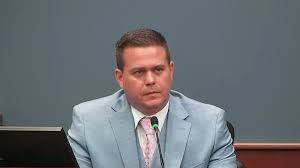
Georgia v. A.J. Scott: The Speeding Trooper Homicide Case
A state trooper driving 91 mph killed two teenage girls. Nearly a decade later, the families are still waiting for justice.
By Steven Askin | Justice Is A Process
The Defendant
Anthony James "A.J." Scott
Age: 40
Former Occupation: Georgia State Patrol Trooper (2011-2015)
Current Position: Mayor of Buchanan, Georgia
Military Service: U.S. Marine Corps (2007-2011), including deployment to Fallujah, Iraq
The defendant is presumed innocent until proven guilty in a court of law.
Welcome to Justice Is A Process. I'm Steven Askin, and this case is one that's haunted me since I first read about it.
Two teenage girls are dead. A state trooper was behind the wheel. And for nearly a decade, the families of Kylie Lindsey and Isabella Chinchilla have been fighting through a system that seemed designed to protect one of its own.
This is a case that raises every question we care about at Justice Is A Process. What happens when law enforcement officers become defendants? Does the system that usually protects them suddenly become interested in justice? Or does the badge provide a layer of protection that ordinary citizens will never receive?
Before we watch a single minute of trial footage together, you need to understand something: Anthony James "A.J." Scott has not been found guilty of anything. He is presumed innocent. That's not just a legal formality I'm required to say. That's the entire foundation of what we do here. The presumption of innocence exists because we've seen what happens when the system decides someone is guilty before the evidence is presented.
I believe in that presumption. I believe it applies to everyone, including former law enforcement officers. I believe the prosecution has the burden of proving their case beyond a reasonable doubt, and I believe defense attorneys have an absolute right to vigorously defend their clients.
But here's the thing about this case that makes it so important to watch: this is a case about whether the rules apply equally to everyone. When a state trooper is accused of causing a deadly crash, does the system hold him accountable the same way it would hold you or me? Or does the badge provide a layer of protection that ordinary citizens don't get?
We're going to find out together.
I want to prepare you for what we're about to cover. This case involves the deaths of two teenage girls. It involves devastating injuries to two teenage boys. It involves dashcam footage that's difficult to watch. It involves body camera audio from the scene that's difficult to hear. This is not entertainment. This is education about how the system works, or fails to work, when tragedy strikes.
If you're here to learn, to understand, to watch the process unfold, welcome. Let's do this together.
Part One: September 26, 2015
A Saturday Night in Carroll County
The rain had been falling on and off all evening in Carroll County, Georgia. It was late September, but the summer heat hadn't fully released its grip on west Georgia. The roads were slick. Visibility was limited.
Trooper Anthony James Scott was working the midnight shift, though he'd clocked in around 10 PM. He was assigned to patrol Carroll and Douglas counties, a sprawling rural area about 55 miles west of Atlanta, near the Georgia-Alabama line.
Scott was 26 years old. He'd been a trooper with the Georgia State Patrol since 2011, joining shortly after completing his service in the United States Marine Corps. He'd served from 2007 to 2011, including a deployment to Fallujah, Iraq. By all accounts, he'd come home wanting to continue serving in a law enforcement capacity. He'd worked posts in Thomaston, Jasper, and Villa Rica before settling into his regular trooper assignment in the Carroll County area.
That night, something mundane was on his mind: his body-worn radio had a dead battery. He'd left it with a Bremen police officer who'd offered to charge it. At some point during his shift, Scott decided to drive to Bremen to retrieve it.
There was no emergency call. No pursuit. No urgent situation requiring immediate response.
He was just driving.
The Intersection
U.S. Highway 27 runs north-south through Carroll County. It's a major thoroughfare, four lanes in places, with periodic intersections that require careful navigation, especially at night. One of those intersections is Holly Springs Road, just outside the town of Bremen.
Approaching that intersection from the south, the road climbs a hill. The posted speed limit drops from 55 mph to 45 mph as drivers approach, a recognition that visibility is limited as vehicles crest the hill and descend toward the intersection.
Around 11:30 PM, a silver 2005 Nissan Sentra was heading south on Highway 27. Inside were four teenagers, all students or recent graduates from schools in Paulding County, about 20 miles east of where they found themselves that night.
Dillon Wall, 18, was behind the wheel. He was the only one wearing a seatbelt. In the passenger seat was Benjamin Finken, 17. In the backseat were two girls who'd been best friends since childhood: Isabella "Bella" Chinchilla, 16, and Kylie Lindsey, 17.
They were approaching the intersection with Holly Springs Road. Dillon Wall was preparing to make a left turn.
The Collision
What happened next took only seconds.
According to data recovered from the "black box" recorder in Scott's patrol vehicle, a 2008 Dodge Charger, the trooper was traveling at approximately 90 miles per hour as he crested the hill approaching the intersection. That's nearly double the posted 45 mph limit for that stretch of road, and 35 mph over the enforceable 55 mph limit.
His emergency lights were not activated. His siren was not on. He was not responding to a call.
The Nissan Sentra, weighing approximately 2,638 pounds, had begun its left turn across Highway 27 onto Holly Springs Road. Scott's Dodge Charger, weighing approximately 4,281 pounds, was bearing down on them from the north.
Did Dillon Wall see the patrol car coming? Could he have seen it? At 90 miles per hour, objects appear in your field of vision and close distance with terrifying speed. A vehicle traveling at that rate covers 132 feet per second. If Wall looked, if he saw headlights cresting that hill, how much time did he have to process what was happening?
Scott hit the brakes. The data shows he was traveling approximately 65 mph at the moment of impact.
The patrol car struck the Nissan Sentra on the passenger side with devastating force.
The Immediate Aftermath
The scene was chaos.
Kylie Lindsey, who had been in the backseat, was ejected from the vehicle. First responders would find her lying on the roadway on Holly Springs Road, severely injured, with visible bruising around her eyes and blood coming from her mouth.
Isabella Chinchilla remained trapped in the wreckage.
Dillon Wall, the driver, was found standing near the vehicle, dazed and covered in blood. He had suffered a fractured skull. Benjamin Finken was motionless inside the vehicle, also bleeding heavily, also with a skull fracture. Both boys had sustained traumatic brain injuries that would affect their memories of the night's events.
Trooper Scott was bloodied but ambulatory. He was treated at Tanner Medical Center in Carrollton and released.
Body camera footage from Bremen Police Corporal Joseph Alexander, one of the first officers on scene, captured Scott's immediate statements. The recording is difficult to listen to.
"I was making the left turn right there," Scott said.
Alexander asked: "And you didn't see him?"
Scott responded: "I saw them, I tried to, I went right when I should have went damn left."
Alexander then asked the questions that would define the next decade of legal proceedings: Were you running lights and sirens? Were you going to a call?
Scott's answer to both questions: "No."
The Losses
Kylie Hope Lindsey was transported to a trauma center. Her injuries were catastrophic. She would not survive.
Isabella Alise Chinchilla died at the scene.
Both girls were students at South Paulding High School. Kylie was a senior, 17 years old, known for her infectious smile and her kindness. Her friends would later describe her as the type of person who made you want to be a better person just by being around her. Isabella was a junior, 16 years old, described by family members as having big dreams and bigger goals.
They were best friends. They had their whole lives ahead of them.
On Thursday, October 1, 2015, their funerals were held hours apart at West Ridge Church in Dallas, Georgia. Hundreds of mourners attended both services.
Dillon Wall and Benjamin Finken survived, but both suffered traumatic brain injuries that would leave lasting impacts. Finken would later testify that he remembers almost nothing about that night. Wall's injuries were so severe that he was combative during transport to the hospital, a common symptom of traumatic brain injury.
The families of all four teenagers were left to grapple with an unimaginable reality. Two of their children were dead. Two others were forever changed. And the man who crashed into them was a state trooper.
Part Two: The Investigation and Firing
The Georgia State Patrol Responds
In the days following the crash, the Georgia State Patrol's Specialized Collision Reconstruction Team conducted its investigation. This specialized unit handles the most serious crashes involving GSP vehicles and personnel. Their job is to determine exactly what happened, using all available data and forensic analysis.
The team analyzed multiple sources of evidence:
The Patrol Car's "Black Box": Modern patrol vehicles are equipped with what's essentially an automotive equivalent of an airplane's flight recorder. This data logger captures information about the vehicle's speed, RPMs, braking, acceleration, and other telemetry, broken down into fractions of a second. The data from Scott's Dodge Charger would prove crucial. It provided an objective, indisputable record of how fast he was traveling in the seconds before impact.
The Dashcam Footage: Scott's patrol car was equipped with a forward-facing dashboard camera that recorded the moments leading up to and including the collision. This footage would become a central piece of evidence, providing a visual record of what Scott saw, or should have seen, in the seconds before impact. The video ends with the moment of collision. It's difficult to watch.
Physical Evidence at the Scene: Investigators documented the crash site extensively. The crushed Nissan Sentra. The damaged patrol car. The debris field. The blood on the roadway. The broken glass. The position of the vehicles after impact. Every detail was photographed, measured, and analyzed. The physical evidence told a story of a devastating collision, the kind of impact that occurs when a heavy vehicle traveling at high speed strikes a lighter vehicle making a turn.
Witness Statements: Officers interviewed everyone who was present at the scene, including Scott himself. The body camera recording from Corporal Joseph Alexander captured Scott's initial statements. Christopher Butler, a civilian who had been driving home when he witnessed the collision, also provided a statement. First responders described the scene they encountered, the injuries they observed, the chaos of those first moments.
Vehicle Dynamics Analysis: Crash reconstructionists calculated the physics of the collision. The Nissan Sentra weighed approximately 2,638 pounds. Scott's Dodge Charger weighed approximately 4,281 pounds. When a vehicle nearly twice the weight of another strikes it at highway speed, the results are catastrophic. The analysis would show exactly how the collision unfolded, the angle of impact, the forces involved, and the resulting damage to both vehicles and their occupants.
The Data Tells the Story
The findings were damning.
The data confirmed that Trooper Scott had been driving approximately 91 miles per hour just five seconds before impact. As he approached the intersection, the speed limit dropped from 55 mph to 45 mph, a reduction designed to account for the limited visibility as drivers crest the hill approaching Holly Springs Road. Scott was traveling at nearly double that reduced limit.
Let's think about what 90 miles per hour means in practical terms. At that speed, a vehicle covers 132 feet per second. That's 44 yards in the time it takes to blink. If someone making a turn sees headlights cresting a hill, they have almost no time to react before that vehicle is upon them.
Even after he applied his brakes, Scott was still moving at approximately 65 mph at the moment of impact. That's still 20 mph over the reduced speed limit, still traveling at a rate that made the collision devastating. The force of the impact was enough to eject Kylie Lindsey from the vehicle.
The investigation also confirmed what Scott himself had admitted at the scene: He was not responding to an emergency call. He was not using his lights or sirens. He had no dispatch-authorized reason to be traveling at that speed.
Why Was He Speeding?
This question would haunt the case for nearly a decade. If Scott wasn't responding to an emergency, why was he driving 90 miles per hour through a rainy night on a road with limited visibility?
According to testimony that would later emerge, Scott had been behind on paperwork. He'd been written up for not completing crash reports on time. That night, he said he was driving to Bremen to retrieve his body-worn radio, which another officer had offered to charge because the battery was dead. There was no urgency. No emergency. Just a routine errand.
Think about that. A dead radio battery. That's what he was doing. That's why he was driving 90 miles per hour. To pick up a radio.
The investigation also examined whether Scott's training should have prevented this crash. All Georgia State Patrol troopers undergo Emergency Vehicle Operator Courses (EVOC), which specifically train officers on high-speed vehicle operation, including when it's appropriate to exceed speed limits and how to manage the increased risks that come with high-speed driving.
The training emphasizes that speed reduces reaction time, that officers must be prepared for unexpected obstacles, that the laws of physics don't care about badges. Troopers are taught that even in emergency situations, the risk of high-speed driving must be weighed against the risk to public safety. And when there's no emergency? When you're just driving to pick up a radio? There's no justification at all.
Scott had received this training. Multiple times. He knew, or should have known, the dangers of what he was doing.
Brandon Stone, a retired GSP trooper who specialized in crash reconstruction and EVOC training, would later testify that the training teaches troopers how to avoid collisions, how to assess risk, how to operate vehicles safely even at high speeds when circumstances require it. The circumstances that night didn't require it.
The Firing
On October 7, 2015, eleven days after the crash, the Georgia State Patrol fired Anthony James Scott.
The GSP's decision was straightforward: Scott had violated department policies regarding vehicle operation. He was speeding excessively with no justification. He was not using emergency lights or sirens. He was not responding to a dispatch. He had no authorized reason to be traveling at that speed. His conduct had resulted in the deaths of two people and the serious injury of two others.
The firing was unusual in its swiftness. Law enforcement agencies typically conduct lengthy internal investigations before taking disciplinary action. The fact that the GSP moved so quickly to terminate Scott's employment suggested the evidence was overwhelming.
For Scott's former colleagues, for the families of the victims, and for the community watching, the firing seemed to acknowledge what was obvious: something had gone terribly wrong that night, and Scott was responsible.
But being fired is not the same as being held criminally accountable. Losing your job is an administrative consequence. Going to prison is a criminal one. The families would soon learn that the system treats these very differently, especially when the accused is someone who used to wear a badge.
The Alcohol Question
Before we go further, we need to address something that would become central to the defense's strategy in this case: the presence of alcohol in the teenagers' vehicle.
First responders at the scene reported smelling alcohol. Crash scene photos showed broken beer bottles scattered around the Nissan Sentra, packaging for Bud Lime visible near the wreckage. One investigator described the smell of alcohol "permeating" the vehicle.
This evidence raised obvious questions. Were the teenagers drinking that night? Was Dillon Wall impaired when he made the left turn?
Here's what the investigation determined: Dillon Wall did not have alcohol in his system. The Georgia State Patrol's Nighthawks DUI Task Force, which specializes in impaired driving investigations, found insufficient evidence to charge Wall with DUI. Despite the presence of alcohol containers in the vehicle, there was no probable cause to believe the driver was intoxicated.
We'll likely see the defense make much of those beer bottles. We'll see arguments that the teenagers were drinking, that their judgment was impaired, that Wall failed to yield properly.
But remember what the investigation actually found. And remember who was driving 90 miles per hour through that intersection.
Part Three: The Fight for Indictment
The First Grand Jury
What happened next is where this case becomes a study in how the system sometimes works differently when the accused wears a badge.
Criminal charges don't automatically follow from a tragic accident, even a fatal one. A prosecutor must present evidence to a grand jury, which decides whether there's probable cause to believe a crime was committed. If the grand jury returns an indictment, the case proceeds to trial. If they don't, there are no criminal charges.
On February 17, 2016, nearly five months after the crash that killed Kylie Lindsey and Isabella Chinchilla, a Carroll County grand jury declined to indict Anthony Scott.
No charges. No trial. No accountability.
The families were devastated. Two days after the grand jury's decision, more than 60 people gathered outside the Carroll County Courthouse, holding signs, demanding justice for Kylie and Isabella.
Think about that for a moment. A state trooper drives 90 miles per hour through an intersection, not responding to a call, no lights or sirens, and kills two teenage girls. The State Patrol fires him. And a grand jury decides there's not even enough evidence to bring charges?
The system was telling the families that what happened to their daughters wasn't a crime.
The Second Grand Jury
The families didn't give up. They couldn't.
In November 2016, the case was presented to a different grand jury. This time, Scott was indicted, but only on misdemeanor charges: speeding and reckless driving.
It was something, but it felt like an insult. Two young women were dead, and the most serious charges prosecutors could bring were misdemeanors?
But even those charges didn't survive. A judge later threw out the indictment.
The Third Grand Jury
On August 31, 2017, nearly two years after the crash, a third grand jury finally returned a substantive indictment against Anthony James Scott.
The charges:
Two counts of second-degree vehicular homicide (misdemeanors)
Two counts of serious injury by vehicle (felonies)
Violation of oath of office
Speeding
Reckless driving
Scott pleaded not guilty to all charges.
It had taken three grand juries, two years of waiting, and relentless pressure from the victims' families to get to this point. But finally, there would be a trial.
Or so everyone thought.
Part Four: The First Trial and Mistrial
Trial Begins: May 2019
On May 13, 2019, nearly four years after the crash, Anthony James Scott's trial began in Carroll County Superior Court before Judge John Simpson.
The wait had been agonizing for the families. They'd watched Scott move on with his life while they were frozen in grief. Just six weeks after the crash that killed their daughters, Scott had been elected to the Buchanan City Council. He'd rebuilt his public image. He'd become a local political figure.
Now, finally, he would face a jury.
The prosecution's case was straightforward: Scott was driving recklessly, at nearly double the speed limit, with no emergency justification, and he killed two people and seriously injured two others as a result. His own words at the scene, his own patrol car's data recorder, his own dashcam footage would tell the story.
The defense's strategy was equally clear: blame the driver of the other vehicle. Dillon Wall failed to yield. The teenagers had alcohol in the car. This was a tragic accident, not a crime.
The Withheld Evidence
What happened next would derail the entire proceeding.
During the trial, Scott's defense attorney, Mac Pilgrim, discovered that prosecutors had not disclosed certain evidence to the defense before trial. Specifically, there was a theory developed by Georgia State Patrol investigators about where Kylie Lindsey may have been seated in the vehicle.
The theory, developed by GSP investigators Chad Barrow and Brandon Stone, suggested that Kylie might have been in the front seat, perhaps sitting in the lap of the front passenger or positioned between the front seats, rather than in the backseat where she was believed to have been. The investigators had examined enhanced dashcam footage and believed they could see a "white image" in the front seat area. Kylie had blonde hair.
Why did this matter? Because if Kylie had been positioned in the front seat, she might have blocked the driver's view of the oncoming patrol car. It could potentially support the defense's argument that Dillon Wall was responsible for the crash because he couldn't see Scott approaching.
The defense argued that prosecutors had violated their constitutional obligation under Brady v. Maryland to disclose potentially exculpatory evidence. This wasn't about whether the theory was right or wrong. It was about whether Scott's defense team had the right to know about it, to investigate it, to cross-examine witnesses about it.
On May 24, 2019, Judge Simpson granted the defense's motion for mistrial.
The families were devastated. Again. Four years of waiting, and now they would have to start over.
Legal Chaos: Judge vs. Prosecutor
What followed the mistrial was a legal battle that threatened to bury the case entirely. It became a conflict between two powerful figures in the Carroll County legal system, with the victims' families caught in the middle.
Judge Simpson was furious with the prosecutors. He didn't just grant the mistrial. He took the extraordinary step of filing motions suggesting that the prosecutors be held in criminal contempt of court, accusing them of lying to the defense about the evidence.
Simpson ordered Carroll County District Attorney Herb Cranford and two assistant district attorneys, Lara Myers and Matthew Swope, to appear at a hearing scheduled for July 10, 2019. The purpose: to determine whether their conduct during the trial amounted to criminal contempt of court.
Think about the implications of that. A judge was considering holding prosecutors in criminal contempt, potentially facing sanctions or even criminal charges, for how they handled a case against a former law enforcement officer.
The prosecutors fired back. On July 8, 2019, just two days before the contempt hearing was scheduled, Cranford's legal team filed an emergency motion with the Georgia Court of Appeals to halt the proceeding. They argued that Judge Simpson had become biased against the prosecution and could no longer fairly oversee the case.
Cranford's position was that the prosecution hadn't intentionally withheld anything. They said the alternative seating theory had been quickly discounted after reviewing the facts and that they'd turned over all evidence in their file. They maintained that Kylie Lindsey was, in fact, in the backseat at the time of the crash, just as initially believed.
"Shame on them. It should have been. We should have known that someone brought a theory that my daughter may have been sitting up front because we could have looked at that and looked into it and put a stop to it because she wasn't."
— Kellie Lindsey, Kylie's mother
The families were caught in the crossfire. They knew their daughter. They knew where she had been sitting. The alternative theory, they believed, was baseless. But now that baseless theory had become the centerpiece of a legal battle that was delaying justice even further.
The Stalemate Breaks
The case remained in legal purgatory for months. Two powerful figures in the Carroll County legal system were at war, and neither seemed willing to back down.
On August 28, 2019, Gary Bunch, an attorney representing the victims' families, filed a motion asking Judge Simpson to appoint a new prosecutor so that the case could proceed. The families were trying to find any way out of the stalemate.
Finally, in September 2019, both Judge Simpson and District Attorney Cranford recused themselves from the case. The legal dispute between them had made it impossible for either to continue fairly. The appeals to the Georgia Supreme Court were withdrawn. The case would get a fresh start, with new players.
Georgia Attorney General Chris Carr appointed the DeKalb County District Attorney's Office, under Sherry Boston, to take over the prosecution. Senior Assistant District Attorney Heather Waters was assigned to the case.
But the damage was done. The trial was over. The case had been mired in legal warfare for months. And the families were left to wonder if justice would ever come.
Four years after two teenage girls were killed by a speeding trooper, they were back at square one.
Part Five: A.J. Scott Becomes Mayor
The Campaign
Here's where this story takes a turn that still makes my blood boil.
Just three months after his trial ended in mistrial, while still facing potential retrial on charges of killing two teenagers, A.J. Scott announced he was running for mayor of Buchanan, Georgia.
Buchanan is a small town, about 1,000 residents, serving as the county seat of Haralson County. It's located about 55 miles west of Atlanta, near the Georgia-Alabama line. Scott had been on the city council there since 2015, elected just weeks after the crash.
His campaign slogan? "Focused on our future."
"AJ has no shame. His campaign sign says 'Focused on our future.' What about Kylie and Isabella's future? It's almost as if he is taunting us."
— Kellie Lindsey, Kylie's mother
Allen Lindsey, Kylie's father, believed Scott's political ambitions were strategic. "Absolutely I do believe that's the reason he's continuing to go further into politics," he said. He suspected Scott was trying to build political clout to avoid being retried.
It's worth stopping here to consider what we're watching. A man awaiting potential retrial for killing two teenagers decides to run for political office. He's not lying low. He's not showing remorse. He's asking his community to elevate him to a position of public trust and authority.
And in 2019, the people of Buchanan elected him mayor.
Re-election
In 2023, with the retrial still pending, Scott ran for re-election.
He won again, 62 votes to 50.
By this point, the victims' families had been waiting nearly eight years for accountability. They'd watched Scott go from fired trooper to city councilman to mayor, all while avoiding trial for the deaths of their daughters.
"He's not fit to be a mayor. I think AJ is not thinking about anybody but himself. He thinks he's above the law."
— Leslie Woods, Isabella's mother
Troubling Behavior
In 2022, while serving as mayor and still awaiting retrial, Scott became the subject of another investigation.
According to police incident reports obtained by media outlets, on September 15, 2022, an employee at a Bremen bar called the Buchanan police department asking for help. The bar was trying to close, but Mayor Scott was "very intoxicated" and kept trying to buy more alcohol.
The sole Buchanan police officer on duty drove six miles outside of town to retrieve the mayor from the bar. According to the officer's report, bar employees said Scott "was being rude and got up on the bar and started unzipping his pants." Other employees later said he hadn't actually exposed himself.
The officer gave Scott a ride home. The next day, Scott called the police chief asking for a ride back to Bremen to pick up his car. The chief noted that Scott "had a strong odor of alcohol coming from his person."
Twelve days earlier, on September 3, 2022, another police report documented a strange incident. Scott had called police from a park behind city hall late at night. According to the officer's report, Scott "was slurring his words" and claimed that a black SUV had dropped off eight people who were running around the park, and someone had a motorcycle.
The officer found no one in the park. He noted that Scott had his pocketknife out with the blade open, that he could "smell a strong odor of an alcoholic beverage coming from him," and that Scott "was speaking very slurred." The officer noted he "was definitely much more cautious since he had his knife out and was seeing people that could not be explained."
The City of Buchanan hired an outside investigator to look into the mayor's conduct. No disciplinary action was taken.
The families of Kylie Lindsey and Isabella Chinchilla were watching all of this.
"I'm just afraid it's going to take him killing someone else before he's stopped."
— Kellie Lindsey
Part Six: The Road to Retrial
Years of Waiting
After the mistrial in 2019, the case entered a legal purgatory that would last for years.
The recusals of Judge Simpson and DA Cranford meant new players had to be brought in. The Georgia Supreme Court had to clear the way for a special prosecutor to retry the case. There were appeals and procedural battles that moved at the glacial pace of a system not particularly motivated to hold one of its own accountable.
Meanwhile, the families waited.
October 1, 2015 came and went. Then 2016. Then 2017. Every year, on the anniversary of the crash, on the anniversary of the funerals, on the birthdays their daughters would never celebrate, the families were reminded of what had been taken from them.
Isabella's bedroom remained untouched, exactly as she'd left it, "as if she was still there," her mother said.
Dillon Wall, the driver who survived, carried the weight of blame the defense had placed on him. He'd suffered a traumatic brain injury that left him with little memory of the crash. But he remembered being blamed. He remembered being told it was his fault.
Benjamin Finken, the other survivor, lived with the same physical and psychological scars.
The Delayed Retrial
Finally, a retrial was scheduled for April 2025. Nearly a decade after the crash.
But then another delay. Defense attorney Mac Pilgrim suffered a stroke and required medical leave. The trial was pushed back to August.
The families had learned long ago not to believe any date on the calendar until they were actually sitting in the courtroom.
The Charges
As the 2025 retrial approached, here's what A.J. Scott faced:
Two counts of second-degree vehicular homicide
Two counts of serious injury by vehicle
Violation of oath of office
Speeding
Reckless driving
If convicted on all charges, he faced up to 30 years in prison.
The felony charges, serious injury by vehicle, each carry a maximum sentence of 15 years. The misdemeanor charges carry up to one year each.
A plea deal was reportedly offered at some point during the years of legal proceedings. According to reports, Scott was offered 15 years with 8 years to serve in prison. He rejected it.
Whether that was confidence in his innocence, faith in his defense, or something else entirely, we can't know. What we do know is that he chose to take his chances with a jury.
Part Seven: Understanding the Legal Landscape
What the Prosecution Must Prove
Let's talk about what actually has to happen for Scott to be convicted.
For the vehicular homicide charges, the prosecution must prove that Scott's driving was "reckless" and that this recklessness caused the deaths of Kylie Lindsey and Isabella Chinchilla.
Under Georgia law, a person is "reckless" when they show a "conscious disregard of a substantial and unjustifiable risk." The prosecution will argue that driving 90 mph in a 55 mph zone, at night, on wet roads, without emergency lights or sirens, while not responding to any call, constitutes exactly that kind of conscious disregard for the safety of others.
For the serious injury by vehicle charges, the prosecution must prove essentially the same thing, but connected to the injuries suffered by Dillon Wall and Benjamin Finken rather than the deaths.
For violation of oath of office, the prosecution must prove that Scott violated his duty as a public officer. This charge acknowledges that Scott wasn't just any driver. He was a sworn law enforcement officer, entrusted with the responsibility to uphold the law, not break it.
What the Defense Will Argue
Based on the 2019 trial and pre-trial proceedings, we can expect the defense to pursue several lines of argument:
The failure-to-yield argument: Defense attorney Mac Pilgrim has consistently argued that Dillon Wall failed to yield when making his left turn. Under Georgia traffic law, a vehicle making a left turn must yield to oncoming traffic. The defense will argue that Wall pulled into the path of Scott's patrol car and bears responsibility for the collision.
The alcohol argument: Despite the investigation finding no evidence that Wall was impaired, the defense will likely emphasize the presence of alcohol in the teenagers' vehicle. The broken beer bottles, the smell at the scene, these details will be used to suggest the teenagers exercised poor judgment that night.
The speed-isn't-recklessness argument: The defense may argue that while Scott was clearly speeding, speeding alone doesn't equal reckless driving. They may point to testimony about road conditions, visibility, and other factors to argue that Scott was operating his vehicle with care despite his speed.
The "tragic accident" framing: Ultimately, the defense wants the jury to see this as a terrible accident, not a crime. Two kids made a turn without seeing an oncoming car. The trooper couldn't stop in time. It's tragedy, not murder.
What Juries Must Consider
If you're watching this trial with us, here's what I want you to think about:
The burden of proof is on the prosecution. Scott is presumed innocent unless and until the state proves its case beyond a reasonable doubt. That's not a formality. That's the foundation of everything we do here.
But the jury will also have to grapple with a fundamental question: Does the badge matter?
If an ordinary citizen had been driving 90 mph through that intersection, not responding to any emergency, and killed two teenagers, what would happen to them? Would three grand juries have failed to indict? Would they have been elected mayor while awaiting trial? Would the case have dragged on for nearly a decade?
The law says everyone is equal. The badge isn't supposed to provide protection. The oath Scott swore as a law enforcement officer isn't supposed to be a shield, it's supposed to be an obligation.
Whether the system lives up to those principles is what we're going to watch together.
Part Eight: The Victims and Survivors
Kylie Hope Lindsey
Kylie was 17 years old when she died. She was a senior at South Paulding High School in Paulding County, Georgia, looking forward to graduation and everything that would come after. She lived in Dallas, Georgia, a small city in northwest metro Atlanta.
Her friends described her smile as "contagious." They said she had a way of making everyone around her feel valued, important, loved. "Her love for everybody and everyone she met and her friends were the type of thing that made you want to be a better person," one friend told reporters after the crash, "because she was just that way."
The school community was devastated by her loss. The Paulding County School District sent grief counselors to South Paulding High in the days following the crash. Students gathered, mourned, and tried to make sense of the senseless. Pink crosses appeared at the crash scene as a memorial, a reminder to everyone who drove past of the lives lost there.
Kylie was the daughter of Kellie and Allen Lindsey.
Kellie Lindsey has been the most visible advocate for her daughter. For ten years, she has fought for accountability. She's been in courtrooms, at protests, on camera, never letting the system forget Kylie. She's watched the man who killed her daughter get elected to public office. She's waited through delays and mistrials and legal maneuvering that seemed to have no end.
"I didn't ever plan for it to be this long. And it has been horrific."
— Kellie Lindsey
At every hearing, at every court date, Kellie has been there. She's refused to let the system forget what happened. She's refused to let Scott's public rehabilitation erase her daughter's memory.
Isabella "Bella" Alise Chinchilla
Isabella was 16 years old. A junior at South Paulding High School. Best friends with Kylie since childhood.
She lived in Hiram, Georgia, another community in Paulding County. Her family called her Bella. She had goals, dreams, plans for the future that she would never get to pursue.
Her mother, Leslie Woods, has been equally relentless in demanding justice. She's described the pain of walking past Isabella's bedroom, which remains exactly as her daughter left it.
"Everything sits in her room as if she was still there."
— Leslie Woods, Isabella's mother
"She had goals, she had dreams," Leslie has said to the court, directing her words at Scott. "You took it away."
The two mothers, Kellie and Leslie, have become close over the years. They've supported each other through every delay, every disappointment, every moment when the system seemed determined to protect the man who killed their daughters. United in grief and determination, they've refused to give up, refused to let the system grind them down, refused to accept that two teenage lives could be ended without consequence.
The Funerals
On Thursday, October 1, 2015, five days after the crash, the funerals for Kylie and Isabella were held hours apart at the same church: West Ridge Church in Dallas, Georgia.
Isabella's service was at 10:00 AM. Kylie's was at 3:00 PM.
The church was packed for both services. Classmates, teachers, family members, community members who'd never met the girls but felt the weight of their loss. They were teenagers. They were supposed to have their whole lives ahead of them.
Dillon Wall
Dillon was 18 years old that night. He was the driver. He was the only one wearing a seatbelt.
He survived the crash with a fractured skull and traumatic brain injury. The injuries were severe enough that he was "combative" during transport to the hospital, a common symptom of brain trauma that indicates significant damage.
His memory of the events is limited, a consequence of the brain trauma. When asked about the details of the crash, he can only say what he knows for certain: "Sir, I had a brain injury. I don't remember anything."
But he remembers what people have said about him.
For years, the defense strategy has been to blame Dillon for the crash. He failed to yield. He should have seen the patrol car. He pulled into oncoming traffic. The presence of alcohol in the vehicle, even though Dillon was not found to be impaired, has been used to cast doubt on his judgment, his driving, his responsibility.
Dillon has lived with that blame while recovering from injuries that changed his life forever. He lost two friends that night. He nearly lost his own life. And then he spent years being told it was his fault.
"I got victim blamed for 10 years," he has said.
Benjamin Finken
Benjamin was 17, a passenger in the front seat. He also suffered a fractured skull and traumatic brain injury.
Like Dillon, his memory of the crash is limited. "Sir, I had a brain injury, I don't remember anything," he testified in the first trial when asked about the events of that night.
He saw headlights. Then he woke up in a hospital.
Both young men have had to rebuild their lives in the shadow of that night, carrying physical and psychological scars that will never fully heal.
Part Nine: The System on Trial
Why This Case Matters
I've covered a lot of trials. Cases where the defendant is clearly guilty. Cases where the evidence is weak. Cases where reasonable people could disagree about what happened.
This case is different.
The facts aren't really in dispute. A.J. Scott was driving 90 mph. He wasn't responding to a call. He didn't have his lights or sirens on. He hit a car full of teenagers. Two of them died. Two others were catastrophically injured.
His own patrol car recorded his speed. His own dashcam captured the collision. His own words at the scene admitted he wasn't on an emergency call, wasn't running lights and sirens, "went right when I should have went damn left."
What IS in dispute is whether those facts constitute a crime, or whether they're just a "tragic accident" that can be blamed on a teenager who made a left turn.
And underlying all of it is a question that goes to the heart of how our system works: Does the badge protect you from accountability?
Two Systems of Justice?
Consider the sequence of events in this case:
A state trooper kills two teenagers while driving 90 mph, not responding to any emergency. The State Patrol fires him. But then:
Three grand juries have to be convened before an indictment is returned. The first two decline to charge him with anything.
When a trial finally happens, it ends in mistrial due to an evidentiary dispute.
The judge and prosecutor end up at war with each other, both recusing from the case.
The defendant, while awaiting retrial on charges of killing two teenagers, runs for mayor and wins. Twice.
Nearly a decade passes before the case comes to trial again.
Now ask yourself: If you or I had been driving 90 mph and killed two teenagers, would it have taken three grand juries to get charges? Would we have been elected to public office while facing those charges? Would the case have dragged on for nearly a decade?
This isn't a rhetorical question. It's the central question this case poses.
Our system promises equal justice under law. It promises that the rules apply to everyone, regardless of who they are or what job they hold. The badge a law enforcement officer wears is supposed to represent a commitment to uphold the law, not a license to break it.
But too often, when officers become defendants, the system seems to treat them differently. The benefit of the doubt that should go to any defendant sometimes feels like more than the benefit of the doubt. It can feel like protection.
The Constitutional Stakes
Every criminal case implicates the Constitution. The presumption of innocence. The burden of proof. The right to a fair trial. Due process of law.
These protections exist because we know what happens when the state is unchecked. We know what happens when the government can convict people without proof, punish people without trials, decide guilt based on who someone is rather than what they did.
The protections apply to A.J. Scott just as they apply to anyone. He's entitled to the presumption of innocence. He's entitled to a fair trial. He's entitled to make the prosecution prove its case beyond a reasonable doubt.
But here's the thing about constitutional protections: they only have meaning if they apply equally. If some defendants get more protection than others, then the promise of equal justice is hollow.
This case is a test. Does A.J. Scott get a fair trial? He should. Do the victims and their families get justice? That's what we're watching to find out.
My Father's Story
My father, Steven M. Askin, was a criminal defense attorney in West Virginia. He spent his career fighting for people who the system wanted to crush, holding police and prosecutors and judges accountable when they cut corners or violated rights.
The system destroyed him for it. Twice.
In 1994, he went to prison for refusing to violate attorney-client privilege. Federal investigators wanted him to testify about his clients based on surveillance he believed was unconstitutional. He stood on principle. He refused. They held him in contempt. He was indicted for criminal contempt. He lost his appeal. He took a plea. He served seven months at FCI Cumberland, Maryland. The West Virginia Supreme Court disbarred him.
Then he rebuilt. He became what he called a "street lawyer," helping people from coffee shops, teaching them their rights, showing them how to fight back against a system that didn't want them to fight back. He did it for free, or for whatever they could afford. He did it because he believed that due process and the presumption of innocence aren't just for people who can pay.
In 2006, he applied to have his law license reinstated. A three-member panel voted 3-0 to recommend reinstatement with conditions. But one panel member died before the decision was finalized. The new court composition denied reinstatement with no reasoning, just three paragraphs. It crushed him.
Then came what should have been redemption. Mountain State University recruited him to build West Virginia's first online law school. They would fund his reinstatement. He would be the founding dean, training young lawyers, teaching constitutional advocacy.
But in February 2009, on the morning he was supposed to get his license back, he was indicted on 11 counts of unauthorized practice of law. For helping people from a coffee shop.
A prosecutor opposed his reinstatement, stating she feared he would "disrupt the legal system" by training young lawyers the way he practiced, insisting on constitutional protections, demanding due process, protecting the presumption of innocence.
Think about that. A prosecutor was afraid that my father would train lawyers to do their jobs. To demand due process. To protect the presumption of innocence. To hold the system accountable.
He was convicted in what may have been West Virginia's first criminal UPL conviction. For helping people understand their rights.
The Connection
Why am I telling you my father's story in a case about a Georgia trooper?
Because that fear, the fear that someone might "disrupt the legal system" by demanding accountability, is the same fear at the heart of this case.
The system doesn't want to be accountable. It doesn't want to hold its own accountable. When a trooper kills two teenagers, the system's instinct is to protect the trooper, not the victims. That's why three grand juries were needed for an indictment. That's why the case has taken a decade. That's why Scott was able to build a political career while facing charges for killing two girls.
My father spent his life trying to make the system accountable. He was destroyed for it. But the work continues. Justice Is A Process is part of that continuation.
Every video we produce, every trial we cover, every word we write is part of building the machine my father tried to build, the one the system feared. A machine that watches. That questions. That refuses to let them operate in darkness.
This case matters because it tests whether the system will hold one of its own accountable. It matters because Kylie Lindsey and Isabella Chinchilla deserve an answer to that question. It matters because their families have spent a decade fighting for something the system should have provided automatically.
What We're Watching For
As we go through this trial together, here's what I'll be looking for:
Is the process fair? Is each side getting a fair opportunity to present their case? Are the rules being applied equally? Is the judge maintaining neutrality? Are evidentiary rulings consistent with how they'd be made in any other case?
Is the burden of proof being honored? The prosecution has to prove its case beyond a reasonable doubt. That's a high bar, intentionally so. We should watch to see if they meet it. We should also watch to see if the defense is held to the same standards as any other defense.
Is the defense playing by the rules? Defense attorneys have every right to vigorously advocate for their clients. Mac Pilgrim is doing his job when he argues for Scott. But there's a line between advocacy and deception. There's a line between presenting an alternative theory and blaming victims for their own deaths. We'll be watching to see where that line falls.
Are the victims being treated with dignity? Kylie and Isabella aren't here to speak for themselves. Dillon and Benjamin have lived with trauma for nearly a decade. How the system treats them, whether it respects their loss or dismisses it, tells us a lot about what kind of justice we can expect.
Does the badge matter? At the end of the day, this is the question. If A.J. Scott were just some guy driving 90 mph through that intersection, not a trooper, would we even be having this conversation? Would three grand juries have failed to indict? Would the case have taken nearly a decade to reach trial?
Part Ten: What Comes Next
The Trial
The trial takes place in Carroll County Superior Court in Carrollton, Georgia. Judge Erica Tisinger is presiding. Senior DeKalb County ADA Heather Waters is prosecuting. Mac Pilgrim represents the defense.
Jury selection was expected to take up to two weeks given how much publicity the case has received. More than a third of potential jurors, when polled, indicated they had heard, seen, or read things about the case. Several indicated they had already formed opinions.
Both sides will present their cases. Witnesses will testify. Evidence will be presented. The dashcam footage, the patrol car data, the body cam audio, the testimony of survivors and first responders.
And then a jury of twelve citizens will decide whether A.J. Scott is guilty of killing two teenage girls.
What Justice Looks Like
Here's the hardest part of covering cases like this: Sometimes there is no justice.
Kylie Lindsey and Isabella Chinchilla are gone. Nothing changes that. No verdict, no sentence, no amount of accountability brings them back.
Their families have spent nearly a decade fighting for something the system should have provided automatically: a fair reckoning with what happened that night.
If Scott is convicted, it won't erase the years of waiting, the pain of watching him elected to office, the frustration of a system that seemed determined to protect him.
If Scott is acquitted, the families will have to find a way to live with that, too.
Justice isn't revenge. It isn't about making someone suffer. It's about the system working the way it's supposed to work. It's about the rules applying to everyone, even those who wear badges. It's about honoring the lives that were lost by taking seriously what happened to them.
That's what we're watching for.
Join Me
I'm going to cover this trial the way my father covered trials: by paying attention, by asking questions, by refusing to let the system operate in darkness.
Every witness, every piece of evidence, every argument from both sides. We're going to watch it together. We're going to think about what it means. And we're going to honor Kylie and Isabella by demanding that the system treat their deaths with the seriousness they deserve.
This is Justice Is A Process. The process matters.
Let's watch.
Case Timeline
September 26, 2015
Trooper A.J. Scott, driving approximately 90 mph without emergency lights or sirens, collides with a Nissan Sentra at the intersection of Highway 27 and Holly Springs Road near Bremen, Georgia. Kylie Lindsey, 17, and Isabella Chinchilla, 16, are killed. Dillon Wall, 18, and Benjamin Finken, 17, are seriously injured.
October 1, 2015
Funerals for Kylie and Isabella are held hours apart at West Ridge Church in Dallas, Georgia.
October 7, 2015
Georgia State Patrol fires Scott after investigation determines he was driving 91 mph five seconds before impact while not responding to an emergency.
November 2015
Scott is elected to Buchanan City Council, six weeks after the crash.
February 17, 2016
First grand jury fails to indict Scott.
February 19, 2016
More than 60 people protest outside Carroll County Courthouse demanding justice.
November 2016
Second grand jury indicts Scott on misdemeanor charges of speeding and reckless driving. A judge later throws out the indictment.
August 31, 2017
Third grand jury indicts Scott on two counts of vehicular homicide, two counts of serious injury by vehicle, violation of oath of office, speeding, and reckless driving.
May 13, 2019
First trial begins before Judge John Simpson.
May 24, 2019
Judge Simpson declares mistrial, ruling prosecutors failed to disclose evidence about a theory regarding victim seating position.
September 2019
Both Judge Simpson and DA Herb Cranford recuse from the case. Georgia Attorney General Chris Carr appoints DeKalb County DA's office to prosecute.
November 2019
Scott elected mayor of Buchanan.
September 2022
Police reports document incidents involving Scott at a Bremen bar and Buchanan city park, raising questions about his conduct while awaiting retrial.
November 2023
Scott re-elected as mayor.
January 2025
Carroll and Heard counties split from Coweta Judicial Circuit, establishing West Georgia Judicial Circuit.
April 2025
Retrial postponed due to defense attorney Mac Pilgrim's medical leave.
August 2025
Retrial scheduled to begin.
The People
The Defendant
Anthony James "A.J." Scott, 40. Former Georgia State Patrol trooper. Former mayor of Buchanan, Georgia. U.S. Marine Corps veteran (2007-2011).
The Deceased Victims
Kylie Hope Lindsey, 17. Student at South Paulding High School. Resident of Dallas, Georgia.
Isabella "Bella" Alise Chinchilla, 16. Student at South Paulding High School. Resident of Hiram, Georgia.
The Survivors
Dillon Lewis Wall, driver. Suffered fractured skull and traumatic brain injury.
Benjamin Alan Finken, passenger. Suffered fractured skull and traumatic brain injury.
The Families
Kellie Lindsey, Kylie's mother
Allen Lindsey, Kylie's father
Leslie Woods, Isabella's mother
Legal Teams
Prosecution: Senior DeKalb County ADA Heather Waters
Defense: Attorney J. Mac Pilgrim
Judge: Superior Court Judge Erica Tisinger
The Charges
Two Counts of Second-Degree Homicide by Vehicle (Misdemeanor)
Related to the deaths of Kylie Lindsey and Isabella Chinchilla. Maximum penalty: 1 year per count
Two Counts of Serious Injury by Vehicle (Felony)
Related to the injuries of Dillon Wall and Benjamin Finken. Maximum penalty: 15 years per count
Violation of Oath of Office
Related to Scott's conduct as a sworn law enforcement officer
Speeding
Reckless Driving
Maximum possible sentence if convicted on all charges: 30+ years
Source Notes
This report draws on coverage from the following sources:
Court TV trial coverage and case summary
Atlanta Journal-Constitution reporting (2015-2025)
11Alive/WXIA-TV coverage
FOX 5 Atlanta reporting
WSB-TV Channel 2 coverage
Atlanta News First reporting
Times-Georgian (Carroll County) local coverage
The Georgia Gazette reporting
NBC News initial crash coverage
CBS News initial crash coverage
Georgia State Patrol statements and investigation findings
Carroll County court filings and docket information
Want More?
Subscribe to Justice Is A Process on YouTube for live trial coverage, No Breaks editions, and breaking news as it happens.