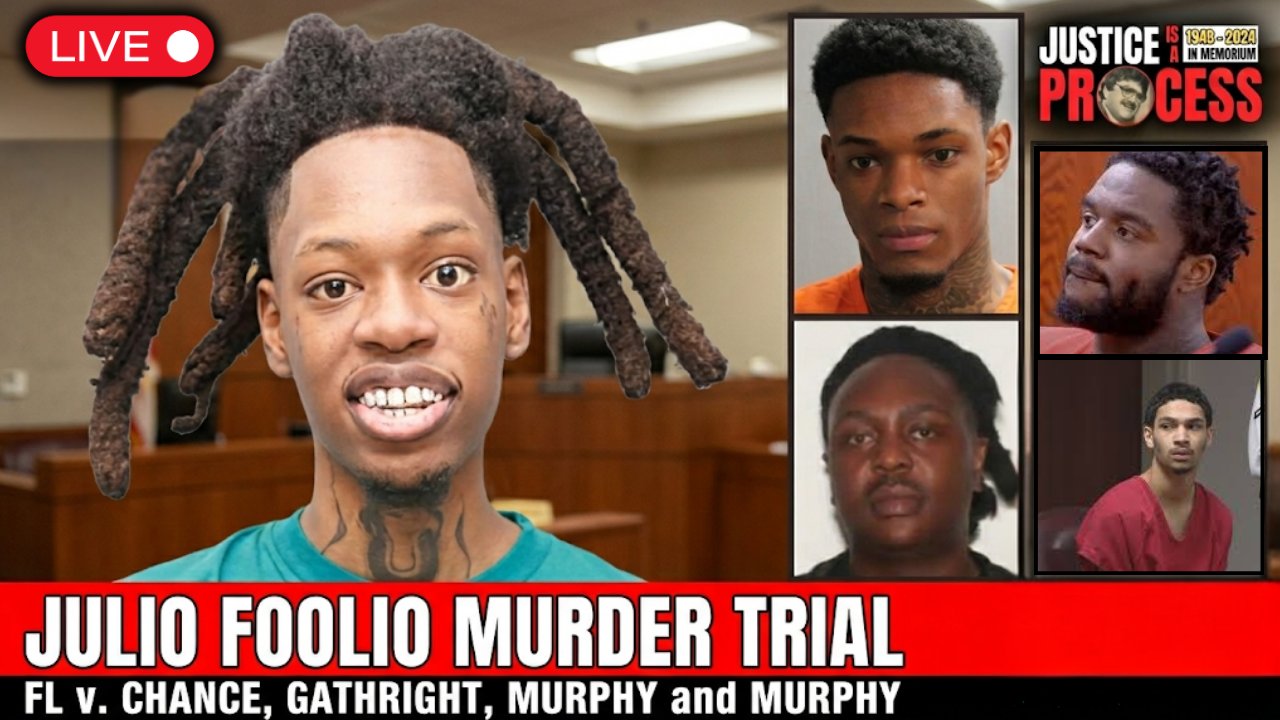
Four defendants. One jury. A death-penalty case built on the ghost of a manslaughter verdict.
April 2026 | Justice Is A Process
Charles Jones came to Tampa to celebrate turning twenty-six.
He told his followers where he’d be. Seven days of posts, an Instagram countdown to a nightclub called Teasers on June 22nd between 8pm and 3am. He had a birthday trip planned. An Airbnb rented for the weekend. A night out with his people. The kind of weekend any twenty-six-year-old might announce. Except Charles Jones was Julio Foolio, a Jacksonville drill rapper whose music had sat at the center of a years-long gang war that had already tried to kill him at least once. In October 2023, someone shot him in the foot. He survived. He kept posting. He kept recording. He kept being a father, a son, a man with a life that extended well beyond the beef his music was built on.
He did not survive his birthday.
Early on June 23, 2024, in the parking lot of the Holiday Inn Tampa North near the University of South Florida, three masked gunmen opened fire on his car. Foolio was hit. Three other people were wounded. He died from his injuries at twenty-six years old. The state would later allege that the men who pulled those triggers had left Jacksonville the day before in two cars, tracked him from nightclub to nightclub through the city, stayed at an Airbnb one mile from the final scene, and waited for him to come out.
Now, in April 2026, four men are standing trial together for that killing. Prosecutors are asking a single Tampa jury to sentence each of them to death.
I am not here to tell you whether they did it.
I am here to tell you that one jury has already weighed the state’s theory of this case, and the result should be on every viewer’s mind as this trial begins. Alicia Andrews, the woman prosecutors said tracked Foolio that night on behalf of her boyfriend and his associates, went to trial first. A Tampa jury heard the phone data showing the drive from Jacksonville. The Ring camera footage at the Airbnb. The surveillance video from a house in Jacksonville showing two men loading bags that investigators described as big enough to carry rifles. The same gang-war theory. The same prosecutor. The same courtroom. That jury acquitted Andrews of first-degree murder. They acquitted her of conspiracy to commit first-degree murder. They convicted her of manslaughter.
The state’s theory of a coordinated, premeditated execution did not survive its first contact with a jury.
Now the state gets to try it again. Different defendants, different evidence posture, same prosecution team, likely the same judge. Four men at the defense table. One jury. Three alleged shooters and an alleged lookout. A judge whose handling of the Andrews trial was found "legally sufficient" by Florida’s 2nd District Court of Appeal to support a defense petition for disqualification. And defense teams whose motions to separate these four cases were all denied.
This is Justice Is A Process. I am not here to convict anyone. I am not here to acquit anyone. I am here to watch whether the system does what it is supposed to do in a capital case, which is prove its case against each of these men, individually, beyond a reasonable doubt, while protecting their rights even when the public wants a conviction.
Charles Jones deserved to get older. His mother deserved to keep her son. Three wounded people deserved to leave that parking lot the way they arrived. And four men, who the state says took all of that from them, deserve what every person accused of a crime in this country deserves: a trial where the burden is entirely on the state and the presumption is entirely in their favor, right up until a jury decides otherwise.
Let’s begin.
To make sense of why the state believes Foolio ended up dead in a Tampa parking lot, you have to know a little about where he was from. Charles Jones was a documented member of a Jacksonville street gang known as 6 Block. Law enforcement has described 6 Block as being in open rivalry with two allied gangs called ATK, which stands for Ace’s Top Killers, and a crew known as 1200. That rivalry is not a recent thing. Prosecutors and investigators have described the conflict as a multi-year war with bodies on both sides.
Foolio’s music was part of the war. Drill rap, as a genre, often uses the real names of real enemies, celebrates real killings, and treats rival crews as subject matter. Foolio’s catalog fit that pattern. Detectives from Jacksonville have testified in earlier hearings that his videos mocked dead rivals and that his opposition’s music mocked his dead friends. That is the backdrop. That is the context. I am not here to defend that catalog or condemn it. I am here to tell you that the state is going to use it as motive, and the defense is going to have to figure out what to do about it.
Before June 2024, Foolio had already survived multiple attempts on his life. The most specifically documented in this case is an October 2023 shooting in which he was hit in the foot. Ballistic evidence, according to testimony presented in the Alicia Andrews trial, ties the firearm used in that earlier attempt to the firearm used to kill him in Tampa. Prosecutors have also linked physical evidence from that earlier shooting to a vehicle associated with one of the defendants in this case. Those links are not small. They are load-bearing for the state’s theory that the same operation that failed in 2023 eventually succeeded in 2024.
In the days leading up to his twenty-sixth birthday, Foolio posted his itinerary. Over roughly seven days, his social media made clear that he was going to be in Tampa, at a nightclub called Teasers, on the night of June 22nd, between 8pm and 3am. For a public figure with active enemies, this was a spotlight he was putting on himself. Maybe he believed he was safe. Maybe he believed the threat was behind him. Maybe he underestimated how closely people who wanted him dead were watching. The state will argue they were watching very closely.
According to court documents and prior testimony, investigators believe that on June 22, 2024, five people left Jacksonville in two vehicles and drove to Tampa. In one car: Isaiah Chance Jr. and his girlfriend Alicia Andrews, whom the state identifies as the tracking pair. In another car, a black Chevy Impala: Sean Gathright, Rashad Murphy, and Davion Murphy, whom the state identifies as the shooters. Investigators have said phone data shows the route straight from Jacksonville to Tampa, with no other stops along the way. A Tampa Police detective testified at an early bond hearing that there was no other purpose to the trip.
Surveillance video from Gathright’s own house in Jacksonville allegedly shows him and Chance, before the trip, loading bags that investigators described as big enough to carry rifles into the Chevy Impala. That footage is going to be Exhibit A for the prosecution. Whether the defense can chip away at what was in those bags, or where they actually ended up, will matter.
Once in Tampa, the state says, the group stayed at an Airbnb located roughly one mile from the eventual scene of the shooting. The reservation, according to court records, was booked under the name of Rashad Murphy for the dates of June 22 through June 24. A Ring camera at the property captured images of Gathright, Chance, Andrews, and Davion Murphy at that location. Whoever was not captured on camera is still alleged by the state to have been present through other evidence.
Through the night of June 22nd into the early hours of June 23rd, investigators say Chance and Andrews used her phone and her car to follow Foolio and his entourage from one Tampa nightclub to another. The state’s theory as to why Andrews was allegedly used for the tracking is simple and, in the context of the Andrews trial, was not fully persuasive to a jury. She was not a gang member. Her phone and her vehicle would not trigger alarms the way a known rival’s would. That was the state’s theory of Andrews. The jury in her case heard that theory and declined to convict her of anything more serious than manslaughter.
A detail from testimony in the Andrews trial that will likely reappear in this one: investigators obtained the lock log from the owner of the Tampa Airbnb, showing door access times, and contacted an Uber driver who transported some of the defendants during the night. Those are the kinds of granular digital breadcrumbs that make a gang conspiracy case possible to prove. Or, depending on how the evidence is examined, impossible to escape.
In the early morning hours of June 23, 2024, Foolio and his group ended up in the parking lot of the Holiday Inn Tampa North near the University of South Florida. According to his attorney’s public statements shortly after the killing, Foolio had originally been at a Tampa Airbnb but was asked to leave because too many people had gathered there. The Holiday Inn became the next stop. It became the last one.
Surveillance video from the hotel captured what happened next. Three masked gunmen, according to the state’s theory, got out of a second vehicle in the lot and opened fire on Foolio and the people with him. Foolio was hit. Three others were also struck by gunfire. Tampa’s police chief, speaking in a news conference afterward, said the scene looked like a movie. Then he corrected himself. It was not a movie. These were people’s real lives.
Foolio died from his injuries. He was twenty-six.
Jacksonville Sheriff’s Office investigators moved quickly. Within a week of the murder, Isaiah Chance Jr., Alicia Andrews, and Sean Gathright were all arrested. Rashad Murphy was arrested at an apartment complex in Jacksonville’s Ortega area on July 30, 2024. Davion Murphy, who prosecutors identified as the third alleged shooter and as either a cousin or brother of Rashad (different sources describe the relationship differently; courtroom testimony will clarify), remained on the run for more than six months. He was arrested in January 2025.
At the August 2024 press conference, Hillsborough County State Attorney Suzy Lopez declared, with all five defendants either in custody or pending arrest, that the feud would end with this case. She called the planning of the killing alarming. Her office successfully argued against bond for the defendants who had been captured. The case got its charging documents. The defendants got their arraignments. And a long, slow march to trial began.
Charles Jones II was twenty-six when he was killed. He had a mother who, in a public statement after his death, said she had asked him to stop rapping. She told the world she had begged him to walk away from the life his music was documenting. He did not. That is part of his story, and I am going to let that piece of it sit where it is, without editorializing. Every parent who loses a child to violence has a version of that conversation in their head, whether it ever happened out loud or not.
As Julio Foolio, Jones was a significant figure in Jacksonville drill rap. His catalog was provocative. It named rivals. It celebrated moments the rest of society would consider tragedies. It was also, for better or worse, deeply woven into the city’s street economy and, by the state’s reckoning, into the motive for his own killing. None of that changes what a murder trial is. A murder trial asks twelve people whether the state can prove, beyond a reasonable doubt, that specific individuals intentionally caused a specific death. It does not ask whether the victim was a saint. It asks whether the defendants are the killers.
Beyond the rap persona, Jones was a son. He had family who loved him. The wounded victims that night were people with lives of their own. That humanity has to stay on the table, even as the state argues gang war and the defense presses every fact.
Chance, twenty-one at the time of his arrest, is described by investigators as a documented member of ATK. The state alleges that he and his girlfriend Alicia Andrews were the tracking pair on the night of the murder, using her phone and her vehicle to follow Foolio through Tampa. Chance is one of the two people captured in the Jacksonville home-surveillance footage loading bags into the black Chevy Impala. He is not alleged to have pulled a trigger that night. He is alleged to have made the killing possible.
Under Florida law, that distinction is critical, but it is not necessarily decisive. The state can pursue a first-degree murder conviction against someone who did not fire a shot, under principal liability, if it can prove the person intentionally participated in a plan that resulted in a killing. That is a heavy lift. It is also, as the Andrews verdict suggests, one a jury can reject.
Gathright was eighteen at the time of his arrest. He is the defendant with the most specific forensic link to the earlier attempt on Foolio’s life. Ballistic evidence presented in earlier hearings connects a firearm in his vehicle to the October 2023 shooting in which Foolio was wounded in the foot. That same firearm, according to testimony from the Andrews trial, was used in the June 2024 murder. If the state can sell that chain of custody and that ballistic science to the jury, Gathright is in a very different position than his co-defendants.
Gathright is represented by Michele Rayner, a Florida state representative known for her civil rights work, who came onto the case in 2025. That detail matters not because of her politics but because the defense of a young man facing the death penalty in a multi-defendant prosecution requires someone who is going to fight every ruling and every piece of evidence. An experienced attorney is table stakes in a capital case. The quality of representation is not a side issue. It is a due process issue.
Rashad Murphy, thirty at the time of his arrest, is one of the three defendants the state identifies as masked gunmen in the hotel parking lot. The state says he is a documented member of 1200. His case has already produced two unusual filings that tell you how high the stakes feel from inside the defense table.
First, in late 2024, his attorney filed a motion asking the court to fund a forensic neuropsychological evaluation, signaling a possible insanity defense. That is not a casual motion. It requires the court to pay for an expert to conduct an extensive clinical interview, psychological testing, and a review of the defendant’s medical, educational, and employment history. It is a filing that typically only appears when the defense sees no other path away from a capital verdict.
Second, in January 2025, Rashad Murphy tried to fire his attorney and represent himself. He told the court he was competent to handle his own capital defense. Both the presiding judge and his own attorney, identified in that hearing as Brian Gonzalez, warned him that this was a catastrophic decision given the death penalty exposure. Whether he ultimately went back to counsel or continued his own representation is something we will see on the trial record.
Rashad Murphy is also, according to filings from his own defense, not accused by the state of being involved in the October 2023 earlier attempt on Foolio’s life. That matters. Of all four defendants at this joint trial, he has the weakest connection to the prior-acts evidence the state wants to put in front of the jury. His defense argues that the joint trial structure forces the jury to absorb evidence about him that has nothing to do with him.
Davion Murphy was the last to be taken into custody. He evaded arrest for more than six months before being captured in January 2025. The state alleges he is the third of the three shooters and describes him as an associate of 1200. His relationship to Rashad Murphy is family; exactly which family relationship will be clarified in testimony.
One of the more telling pieces of evidence the state had hoped to put before the jury was a text message attributed to Davion Murphy sent to Sean Gathright hours after the killing. The message, celebrating the act in language that referenced a bottle of Don Julio tequila in a way that the state believed directly mocked the victim’s stage name, would have been powerful. The court ruled that because the text was sent after the homicide, it did not qualify as a co-conspirator statement under Florida law. The state has indicated it will not attempt to introduce that particular message at the joint trial.
Andrews is not on trial here. She already was. And the result of her trial is, in my judgment, the single most important fact sitting in the courtroom when this new jury is sworn in.
Andrews was twenty-one at the time of her arrest. She was Chance’s girlfriend. Prosecutors conceded she was not a gang member. Her defense at trial was, essentially, that she believed the Tampa trip was a reconciliation weekend with Chance and had no idea his associates were planning a killing. Her attorneys argued she was a victim of domestic violence at Chance’s hands, though the trial court barred her from arguing that she was involved under duress. She testified in her own defense. And on October 31, 2025, after an eight-day trial, a Tampa jury acquitted her of first-degree murder and of conspiracy to commit first-degree murder. They convicted her of manslaughter, a lesser included offense that, in Florida, carries up to fifteen years.
That result is not a legal precedent that binds anyone in this new trial. But it is a data point. It is twelve people telling the Hillsborough County State Attorney’s Office that the evidence, as presented, did not support the murder theory against the defendant who was the state’s alleged tracker. The four men being tried now were alleged triggermen and lookout. A different evidence posture. A different argument. But the jurors in this room are going to weigh that argument having been told, one way or another, that there was an earlier trial. The case is too public for them not to know. And the defense is going to do everything they can to remind them.
State Attorney Suzy Lopez of the 13th Judicial Circuit has made this case a signature prosecution for her office. Her lead trial attorneys in the Andrews trial included Assistant State Attorneys Michelle Doherty and Scott Harmon. Whether the same team carries this trial or whether the office rotates lead counsel is something we will see in Day 1 coverage. What we know is that this is not a case the office is going to hand to its junior prosecutors. The death penalty is on the table for all four defendants. The political stakes are high. The legal stakes are higher.
Four defendants means four defense teams, each with the right and the obligation to defend their client as if the others at the table did not exist. That is going to create moments in this trial that no television audience has ever seen in a case Justice has covered. A defense attorney for one defendant is going to cross-examine a witness in a way that hurts another defendant. A defense attorney is going to argue that the evidence against their client is so different from the evidence against someone else at the table that the jury should not conflate the two. A defense attorney may try to pin the state’s theory on a co-defendant in a way the prosecutor could never do directly.
What I can tell you is that Sean Gathright’s counsel is Florida State Representative Michele Rayner. Rashad Murphy’s counsel, at least as of early 2025, was Brian Gonzalez. Defense teams for Isaiah Chance Jr. and Davion Vershard Murphy will be identified in early trial coverage. All four have pleaded not guilty. All four have put the state to its proof. That is their right, and it is the system working the way the system is supposed to work.
Judge Michelle Sisco has presided over the Julio Foolio prosecutions from the earliest bond hearings forward. She heard the pretrial motions. She handled the Andrews trial. She ruled on the severance motions filed by the four remaining defendants and denied them on March 30, 2026. On January 29, 2026, Florida’s 2nd District Court of Appeal granted a petition filed by Andrews’ counsel to disqualify Judge Sisco from presiding over Andrews’ sentencing. The three-judge panel found the defense’s petition "legally sufficient" and ordered Chief Judge Christopher Sabella of the 13th Judicial Circuit to appoint a new judge immediately for that sentencing.
The scope of that disqualification, as I read the record, was limited specifically to the Andrews sentencing. That would leave Judge Sisco presiding over the joint trial of the four remaining defendants. I will confirm that on Day 1. What cannot be undone is the appellate record itself. The defense’s 18-page petition argued that the judge had abandoned cold neutrality, that she had publicly humiliated defense counsel in front of the jury, that she had treated defense witnesses more harshly than prosecution witnesses, and that she had pressured the defense to hurry its presentation. The appellate court did not explain its reasoning in detail, but its three-sentence order agreed the petition had enough substance to warrant removal. That appellate finding is public. Every defense attorney in this trial will carry it into every hearing.
The charges vary slightly across the four defendants based on each one’s alleged role. What follows is the core framework. Individual counts for each defendant will be confirmed from the charging documents and verified in Day 1 of trial coverage.
What it means: Florida’s first-degree murder statute requires the state to prove that the defendant unlawfully killed a human being, and that the killing was committed from a premeditated design to cause that death. Premeditation is not the same as a long-planned act. It is a decision to kill formed before the killing occurs, however briefly. But in this case, the state’s theory is not a split-second premeditation. The state alleges a plan that took shape over weeks, involved multiple vehicles, multiple locations, and multiple people.
What the State must prove: That Charles Jones is dead. That the defendant caused the death or intentionally participated in a plan that caused it. That the defendant acted with premeditation. For three of the defendants, the state will argue they were the shooters. For Isaiah Chance Jr., the state will argue principal liability, which under Florida law allows a person who aids and abets a first-degree murder to be convicted as if they had pulled the trigger themselves.
Potential sentence: In Florida, first-degree murder carries either a life sentence without the possibility of parole or the death penalty. Prosecutors have announced they are seeking death against all four defendants in this case.
What it means: Conspiracy is an agreement between two or more people to commit a crime, plus an overt act in furtherance of that agreement. It is a separate crime from the underlying offense. A defendant can be convicted of conspiracy to commit murder even if the murder itself is not completed.
What the State must prove: That there was an agreement among the defendants to kill Charles Jones, that each defendant knew about and joined that agreement, and that at least one overt act occurred in furtherance of it. The state will point to the travel from Jacksonville to Tampa, the surveillance of the victim, the tracking through Tampa nightclubs, the Airbnb stay, and the coordinated arrival at the hotel as overt acts.
Potential sentence: A conviction for conspiracy to commit first-degree murder in Florida carries a maximum sentence of life in prison.
What it means: Three other people were shot and wounded in the parking lot that night. The state has charged attempted first-degree murder as to each of them. An attempt requires the state to prove the defendant took a direct, overt step toward committing murder with the requisite intent, but failed to complete the killing.
What the State must prove: For each count, that the defendant fired at that specific victim (or participated as a principal in the firing), with premeditated intent to kill, and that the victim survived. Intent to kill can be inferred from the circumstances, including the use of a firearm at close range.
Potential sentence: Attempted first-degree murder with a firearm in Florida is a first-degree felony punishable by up to life in prison, with mandatory minimum sentences based on firearm enhancement laws.
What it means: Tampering with physical evidence covers destroying, altering, concealing, or removing evidence with the intent to impair its availability in a criminal proceeding or investigation. Which defendants face this count, and what specific evidence the state alleges was tampered with, will be clarified from the charging documents.
What the State must prove: That the defendant took an action with respect to physical evidence, and that the action was taken with the specific intent to hinder law enforcement or prosecution.
Potential sentence: Tampering with physical evidence is a third-degree felony in Florida, punishable by up to five years in prison.
Stacked together, the exposure for each defendant in this case runs from life without parole to the death penalty, depending on the specific charges returned by the grand jury for that defendant and the verdicts the jury returns on each count. The death penalty is not a sentence that gets handed out on a judge’s say-so. In Florida, after a 2023 change to state law, a jury recommendation of death now requires the agreement of only eight of twelve jurors, rather than the unanimous recommendation previously required. Florida is the only state in the country where a capital verdict can be returned by a non-unanimous jury.
That is not a small point. It is, in my view, one of the most important legal facts about this trial. Twelve jurors have to unanimously convict on the underlying first-degree murder count. But if they do, the same jury can then recommend death on an eight-to-four vote. A defendant in this courtroom can face execution by the State of Florida without unanimous jury agreement on the sentence itself. Keep that in mind every time someone calls capital punishment the ultimate expression of democracy.
Every case that reaches a jury exists for a reason. The reason usually sits right at the boundary between what the state can prove and what the defense can exploit. In this case, the reason this trial is happening, for me, is the Alicia Andrews verdict.
That verdict told the state something important. It told them that a Tampa jury, presented with the full sweep of the phone data, the Ring cameras, the Jacksonville home video, the Airbnb, the Uber driver, and the gang-war context, was not going to convict on the murder theory against every person accused of being part of the plan. It told the state that principal liability for first-degree murder does not work automatically just because the defendant traveled with the group. It told the state that the defense had real oxygen in this case, even if only for one defendant, and that other juries might find similar oxygen in different facts.
The state’s response to that outcome is the joint trial structure. By trying these four men together, under one jury, with all the gang-war evidence in the room at once, the prosecution gets to present its case in its strongest possible form. Evidence that is devastating against Gathright, who is the subject of the ballistic and earlier-attempt testimony, is evidence the jury will hear in the same trial in which they are deciding Rashad Murphy’s fate. Evidence that ties the whole group to the Airbnb and the Jacksonville home is evidence the jury will hear against all four. The defense argues that this blending is the prejudice. The state argues it is the truth of what happened.
The state’s case is built on four categories of evidence that are going to matter most. Phone data tracking the defendants from Jacksonville to Tampa and through the nightclub circuit. Physical evidence at the Airbnb one mile from the hotel. Home surveillance footage from Gathright’s Jacksonville residence. And ballistic and physical evidence tying at least one defendant’s vehicle to the earlier October 2023 shooting of Foolio.
On top of that evidence, the state will layer gang-context testimony. Expect a Jacksonville detective who specializes in gangs to testify about 6 Block, ATK, and 1200, to describe what the rivalry has meant on the streets, and to explain why Foolio’s music and persona made him a target. That testimony is going to be dramatic. It is also going to require the state to draw specific lines between individual defendants and individual gang affiliations. The state has already conceded, in the Andrews trial, that Andrews was not a gang member. They will need to prove gang affiliation as to each of the four remaining defendants where it matters.
The prosecution will also argue motive rooted in retaliation. The theory will be that Foolio’s music, his conduct toward rivals, and the unresolved violence between 6 Block and the allied crews created a pressure that built over years and released in a Tampa parking lot. The state is not obligated to prove motive, but in a case that depends on linking people who did not know each other socially into a single conspiracy, motive helps the narrative.
Four defense teams are going to run four defenses. Here is what the filings and early hearings have told us so far.
For Sean Gathright, the strongest defense case is going to be about contesting the ballistic evidence, challenging the chain of custody of the firearm, and attacking the reliability of the identification of the Jacksonville home surveillance as showing what the state claims it shows. His counsel will also have to address the earlier October 2023 attempt on Foolio’s life, which is the evidentiary piece most specifically tied to him.
For Rashad Murphy, the defense has signaled a possible insanity defense, supported by forensic neuropsychological evaluation. It has also argued, in the severance motion, that he had no role in the earlier October 2023 shooting, which means a joint trial forces him to sit through weeks of evidence unrelated to him that prejudices the jury against him anyway. Whether the insanity defense actually reaches the jury, and whether it is Rashad Murphy’s sole strategy or one of several, will become clear at trial.
For Davion Murphy, who was on the run for more than six months before his January 2025 arrest, the defense will have to address the consciousness-of-guilt implications of flight. Flight is admissible in Florida as circumstantial evidence of guilt, but it is not proof of guilt. Juries are instructed that there can be many reasons a person avoids arrest. The defense will use that instruction.
For Isaiah Chance Jr., the defense will have to wrestle with the fact that he was a central figure in the state’s Andrews prosecution, not as a defendant but as the alleged partner in the tracking. Andrews testified at her own trial. What she said about Chance, and what the state will ask this jury to make of their relationship, will shape a large part of his defense. If Andrews testifies in this trial, either for the state or the defense, the dynamic changes again.
Three pretrial rulings are going to echo through this trial from Day 1.
The first is the severance ruling. On March 30, 2026, Judge Sisco (or, if another judge now presides, the successor judge) denied all four severance motions and ordered the four defendants to be tried together before a single jury. The defense had argued that gang affiliations, prior-acts evidence, and statements attributable to some defendants but not others would unfairly prejudice the jury against everyone at the table. The court ruled that there was no sufficient legal basis to split the proceedings, relying in part on Florida’s preference for joint trials in conspiracy cases.
The second is the Bruton ruling. Bruton is a United States Supreme Court decision that says a non-testifying co-defendant’s confession or statement that directly implicates another defendant cannot be used against that other defendant at a joint trial, because of the Sixth Amendment right to confront witnesses. In this case, the state and defense agreed there was no Bruton issue, meaning the state is not seeking to introduce any specific co-defendant’s confession that would implicate the others. That is significant. It takes one big constitutional problem off the board for the prosecution.
The third is the exclusion of two specific text messages. The court ruled that a message attributed to Chance from around October 8, 2023, telling a co-defendant to stay low and stay loyal, would not be admissible against all defendants. The court also ruled that the post-murder text attributed to Davion Murphy, referencing a bottle of Don Julio in what the state believed was a celebration of the killing, would not qualify as a co-conspirator statement because, under Florida law, a conspiracy typically ends once the target crime has been completed. The state has indicated it will not seek to introduce either message at the joint trial. The defense is going to watch carefully to make sure the state keeps that promise.
Every trial is a test of whether a system built to protect rights actually protects them when the public wants blood. This one is going to test that question in ways most trials do not.
The most fundamental question in a multi-defendant capital case is whether the jury can keep each defendant separate in their own head. Florida jury instructions tell jurors they must consider the evidence against each defendant individually. That is the theory. The practice, in a case where the same witnesses testify against all four, where the same surveillance video plays for all four, where the same gang-war narrative covers all four, is different. The defense fought the severance motions precisely because they know this. The jury’s ability to separate the evidence is not a procedural afterthought. It is the substance of the due process these four defendants are owed.
I will be watching every defense cross-examination for moments where one defendant’s counsel tries to remind the jury that not every defendant at the table is in the same position. I will be watching every prosecutorial closing for moments that blur those lines inappropriately. And I will be watching every jury instruction the court gives on this issue, because the quality of those instructions could determine whether a conviction stands on appeal.
Whether Judge Sisco remains the presiding judge of this joint trial, or whether Chief Judge Sabella has assigned a different jurist to handle it, the appellate record on Sisco’s conduct in the Andrews trial is public. Every defense team is going to cite that record in every significant ruling this court makes. Every time a defense objection is overruled, the record will be built for appeal. Every time the court limits defense cross-examination, the record will be built for appeal. Every time the court rules on the scope of gang-war testimony, the record will be built for appeal.
That is how the system is supposed to work. When a judge’s impartiality has been publicly questioned by a higher court, every ruling gets a second look. This does not mean the trial judge will do anything improper. It means the record is being made in real time for the next court that is going to read it.
Florida’s eight-to-four death recommendation rule is going to hang over the sentencing phase if any of these four are convicted of first-degree murder. In a state where a unanimous twelve-person vote used to be required to recommend execution, the fact that only two-thirds of a jury now suffices is a profound change in how the death penalty operates. The 2023 statutory change was enacted after a high-profile case where a single holdout spared a notorious defendant from the death penalty. The political logic is obvious. The constitutional logic is contested.
I am not going to tell you what to think about the death penalty. I am going to tell you what the rule is and to watch how it plays out. If this trial ends with four death sentences based on eight-to-four recommendations, you should know exactly what that means and how we got here.
The single most important thing the defense can do in this trial is remind the jury, where legally permissible, that a different jury heard an earlier version of this case and did not return the murder conviction the state was asking for. That is not an easy task. Courts generally do not permit direct reference to prior verdicts in related cases, because that introduces propensity reasoning that is prejudicial on both sides. But smart defense lawyers find ways to make the absence of a murder conviction in the related case a feature of their cross-examination, their witness list, and their closing argument.
I will be watching for those moments. I will be watching for the prosecution’s response. And I will be asking whether, in the end, this jury reaches the same conclusion as the one that heard the Andrews case, or whether the different evidence posture of four alleged shooters and a lookout produces a different result.
My father, Steven M. Askin, who fought West Virginia prosecutions twice for things the system decided he should not have done (once for protecting attorney-client privilege, once for teaching people their constitutional rights from a coffee shop), would have had a lot to say about this trial. He would have said, first, that no jury should be forced to weigh evidence against four different people simultaneously in a death-penalty case and be expected to give each defendant the full benefit of individualized proof. He would have said, second, that when a higher court has questioned a trial judge’s impartiality in a related case, the ruling court should recuse itself from the companion proceedings, not just the specific sentencing hearing that drew the petition. And he would have said, third, that a state that allows execution on an eight-to-four jury vote is a state that has lost its nerve about the presumption of innocence.
He would have said those things out loud, in a Berkeley County courtroom, and the system would have tried to punish him for saying them. That is the system we are watching. That is the inheritance of what we do here. Every question this trial raises is a question he spent his career raising, until the machine could not tolerate the noise anymore and came for him instead. We are not going to stop asking them. We are going to ask them out loud, every day of this trial, on behalf of every viewer who needs to understand that the protections in play here are their own protections.
From the night of the killing to opening statements, this case has taken roughly twenty-two months. Here is how it got here.
As of publication, jury selection is ongoing. Opening statements will begin once a panel is seated. Coverage begins the moment openers begin.
Here is how this case is going to live on Justice Is A Process, from today through verdicts for all four defendants, and through any death-penalty proceedings that follow.
Every court day, we go live. The Live Broadcast carries the raw feed, framed by our case knowledge, with real-time guidance on what to watch for as each witness takes the stand. Every court day, we also produce a No Breaks Edition, which is the full day of testimony without the procedural pauses, built for viewers who want to see the trial the way the jury saw it.
Every day, we package witnesses into Testimony Segments on the Justice Is A Process channel, so you can revisit a specific cross-examination, a specific objection, a specific ruling, without scrubbing through hours of footage. Every day also produces a Trial Analysis Podcast episode that distills what mattered, what advanced which side’s case, and what to expect next.
On justiceisaprocess.com, where you are now, we publish deeper analysis pieces. Desk posts for breaking news. Justice Breakdowns for the longer legal analysis the trial earns. Case updates as the story develops. You are reading the first anchor of that coverage right now.
On our NotebookLM Case AI, members can ask questions about the case, debate the evidence, and pressure-test their own thinking against an AI trained on the case materials. Membership access opens that layer up.
We do not take sides. We do not cheer for prosecutors or defenders. We carry the trial, we hold the story together across platforms, and we hold the system to its own rules. That is the whole job. That is the entire point.
Live broadcasts. No Breaks editions. Testimony segments. Justice Breakdowns every night.
The defendants are presumed innocent until proven guilty beyond a reasonable doubt.
Let’s watch the system together.
Subscribe to Justice Is A Process on YouTube for live trial coverage, No Breaks editions, and breaking news as it happens.
🔴 Subscribe on YouTube111,000+ subscribers watching the system with us
Discussion