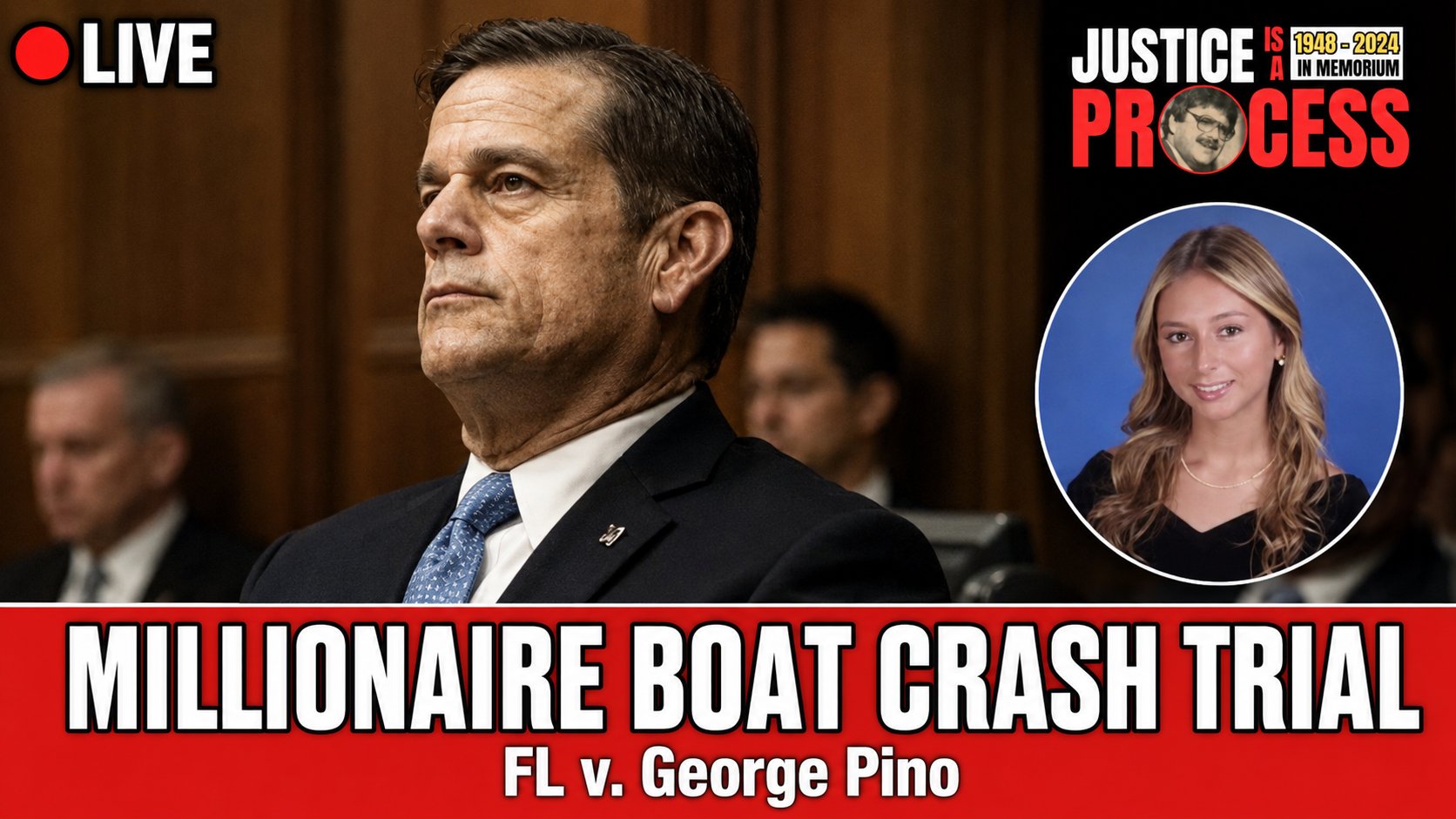
The Millionaire Boat Crash Trial: a teenager dead on Biscayne Bay, and the investigation that almost let it go.
June 2026 | Justice Is A Process
On September 4th, 2022, a group of teenage girls climbed onto a boat in Biscayne Bay to celebrate a birthday.
It was Labor Day weekend. A clear evening, the water crowded with boats, the kind of South Florida night that ends up on a postcard. The girls had spent the day on Elliott Key. One of them was turning eighteen, and she wanted her best friends around her.
Most of them came home.
Lucy Fernandez did not.
Seventeen years old. A senior at Our Lady of Lourdes Academy, just starting the year that was supposed to end with college applications and a graduation walk across a stage. She was on that boat because a friend asked her to be there. By the next afternoon she was gone, and her classmate Katy Puig was in a hospital bed with a brain injury so severe that a doctor told her family she had a five percent chance to live.
The man at the wheel was George Pino. A prominent real estate broker out of Doral. A husband, a father, the host of his own daughter's birthday outing. When his 29-foot boat slammed into a concrete channel marker near Boca Chita Key, fourteen people went into the water in an instant.
Here is where most coverage of this case tends to stop. The crash. The death. The grief of two families that will never be whole again. Those things matter more than anything else in this story, and we will not lose sight of them. But they are not the reason twelve jurors are about to sit in a Miami courtroom and decide whether George Pino spends the next three decades of his life in prison.
They are sitting there because of what happened after the boat hit the marker.
Because the state agency that investigated this crash never tested the man at the helm for alcohol, even after it pulled dozens of empty bottles and cans off his boat, and even though its own training told its officers to test in a case with a death. Because that agency put it in writing, within days, that alcohol was not a factor, in a case it had barely begun to examine. Because for nearly a year, the only thing George Pino faced was three misdemeanors carrying a maximum of sixty days in jail. And because it took a newspaper, not the police, to turn a dead teenager into a felony case.
We are not here to convict George Pino. He is presumed innocent, and the state has to prove every element of every charge beyond a reasonable doubt. That is not a loophole. That is the same protection that stands between you and a prosecutor on the worst day of your life. We are not here to acquit him either. We are here to do what we always do. We are going to watch whether the system can finally do its job in a case where the system already failed once.
This is Justice Is A Process. Let's begin.
Start with the celebration, because that is what it was supposed to be. George and Cecilia Pino had taken their younger daughter Cecilia, who goes by Cassie, out on the water for her eighteenth birthday. She had invited eleven of her close girlfriends along, most of them students at Lourdes Academy and Carrollton School of the Sacred Heart, two private schools in Miami-Dade. Fourteen people in all on a 29-foot Robalo center console: two adults and twelve teenage girls.
They had spent the day at a sandbar off Elliott Key, a popular gathering spot in the southern reaches of Biscayne Bay. As the sun got lower, sometime around six-thirty in the evening, Pino pointed the boat back toward shore and ran it through a marked channel. Investigators say he was moving at a high rate of speed when he lost control and drove the vessel straight into a fixed concrete channel marker.
A channel marker does not move. It is a solid post anchored in the bay to tell boaters where the safe water is. Hitting one at speed is like driving a car into a bridge pillar. The Robalo capsized. Everyone aboard was thrown into the water, some of them ejected by the force of the impact.
Of the fourteen people on the boat, eleven were hurt. Four were airlifted out as trauma alerts by Miami-Dade Fire Rescue. Lucy Fernandez was one of them. She died the next day in the hospital from the injuries she suffered in the bay. She was seventeen.
Katy Puig, also seventeen, also a Lourdes student and one of Lucy's closest friends, survived with a traumatic brain injury. A firefighter who was there that night later described how Katy's body reacted to the seawater, how she retched, how witnesses said she moved in the water. That account helped the neurosurgeons decide to operate. It may be the reason she is alive at all.
George Pino told investigators that the crash was not his fault. He said a larger boat heading toward him in the channel threw a wake, that the wake caused him to lose control, and that he hit the marker as he turned to check on the girls. That is his account. We will come back to it, because the wake is going to be one of the central fights of this trial.
Here is the part of the story that should make every person who has ever been pulled over feel something.
The Florida Fish and Wildlife Conservation Commission, the FWC, is the state police agency that investigates boat crashes. Its officers are trained to seek a blood test in a boating accident with serious injuries or a death. The State Attorney's own training materials say the same thing. They tell investigators that significant injuries and deaths are exactly the circumstances where you pursue a blood draw, and they hand officers a hotline number to a prosecutor who is on call around the clock to help them get a warrant.
None of that happened the night Lucy Fernandez was dying.
The FWC investigator on the scene, William Thompson, asked George Pino to voluntarily give two vials of blood. Pino said no. According to Thompson's official report, Pino declined because his attorney was not present. But the officer's own body camera footage tells a different story. On the video, when Thompson asks for blood, Pino's immediate answer is, "No. I had two beers."
Two different reasons for the same refusal. One written in the report. One captured on camera. They do not match.
And Thompson did not push. The body camera shows him telling Pino that drinking a couple of beers and operating a boat is not illegal, that the test was "voluntary," that it was "up to you." He framed a blood draw in a fatal crash as a favor he was asking, not a step the situation demanded. He never launched a criminal investigation that night.
The next day, when the FWC pulled the Robalo out of the water, they found 61 empty bottles and cans of alcohol on the boat. Four days after the crash, a preliminary report stated alcohol was not involved. That August, the final report said the same thing. No alcohol. Case effectively closed, in the eyes of the agency that praised itself for being meticulous.
How do you rule out alcohol when you never tested for it? That question sits at the center of everything.
It gets worse. A second FWC officer at the scene, Julian Gazzola, later said in a sworn deposition that Pino smelled of alcohol, had bloodshot eyes, and seemed disoriented that night. Gazzola said his own body camera footage from the scene was handed over to the lead investigator. That footage has since been deleted. Gone. In a case where the central question is whether the operator was impaired, video that one officer says captured signs of impairment no longer exists.
The FWC has maintained that it had no probable cause to force a test, because Pino, though shaken, did not appear impaired to the investigator who interviewed him. The Miami Herald, which obtained the records and the body camera footage under Florida's public records law, found that the agency's own manuals and the State Attorney's own manuals said otherwise. Email records the Herald reviewed showed that Laura Adams, the State Attorney's chief of traffic and vessel homicide, was included in communications about the case in the hours right after the crash. The office that could have asked a judge to compel a blood draw was in the loop. The blood draw never came.
There is a comparison that sharpens all of this. The Herald looked at a second fatal boat crash in the Keys, near Key West, and found that a very different set of charges came out of it. The FWC has flatly denied that George Pino received special treatment. But set the two cases next to each other, look at how the alcohol question was handled in each, and you start to understand why so much of this community does not take the denial at face value. In public statements, the agency and the State Attorney's Office praised their teams for meticulously reviewing every aspect of this case, and went out of their way to stress that alcohol was not a factor. They cannot actually know that. They cannot know it because their investigators never ran the one test their own manuals called for. When the words an agency uses and the record it leaves behind stop lining up that cleanly, the public notices. And the damage runs deeper than one case. It chips at the thing the whole system depends on, which is ordinary people believing the law is theirs too.
Keep one more fact in view as this trial unfolds. The reason any of this is known at all is that journalists filed public records requests and refused to accept the official version. The body camera footage, the emails, the training manuals, the contradictions between the report and the video, none of it came from the agency volunteering the truth. It came from a newspaper prying it loose. That matters for how we read everything that happens in the courtroom, because the case the state is now trying is, in a real sense, a case the press resurrected.
For almost a year, that was the end of it. In August 2023, prosecutors charged George Pino with three misdemeanor counts of careless boating. The most serious of them carried a maximum penalty of sixty days in jail. Sixty days, for a crash that killed one teenage girl and left another fighting to walk and speak.
The families were outraged. Anyone paying attention should have been.
Then the Miami Herald started publishing. A series of articles laid out how investigators never took statements from key eyewitnesses at the scene, how the sobriety test never happened, how the body camera contradicted the report, how the empty bottles were found, how the alcohol question was closed before it was ever opened. The reporting put the bungled investigation in front of the public in a way the official reports never did.
Prosecutors say they also reexamined the case after a veteran Miami-Dade firefighter, Matthew Smiley, came forward with what he knew. And the surviving girls, the ones who had been on the boat, gave testimony that prosecutors say pushed them further still.
In October 2024, the State Attorney's Office dropped the misdemeanors and charged George Pino with felony vessel homicide. On November 21, 2024, more than two years after the crash, Pino surrendered to jail authorities and was booked. He arrived with a strong show of support, dozens of family members and friends behind him. In August 2025, prosecutors added a second felony, manslaughter, after the testimony of the girls on the boat. Pino pleaded not guilty to that charge too. His attorneys called it duplicative and said they would move to dismiss it.
A case that was nearly buried under three misdemeanors is now a two-count felony trial with roughly thirty years on the line. That journey, from sixty days to thirty years, is not a footnote. It is the story.
Luciana Fernandez went by Lucy. She was seventeen, a senior at Our Lady of Lourdes Academy, with the whole shape of a life still in front of her. She was on that boat for the simplest reason a teenager gets on a boat. A friend was turning eighteen, and she wanted to be there.
Her family did not let her death become a statistic. They built the Lucy Fernandez Foundation, and they took her name to the Florida Legislature. On June 27, 2025, the governor signed Lucy's Law, which took effect on July first. It anchors a boating safety campaign built around a phrase any parent can understand: have fun, be safe. A seventeen-year-old who never got to graduate now has her name on a state law meant to keep other people's children alive on the same water that took her. That is what a grieving family did with the worst thing that ever happened to them.
We will say her name in this coverage. Not "the victim." Lucy.
Katerina Puig went by Katy. She was seventeen the night of the crash, a standout soccer player, named a Dade Big School Player of the Year, the kind of athlete coaches build a team around. She was also a math whiz and a Florida Bright Futures Scholarship recipient. A kid who had her future mapped.
The crash gave her a five percent chance to live. Her sister has described walking into the hospital, seeing her, dropping to the floor, screaming. Her family lived day to day after that, waiting to see if she would wake up, if she would breathe on her own, if she would come back.
She came back. Slowly, and at enormous cost. Three years later, Katy uses a wheelchair. She struggles to speak. She can eat on her own now, though she needs help cutting her food. Less than a year after the crash she passed a swallowing test. Eleven months after the crash, doctors removed her feeding tube. The former math whiz is preparing to apply to Florida International University, where she hopes to study accounting. She has said five words that tell you who she is: "I'm a fighter."
There is a hard fact in this case that we are not going to hide from, because honest coverage does not hide from hard facts. Toxicology from the night of the crash showed that Katy had a blood alcohol level nearly double the adult legal limit for driving. She was seventeen. Underage. Her family has sued George and Cecilia Pino, accusing them of supplying alcohol to the minors on that boat. The Pinos deny it. That civil case is its own fight, and the question of who gave alcohol to a group of underage girls is going to hang over this trial, because it speaks to adult responsibility on a boat full of kids. None of it changes the central truth here. Katy Puig is a victim. A teenager who trusted a ride home and never got one.
Miami has not been able to look away from this case, and that pressure is part of the story too. The girls came from Lourdes and Carrollton, private schools woven into the fabric of the community, and the crash rippled through families, parishes, and youth sports leagues across Miami-Dade. During jury selection, prospective jurors spoke of graduating from local private schools around the time of the crash, of seeing it shared all over social media, of children who play sports alongside students connected to the case. This is not a distant news story to the people who will judge it. It happened to their neighbors' kids. And out of that grief, two families refused to be quiet. They pushed when prosecutors offered misdemeanors. They worked with reporters. They carried Lucy's name to the State Capitol. The reason the system reopened this case is, in large part, that the people closest to the loss would not let it stay closed. That is citizens forcing accountability, which is exactly the kind of pressure a healthy system is supposed to answer.
George Pino is fifty-five years old, a prominent real estate broker based in Doral. By every account he is a family man with deep roots in the Miami community and a wide circle of support. When he surrendered to authorities, dozens of people stood behind him. When he walks into the courthouse, he has done so holding the hands of his daughter Carolina and his wife Cecilia.
He is also, in the eyes of the law, an innocent man. That has to be said plainly and repeated often, because the public mood around this case runs hot. George Pino has not been convicted of anything. He has pleaded not guilty. The burden of proving that he committed a crime rests entirely on the State of Florida, and it never shifts to him. He does not have to prove the crash was an accident. The state has to prove it was a crime. If they cannot do that beyond a reasonable doubt, the law says he walks, and the law is right to say so.
That is the tension we are going to live inside for this whole trial. A community convinced that a connected man got special treatment. A defendant who is entitled to the presumption of innocence no matter how the public feels. Both of those things are true at the same time, and holding both is the entire job.
The trial is before Miami-Dade Circuit Court Judge Marisa Tinkler Mendez, who has pushed hard to keep the case on schedule and has handed down a string of pretrial rulings, most of them against the defense. Leading the prosecution is Assistant State Attorney Laura Adams, the State Attorney's chief of traffic and vessel homicide, working under State Attorney Katherine Fernandez Rundle. Adams is the same prosecutor whose office was in the early communications about this case back in 2022, which is a complicated piece of history for the state to carry into a courtroom.
On the defense side, George Pino is represented by Howard Srebnick, a well known Miami criminal defense attorney, along with Mark Shapiro. Srebnick has set the defense theme in a single sentence. He has called the crash a tragic accident, not a crime. Everything the defense does will flow from that line.
George Pino faces two felony counts, both stemming from the death of Lucy Fernandez. They are closely related, which is exactly why the defense has complained that charging both is redundant. Let's break down what each one actually requires.
What it means: Vessel homicide is the killing of a human being caused by someone operating a boat in a reckless manner that is likely to cause death or great bodily harm. The key word is reckless. Recklessness is more than a simple mistake or ordinary carelessness. It means operating the boat with a conscious disregard for the safety of the people on it.
What the State must prove: That Lucy Fernandez is dead. That her death was caused by George Pino operating the vessel. And that he operated it in a reckless manner likely to cause death or serious injury. All three, beyond a reasonable doubt.
Potential sentence: Vessel homicide is a felony of the second degree, punishable by up to 15 years in prison.
What it means: Manslaughter is the killing of a human being by the act, procurement, or culpable negligence of another, when that killing is not justified, not excusable, and not murder. In a case like this, the state's path is culpable negligence, which Florida law treats as a gross and flagrant disregard for human life, a level of carelessness so reckless that the law treats it as a crime.
What the State must prove: That Lucy Fernandez is dead. That her death was caused by George Pino's act or culpable negligence. And that it was neither justifiable nor excusable. Again, beyond a reasonable doubt, and again, entirely the state's burden.
Potential sentence: Manslaughter is also a felony of the second degree, punishable by up to 15 years in prison.
Two second-degree felonies, each carrying up to fifteen years. Stacked, that is why you have seen the number thirty years attached to this case. The defense has argued that the manslaughter count is duplicative, that it covers the same death the vessel homicide count already covers, and that piling them on adds confusion rather than clarity. The state's view is that they are separate legal theories for proving the same tragedy, and that a jury should be allowed to consider both. The judge will decide how the counts go to the jury.
A word on the numbers, because they move fast in coverage like this. A second-degree felony carries a maximum of fifteen years, but a maximum is a ceiling, not a promise. Florida sentences through a scoresheet, and what a judge can actually hand down depends on the conviction and on the defendant's record. So the thirty-year figure is the outer edge of what is theoretically possible if Pino were convicted on both counts and sentenced consecutively, not a number anyone should treat as a forecast. And then there is the standard itself. Beyond a reasonable doubt is the highest burden in American law, and it is high on purpose. It does not mean beyond all doubt, and it does not require the state to erase every question a juror might have. It means the proof has to be strong enough that a reasonable person would not hesitate to act on it in the most serious decisions of their own life. That is the bar the state has to clear, on every element, on each count. Watch whether they clear it.
Notice what both charges have in common. Neither one accuses George Pino of wanting anyone to die. Nobody is alleging he set out to hurt these girls. The entire criminal question is about how he operated that boat, and whether the way he operated it crossed the line from a horrible accident into criminal recklessness. That line, between tragedy and crime, is what twelve jurors are going to spend their days deciding.
Every case that reaches a jury is there for a reason. Something went wrong somewhere. Find that something, and you find the story.
Here, the something is the investigation itself.
This case is at trial because the agency that investigated it never tested the man at the helm, ruled out alcohol it had no way to rule out, and let a wealthy, connected boat owner face nothing but misdemeanors for a teenager's death. Only after a newspaper investigation exposed the botched probe did the charges become felonies. And now the State of Florida has to walk into a courtroom and prove the impairment and recklessness its own investigators failed to preserve, with the clock having run for years and the best evidence either never collected or, in the case of one officer's body camera, deleted.
Sit with how unusual that is. In most cases we cover, the fight is over whether the state overreached, whether it cut corners to build a case, whether it pushed too hard. Here the public accusation runs the other way. The accusation is that the state, or at least the agency working the scene, did not push at all. That it gave a connected man the benefit of every doubt on the night it mattered most, and that a newspaper had to drag the case back to where it should have started.
That creates a strange courtroom. The prosecution now has to prove a serious crime while quietly carrying the weight of how badly the early investigation went. The defense gets to point at every gap the state's own people left behind and ask the jury a simple, powerful question. If there was really evidence of a crime, why didn't your own investigators find it that night?
The state's theory is that George Pino operated that boat recklessly, that his recklessness killed Lucy Fernandez and shattered Katy Puig, and that the early failure to test him does not erase what the evidence still shows. Prosecutors will lean on the things investigators did capture and the people who were there. The 61 empty bottles on the boat. Officer Gazzola's account of bloodshot eyes and the smell of alcohol. The high rate of speed into a fixed marker in a crowded channel. The testimony of the surviving girls about what the day on the water actually looked like, testimony that prosecutors say was significant enough to support adding the manslaughter charge. And the simple physics of driving a boat full of children into a concrete post hard enough to capsize it and throw everyone overboard.
Prosecutors will argue that you do not need a blood test to prove recklessness. Recklessness can be shown by how the boat was operated, not only by what was in the operator's bloodstream. That is the case the state has to build, and it is a harder case to build than it should have been, because of choices other government employees made years ago.
Watch how the state defines reckless. A crowded channel on a holiday weekend. Twelve teenage girls on board, the operator's own daughter and her friends, all of them his responsibility for the ride home. A 29-foot boat driven into a fixed concrete marker hard enough to capsize it and throw fourteen people into the water. The state will argue that the operation itself, the speed, the loss of control in marked water at dusk with a boat full of children, tells the story of recklessness regardless of what a blood test would or would not have shown. The surviving girls are central to that. Their testimony about the day, about the ride, about what they saw and felt in the moments before the impact, is the human core of the prosecution, and prosecutors have said it was significant enough to support adding the manslaughter charge in the first place. Add the firefighter Matthew Smiley, who came forward with what he knew, and Officer Gazzola's account of bloodshot eyes and the smell of alcohol, and the state will try to assemble out of testimony the picture its own agency failed to capture with a test.
The defense has a clear and, frankly, a strong hand to play, and much of it was dealt to them by the state's own failures.
First, the wake. Pino has consistently said another, larger boat threw a wake that caused him to lose control. If the defense can put that doubt in front of the jury, it transforms a reckless act into an unavoidable accident. The challenge is that, by the accounts gathered so far, no one else saw that other boat. Not the people on Pino's vessel, not witnesses on other boats in the channel. The defense will work to establish it anyway.
Second, the alcohol. This is where the state's early failure cuts hard against the state. Defense attorneys say that hours after the crash, when Pino was treated at Baptist Hospital, medical staff drew his blood at around eleven-thirty that night, and that test showed no alcohol detected. The defense will hold that result up and ask why the jury should believe Pino was drunk when the one blood test that exists came back clean.
Third, the brain injury. The defense consulted a Boca Raton neurologist, Dr. Diana Barrat, about whether Pino suffered a traumatic brain injury in the crash, an injury that could have caused amnesia and what the defense describes as false memories about the details of the accident. The defense may use that to explain inconsistencies in Pino's own account.
Fourth, and this one is striking, the defense has pointed to the testimony of Lucy's own father. According to the defense, Mr. Fernandez testified that he drank at the sandbar that day, that he and his wife left before the Pinos did, that they left Lucy in Pino's care, and that he saw no sign that Pino was impaired. A grieving father who would never have let his daughter board that boat if he thought the driver was drunk, telling the court he saw nothing wrong. The defense will ask the jury to take that seriously.
Add it up and the defense theme is the one Srebnick named at the start. A tragic accident, not a crime. A clean hospital test, a wake, a father who saw no impairment, and a prosecution they will argue was driven by public pressure and a newspaper campaign rather than evidence.
Time is on the defense's side in a way that should make the state uneasy. Almost four years will have passed by the time witnesses take the stand. Memories fade. Accounts harden into something rehearsed. Young women who were children on that boat have lived years of their lives since, and the defense will press on every gap between what someone remembers now and what they said then. More than that, the defense gets to turn the state's central weakness into a weapon. Every time a prosecutor asks the jury to infer impairment, the defense can answer with the same line: your own investigators had the chance to know for certain that night, and they chose not to find out. There is a hard irony here. The botched investigation that outraged this community, the thing that makes the case feel like a story about a connected man getting a pass, is the very thing that hands the defense its reasonable doubt. The state created the hole. The defense will live in it.
In the weeks and days before trial, Judge Tinkler Mendez handed the defense a series of losses. She ruled that statements Pino made to investigators after the crash will be allowed at trial, rejecting a defense effort to keep them out. She denied a defense motion to throw the entire case out. She denied a defense request to move the trial out of Miami-Dade County, despite the heavy local coverage. And she denied a defense request for a twelve-person jury, keeping it at the six-person panel that Florida uses for cases like this one.
Those rulings set the board. The statements come in. The case stays in Miami-Dade. Six jurors, not twelve, will decide it. Jury selection ran through the first week of June 2026, and the panel was seated by the end of that week. Opening statements are set to follow.
This case lands on two things we care about more than almost anything else on this channel. Equal treatment under the law. And a system that polices itself honestly. Both are in play here, and they pull in directions that can feel uncomfortable at the same time.
Start with equal treatment. The loudest question hanging over this case is whether George Pino got handled differently because of who he is. A prominent broker, a man of means, a family with standing in the community. The Herald reported on two fatal Keys boat crashes that drew vastly different charges, and the FWC denied any special treatment. But the public is right to ask the question. When the records show that the agency never tested the operator, framed a blood draw in a fatal crash as optional, and closed the alcohol question within days, ordinary people who have been hammered by the system for far less are entitled to wonder whether the rules bent for a connected man. The whole promise of the law is that it applies the same to everybody. When it looks like it didn't, that promise takes a hit, and the damage is not just to one case. It is to every citizen's faith that the system is theirs too.
Now the harder edge. The presumption of innocence cuts in George Pino's favor, completely, no matter how that early investigation looked. This is where it gets uncomfortable for people who are angry, and I understand the anger. But watch closely. The same system that may have given Pino a pass on the night of the crash is now under enormous pressure to convict him. Public outrage, a newspaper campaign, a new state law named after the girl who died, all of it pushing one direction. And here is the thing about pressure like that. It does not care whether the evidence is actually there. A conviction built on momentum instead of proof is not justice. It is just a different kind of failure. So we will be watching whether the state proves its case, or whether it leans on the public mood to carry a case its own investigators left full of holes.
We will be watching the evidence questions too. Whether the FWC had the authority and the duty to compel a blood test that night, and what the jury is told about why it didn't. What happens with the deleted body camera footage, and whether the jury hears that an officer who reported signs of impairment had his video disappear. Whether the hospital blood test that came back clean gets the weight the defense wants. And whether the state can prove recklessness through the operation of the boat alone, without the chemical evidence it never gathered.
Step back and this trial is bigger than one man and one boat. It is a test of whether accountability in this country actually reaches the people with money and standing, or whether it quietly slides off them. That is not a small thing in a county where so many ordinary people feel the full weight of the system land on them for far less than a death. If the state proves its case, it will be telling this community that a connected man does not get to walk away from a dead child because the first investigators looked the other way. If the state cannot prove it, the lesson the public takes may be darker, that the only reason there is a trial at all is a newspaper, and that the original failure ran so deep the truth can no longer be recovered. Either way, people are watching what the answer says about them.
There is a public safety stake on top of the constitutional one. A teenager is dead, another is rebuilding her body and her speech one hard year at a time, and a state law now carries Lucy's name. Florida's waterways are crowded, especially on the holiday weekends when families load up boats with kids. How this case resolves will say something about how seriously the state treats reckless operation when the people hurt are children and the person at the wheel has resources and reach. None of that lowers the burden on the state by an inch. It just raises the stakes of whether the state can meet it.
My father spent his life on the other side of this fight. Steven M. Askin was a criminal defense attorney in West Virginia, and the system came for him twice, once for protecting attorney-client privilege and once for teaching people their rights from a coffee shop. He taught me that the rules of due process are not technicalities and they are not luxuries. They are the only thing standing between any of us and a government that has decided what it wants the answer to be. He believed the presumption of innocence belonged to everyone, the guilty and the innocent alike, because the day it stops protecting the people we dislike is the day it stops protecting us.
So I am going to hold a hard line through this whole trial. George Pino is presumed innocent. And the system that may have looked away for him on the night Lucy died owes the public a clean, honest accounting of how this is handled now. Those two commitments are not in conflict. They are the same commitment, looked at from two sides. A fair process for the man on trial, and an honest system for the rest of us watching.
Three and a half years separate the crash from the courtroom. Here is how the case got from a sandbar off Elliott Key to a Miami jury box.
Expect a fast, dense trial. The witness list runs from FWC officers and first responders to the surviving passengers, an accident reconstructionist, a marine mechanic, and dueling experts on alcohol and on Pino's claimed brain injury. The scheduling itself tells you something. Prosecutors and defense attorneys agreed on a summer trial in part because so many of the witnesses are now college students, scattered for the school year. The girls who were children on that boat in 2022 will take the stand as young adults.
Starting with opening statements, we will be on this trial every day it is in session. Live broadcasts as it happens. No Breaks editions for uninterrupted viewing. A trial analysis podcast for the deep dives. Key moments and testimony segments so you can hear it for yourself, in the witnesses' own words.
This is not speculation and it is not a true crime show. It is a watchdog watching a system that already failed this case once, to see whether it can get it right the second time.
George Pino is presumed innocent until proven guilty beyond a reasonable doubt. That is not a technicality. It is the foundation of everything we do here.
Let's watch the system together.
Subscribe to Justice Is A Process on YouTube for live trial coverage, No Breaks editions, and breaking news as it happens.
🔴 Subscribe on YouTube111,000+ subscribers watching the system with us
Discussion