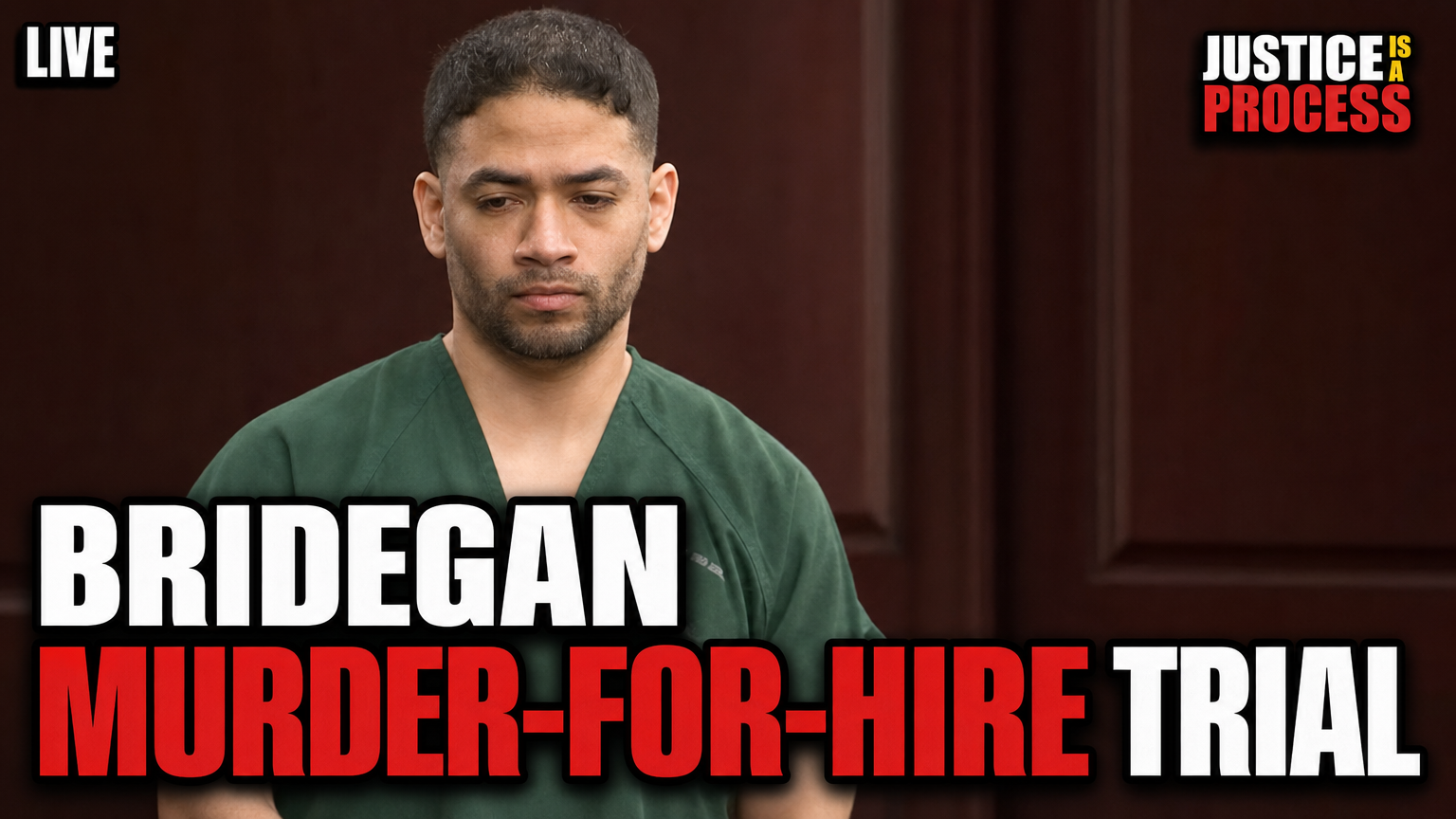
A father shot dead on a dark street, his little girl in the back seat. The first of three trials in a murder-for-hire plot the state says was born of a custody war.
July 2026 | Justice Is A Process
On the night of February 16, 2022, Jared Bridegan did the most ordinary thing a father can do. He took his kids out to dinner.
He had his two twins with him, a boy and a girl, nine years old, the children he shared with his ex-wife. After the meal he drove them back to their mother's house in Jacksonville Beach, dropped them off, and pointed his SUV toward home. In the back seat, buckled into her car seat, was his youngest. His two-year-old daughter, Bexley.
He never made it out of the neighborhood.
Somewhere along his route through the quiet streets of the Sanctuary community, a tire was lying in the middle of the road. Jared did what almost anyone would do. He stopped. He stepped out of the vehicle to move it. And in the dark, someone was waiting for him.
He was shot several times and left to die in the street, feet from his own car, with his toddler strapped in the back seat listening to it happen.
What the state says came next is not a story about a robbery gone wrong or a random act of violence. It is a story about money, about a marriage that ended in a courtroom instead of a church, about a custody fight that never stopped, and about a plan the state says was drawn up to make a problem disappear the only way that could never be undone. Prosecutors call it a murder for hire. They say the man who wanted Jared Bridegan gone did not pull the trigger. They say he paid someone who would.
The man on trial first is Mario Fernandez Saldana. He is the second husband of Jared's ex-wife. He has pleaded not guilty. And in a few short weeks, twelve residents of Duval County will sit in a jury box and decide whether the state can prove what it says he did.
We are not here to convict him. We are not here to acquit him. We are here to watch whether the system does the one thing it is built to do: prove its case beyond a reasonable doubt, in open court, against a man the Constitution says is innocent until it does.
This is Justice Is A Process. Let's begin.
Before we walk through what the state alleges, hold onto one word: allegation. Everything in this section is what prosecutors say happened. None of it has been proven to a jury. That is the entire point of the trial that is about to start. So read it the way a juror is supposed to read an opening statement. This is the map the state has drawn. Whether the evidence fills it in is a different question, and it is the only question that matters.
Jared Bridegan and Shanna Gardner were once married. They had twins together, and then their marriage came apart. They divorced, and by most accounts the fight did not end with the divorce. It moved into family court and stayed there. According to investigators, the two former spouses were locked in near constant litigation over money and over custody of their children for years. One side wanted more time with the twins. One side wanted less sharing. The paperwork piled up. The tension did not ease.
That is the backdrop the state says everything else grew out of. Prosecutors allege that Shanna Gardner wanted her ex-husband out of her life for good, and that she and the man she married after Jared, Mario Fernandez Saldana, set a plan in motion to make that happen. The state's theory is blunt: this was a killing arranged inside a family, over a family, by people who were supposed to be raising children together.
The evening of February 16, 2022, followed the custody routine. Jared had the twins for the night. He fed them dinner and drove them back to Gardner's Jacksonville Beach home to complete the exchange. Then he left with his youngest daughter still in the car.
Investigators say the tire in the road was not an accident. They allege it was placed there deliberately, a trap designed to force Jared to stop his vehicle in a spot chosen in advance. When he got out to clear it, he was ambushed. He was shot multiple times and died at the scene. His two-year-old was physically unharmed, but she was there for all of it.
For a while, the case looked like a mystery. A well-liked father, a design manager for Microsoft, gunned down on a residential street with no obvious enemy. But investigators kept pulling threads, and the threads, they say, led back to a plan.
The person the state says fired the shots is a man named Henry Tenon. Prosecutors describe Tenon as a former tenant of Fernandez Saldana, a connection that the state says is not a coincidence but a link in the chain. In 2023, Tenon pleaded guilty to second-degree murder in Jared's death. As part of that arrangement he faced a negotiated sentencing range, reported as fifteen years up to life, and he avoided a possible death case. In exchange, he agreed to cooperate. In plain terms, the alleged gunman admitted his role and signed up to testify against the two people the state says hired him.
For a long stretch, that made the prosecution look formidable. A confessed shooter, telling a jury from the witness stand who paid him and why, is about as direct as circumstantial-plot cases ever get. Then, in early 2026, Tenon changed course. He moved to withdraw his guilty plea. In court, the message was blunt: he wanted a trial of his own. A judge granted the request and let him take the plea back. According to reporting on the case, Tenon has also indicated he will not testify against his alleged co-conspirators. The keystone of the state's murder-for-hire theory removed himself from the state's case.
That is how the state built its case against Mario Fernandez Saldana and Shanna Gardner, and that is exactly the piece that has since started to come apart. It is worth sitting with what that means. A prosecution that was designed around a cooperating witness now has to prove the connection between the money and the murder using records and inference. The trial we are about to watch is, in large part, a test of whether that can be done.
There is one more thread worth naming honestly, because it speaks to how much of this case is still open. Investigators have indicated in the past that two additional people, reportedly including a former reserve police officer, may have been involved in some way but were not charged. We raise it not to point fingers, because uncharged is uncharged and speculation is not our lane, but because it is a reminder that the public record of this case is not a closed box. When we cover a trial, we cover what is proven in the room, and we say plainly when something sits outside it.
Jared Bridegan was thirty-three years old. He was a senior design manager for Microsoft, the kind of quietly successful professional who built a life in Florida and worked in technology. He was a father several times over. He had the twins from his marriage to Shanna Gardner, and he had two young children with his wife, Kirsten, including the two-year-old who was in the car the night he was killed.
It matters that we say his name and see him as a person, because a case like this can flatten a human being into a role. The victim. The deceased. The name in the caption. Jared was a man who took his kids to dinner, who followed the custody schedule, who stopped his car to move a tire out of the road because that is what a decent person does. He does not get to speak at this trial. The system will speak for him, and our job is to watch whether it does that honestly.
His death did not end the pain for the people who loved him. It reshaped it. In the years since the murder, there has been a wrenching secondary battle over the twins Jared shared with Shanna Gardner. With their mother in jail awaiting trial, the children were placed in the custody of Gardner's parents. Jared's own family, including his widow Kirsten, fought in civil court for guardianship and for the right to remain in the children's lives, and largely did not prevail. We flag this carefully. It is a civil matter, separate from the criminal trial, and it decides nothing about anyone's guilt. But it belongs in the human picture of what this killing set loose, and it is part of why this case has drawn the attention it has.
Mario Fernandez Saldana is the man on trial. He married Shanna Gardner after her marriage to Jared ended, which makes him, in the plain language of this story, the new husband of the victim's ex-wife. The state says he is the one who arranged and paid for the killing on Gardner's behalf. He has pleaded not guilty to every charge.
Here is where the presumption of innocence stops being a slogan and starts being the actual rule of the room. Mario Fernandez Saldana walks into that courtroom as an innocent man. Not innocent in the sense that we personally believe him. Innocent in the sense that the law requires the state to prove otherwise, beyond a reasonable doubt, before anything changes. He does not have to testify. He does not have to call a single witness. He does not have to prove where he was or what he did. The entire burden sits on the prosecution, and it never shifts. If you take one idea away from this report, take that one.
Shanna Gardner. Jared's ex-wife and Mario's estranged wife. The state describes her as the person who wanted Jared gone, the motive at the center of the alleged plot. She faces her own trial, separate from her husband's, and she too has pleaded not guilty. Nothing a jury decides about Mario decides anything about her, and nothing here should be read as a finding about her guilt.
Henry Tenon. The man the state says pulled the trigger. He is the hinge of this entire prosecution, which is why what he does next carries so much weight. More on him in a moment.
The case is being prosecuted in Duval County, Florida, in the Fourth Judicial Circuit, by the office of State Attorney Melissa Nelson. The judge presiding over the trial is Circuit Judge London Kite, who has already handled a long run of pretrial fights in this case and made several of the rulings that will shape what the jury is allowed to hear. Mario Fernandez Saldana is represented by his own defense team, which has spent the last year contesting evidence, seeking bond, and, according to what came out in court, even discussing the possibility of a resolution short of trial.
This is where the case got dramatically smaller, and very recently. When Mario Fernandez Saldana was first indicted, he faced four counts. In the days right before his trial, the state dropped two of them. Understanding what stayed and what fell away tells you a lot about where the prosecution thinks it is strong and where it decided not to fight.
He originally faced first-degree murder, conspiracy to commit murder, solicitation to commit a capital felony, and child abuse. On the eve of trial, prosecutors announced they would not pursue the conspiracy count or the child abuse count. That leaves two charges standing.
What it means: This is the most serious charge in Florida law. The state does not have to prove that Mario Fernandez Saldana personally fired the gun. Under Florida's principal theory, a person who hires, procures, or helps arrange a murder is treated by the law as if he committed it himself. So the question for the jury is not whether he was on that dark street. It is whether he set the killing in motion.
What the State must prove: That Jared Bridegan is dead. That his death was caused by the criminal act of a person. That the killing was premeditated, meaning it was planned rather than impulsive. And that Mario Fernandez Saldana intentionally procured or participated in causing it.
Potential sentence: Prosecutors took the death penalty off the table in this case in late 2025. That means a first-degree murder conviction here carries a mandatory sentence of life in prison without the possibility of parole. There is no middle setting. It is life, or it is not this charge.
The burden: Entirely on the State. Mario Fernandez Saldana does not have to prove anything at all.
What it means: This is the charge that speaks most directly to the murder-for-hire theory. Solicitation is the crime of asking, hiring, commanding, or encouraging another person to commit a crime. Here the state says Mario Fernandez Saldana solicited the killing of Jared Bridegan, in other words that he is the one who reached out and secured a person willing to do it.
What the State must prove: That he asked, hired, or encouraged another person to commit the murder, and that he actually intended for that murder to happen. The solicitation is complete when the request is made with intent. The state does not have to prove the plan worked to prove it was made, though here it says the plan did work.
Potential sentence: Solicitation to commit a capital felony is a serious felony in its own right and carries a lengthy prison term under Florida law. The exact maximum is set by statute, and we will state it precisely once we confirm the count language in the charging document.
The burden: Again, entirely on the State.
Before we go further, one idea deserves its own moment, because it is the legal engine of this entire prosecution and a lot of viewers will trip over it. Mario Fernandez Saldana is charged with first-degree murder even though the state does not claim he was on that street or that he fired a single shot. How can that be murder? Because Florida law, like the law in every state, treats the person who arranges a killing as guilty of the killing. It is called the principal theory. If you hire, procure, or intentionally help bring about a murder, the law does not hand you a lesser charge because someone else pulled the trigger. In the eyes of the statute, you did it. So when you watch this trial, do not wait for evidence that puts the defendant at the scene. The state is not trying to prove that. It is trying to prove that he set the plan in motion. That distinction is the whole case, and it is the thing jurors will be instructed to weigh.
So why drop the other two counts? The state did not explain itself in open court, and we are not going to pretend to read minds. But there is an honest observation to make. Dropping charges on the eve of trial is often a sign that a prosecutor is streamlining, trimming the counts they feel least sure about so they can put their strongest theory in front of a jury without distractions. It can also reflect a judgment that a conviction on the remaining counts delivers everything they need, since first-degree murder here already carries life. Whether the reduction signals confidence or signals a case that has lost some of its footing is one of the first things we will be watching for.
Every case that reaches a jury reaches it for a reason. Something is contested. Something did not resolve. Here, the core tension is unusually sharp, and it is worth naming plainly, because it is the story this entire trial will tell.
This case is at trial because the state has to prove that Mario Fernandez Saldana hired a gunman to kill Jared Bridegan, largely through circumstantial evidence, at the exact moment its most important witness has walked away. The man the state says pulled the trigger, Henry Tenon, confessed and agreed to testify against Fernandez Saldana and Gardner. Then, in early 2026, he moved to withdraw that guilty plea, and a judge let him. According to reporting on the case, Tenon has signaled he will not testify against his alleged co-conspirators after all. The cooperating witness who was supposed to connect the money to the murder has, at least for now, gone silent.
Layer on top of that a second fact. In the days before trial, the state quietly dropped half of its charges and, according to what surfaced in court, there had even been some discussion of a plea. When a prosecution narrows its own case and floats a resolution right before opening statements, it raises a fair question that the defense will press hard: is this a strong case being tidied up, or a weakened case being salvaged?
That is the tension. Not whether Jared Bridegan was murdered. He plainly was. The tension is whether the state can prove that this particular defendant is the man who arranged it, using paper and phone records and inference, without the one human being who could say from the stand that he was hired to do it.
The prosecution's case is a chain, and each link is meant to hold the next. The motive lives with Shanna Gardner and the custody war. The means and the money, the state says, ran through Mario Fernandez Saldana. And the act itself belonged to Henry Tenon.
To connect Fernandez Saldana to Tenon, the state has pointed to two categories of evidence that have surfaced in the public record. First, money. Investigators have described checks, reported to total around ten thousand dollars, that the state ties to payments in the case. Second, communication. The state has described dozens of phone contacts among the alleged conspirators, a pattern of calls it says shows coordination rather than coincidence. Add the tenant relationship between Fernandez Saldana and Tenon, and the state's picture is of a man who knew the shooter, paid the shooter, and talked to the shooter.
Paper and phone records do not recant. That is the quiet strength of a circumstantial case, and it is almost certainly why the state believes it can go forward even without Tenon on the stand. Documents say what they say. The question is whether they say enough, on their own, to erase reasonable doubt.
The defense has spent more than a year fighting on the evidence, not just on the story. Fernandez Saldana's team has contested the state's proof, sought his release on bond, and, as revealed in court, engaged in at least informal discussion about a possible plea, which the defense described as more of a conversation than a formal written offer. That last detail cuts in an interesting direction. Plea discussions are ordinary and prove nothing about guilt. But the fact that talks happened, and that the state then trimmed its charges, will let the defense argue that the prosecution itself had doubts about the full weight of its case.
Expect the defense to hammer the gap the missing witness leaves behind. Without Tenon testifying that Fernandez Saldana hired him, the defense can stand in front of the jury and say the state is asking them to fill that hole with guesswork. Checks and calls, the defense will argue, are not the same as proof that this man ordered a killing. A payment can have another explanation. A phone call is not a murder plot. The presence of a relationship is not the presence of a conspiracy. The defense does not have to prove any alternative. It only has to show the jury that the state's chain has a link that will not hold.
This case has already produced a stack of consequential pretrial fights, and several of them will shape the trial the jury sees.
The most significant involves the state itself. Earlier in the case, the defense moved to disqualify the entire State Attorney's Office, arguing that privileged attorney-client communications, emails and text messages that should never have reached prosecutors, had been improperly reviewed. The judge did not remove the prosecutors, but he did throw out some of the contested communications after finding that privileged material had been inadvertently exposed. That is a serious thing to have happen in a murder case, and it is exactly the kind of process breakdown this channel exists to watch.
There have also been fights over statements made by Henry Tenon. Reporting on the case indicates the judge agreed to block some of Tenon's statements while allowing at least one prior statement to be used. Shanna Gardner's team, in the parallel track of the case, moved to suppress wiretap and cell phone evidence. The precise boundaries of what is in and what is out are the kind of detail we will confirm and track carefully as the trial approaches, because in a circumstantial case, what the jury is allowed to hear is often the whole ballgame.
Then there is the decision that sets up everything you are about to watch: the cases were severed. Originally, the state planned to try Mario Fernandez Saldana and Shanna Gardner together. That changed. The court agreed to give each defendant a separate trial in front of a separate jury, driven in part by concerns about seating an impartial jury and about the risk that evidence admissible against one spouse could unfairly bleed onto the other. So instead of one trial, there will be a sequence. Fernandez Saldana goes first, in August. Gardner follows in September. And the man who once agreed to be the state's witness, Henry Tenon, has a trial track of his own after pulling back his plea. Three defendants, three trials, one killing. What happens in this first trial will echo into the next two, which is one more reason it deserves careful, sober coverage.
This is where Justice Is A Process does the thing other coverage skips. Other channels will tell you what happened in court today. We are going to ask whether the process is working, because the process is the whole ballgame. A verdict is only as trustworthy as the road that produced it.
Can the state carry a murder case without its cooperating witness? This is the central constitutional and evidentiary drama of the trial. The Constitution puts the burden on the state and keeps it there. When the witness who was supposed to deliver the direct link vanishes from the stand, the state is left trying to prove intent and agreement through inference. Watch closely whether the circumstantial evidence actually closes the loop, or whether the jury is being asked to bridge the gap with assumption. Reasonable doubt is not a technicality. It is the space between what the evidence shows and what the state needs you to believe.
Did the privilege breach taint the case? When privileged defense communications end up in a prosecutor's hands, the fairness of the entire proceeding is on the line. The judge fashioned a remedy short of removing the prosecution, but the defense will keep this alive, and it belongs in the public conversation. The attorney-client privilege is not a loophole. It is one of the oldest protections in the law, and it exists so that a person facing the power of the state can speak freely with the one person in their corner. We will be watching whether the remedy actually cured the problem or merely papered over it.
Is a circumstantial case being held to the right standard? Florida law allows convictions on circumstantial evidence. It does not lower the bar to get one. When the proof is checks and calls and relationships rather than an eyewitness or a confession from the man in the dock, the jury has to be especially disciplined about the difference between suspicious and proven. We will watch whether the instructions and the argument keep that line bright.
Is the presumption of innocence surviving the pressure of a sympathetic victim? This is a hard case to watch dispassionately. A father was murdered in front of his toddler. The instinct to want someone to pay is human and understandable. But the presumption of innocence is tested hardest exactly when the crime is worst. A system that only protects the rights of unsympathetic defendants protects no one. We will hold that line in our coverage even when it is uncomfortable, because that is the entire point.
This is the lens Steven M. Askin taught, and it is the reason this channel exists. Not to root for a side. To watch whether the machinery of justice runs clean. Rights that apply to Mario Fernandez Saldana apply to you. Due process is not a favor the state grants. It is the floor beneath everyone.
What to expect once it starts: this is a circumstantial murder-for-hire case, so plan for financial records, phone and communication data, and witnesses who can speak to the relationships among the alleged conspirators. The great unknown hanging over the whole thing is whether Henry Tenon appears at all, and if he does, what he says. A trial that was built around a cooperating gunman now has to stand up without one. How the state solves that problem, and whether the defense can turn it into reasonable doubt, will define these two to three weeks in court.
Live broadcasts as it happens. No Breaks editions for the full day, uninterrupted. Justice Breakdowns with real analysis every night. Testimony segments so you can hear every word for yourself.
Mario Fernandez Saldana is presumed innocent until proven guilty beyond a reasonable doubt. That is not a technicality. That is the foundation of everything we do here.
Let's watch the system work, together.
Subscribe to Justice Is A Process on YouTube for live trial coverage, No Breaks editions, and breaking news as it happens.
🔴 Subscribe on YouTube86,000+ subscribers watching the system with us
Discussion