
Two Brothers, Two Fires, and the Day Before Thanksgiving That Changed Everything
January 2026 | Justice Is A Process
It was 5:01 in the morning, two days before Thanksgiving 2018, when firefighters in Ocean Township, New Jersey received the call. A house fire on Tilton Drive. By the time they arrived, flames were consuming parts of the two-story Colonial. A red gas can sat in the driveway. A charred glove lay on the ground nearby.
Inside, they found Paul Caneiro, his wife Susan, and their two adult daughters. All safe. All accounted for. Paul told them he'd woken up, smelled smoke, and gotten his family out. His wife said she didn't know anyone who would want to hurt them.
Seven hours later, eleven miles away in the wealthy enclave of Colts Neck, a landscaper named Boris Volshteyn spotted smoke billowing from his neighbor's $1.5 million mansion on Willow Brook Road. He rushed over to help. On the front lawn, face down, was his friend Keith Caneiro. The 50-year-old technology CEO had been shot five times. Four bullets to the head. One in the back.
There was no saving him.
As the inferno raged through the afternoon and into the night, firefighters discovered what prosecutors would later call one of the most brutal crime scenes in Monmouth County history. Inside that burning mansion were Keith's wife Jennifer, 45, and their two children: Jesse, 11, and Sophia, 8. All had been stabbed. Jennifer had also been shot in the head. The children, according to autopsy reports, were still alive when the fire started. Eight-year-old Sophia was the last to die, her lungs filling with smoke as the flames consumed her family's home.
Two houses. Two fires. Four dead. And the only connection between them: Paul Caneiro was Keith Caneiro's brother.
Today, more than seven years later, Paul Caneiro finally faces trial for the murders of his brother, sister-in-law, niece, and nephew. He has maintained his innocence from the beginning. His attorneys say there is no confession, and no one has heard his side of the story. The prosecution says they have overwhelming evidence: DNA, bloody clothing, security footage, and a financial motive rooted in stolen money and a salary that was about to disappear.
I'm Steven M. Askin II, and this is Justice Is A Process. We're not here to convict Paul Caneiro before the jury does. We're not here to exonerate him either. We're here to watch whether the system does what it's supposed to do: prove its case beyond a reasonable doubt while protecting the rights of everyone involved, including the man in the defendant's chair.
The defendant is presumed innocent until proven guilty. That's not a legal technicality. That's the foundation of everything we do here.
Let's begin.
The story of what allegedly happened begins the evening before the murders. Keith Caneiro, the younger of the three Caneiro brothers, had been growing increasingly suspicious of his older brother Paul for months. The two men were business partners. Keith owned 90% of Square One, a technology consulting firm he'd built from nothing. Paul owned the other 10%. They also co-owned EcoStar Pest Management, a pest control company they'd acquired in 2011, splitting that one 50-50.
According to court documents and a civil lawsuit filed by Jennifer Caneiro's father, Keith had discovered that money was missing from the businesses. Tens of thousands of dollars. He also believed Paul had been stealing from trusts set up for Jesse and Sophia's education, diverting funds into accounts for Paul's own children or using the money to pay down student loans.
The total, according to the lawsuit, was around $90,000.
On November 19, 2018, Keith made a decision. He emailed two business associates to inform them that Paul would no longer receive his $225,000 annual salary. The payments to Paul's wife (the salary was paid to her because Paul was collecting disability following a car accident) would stop immediately until the missing money was accounted for.
That same evening, Keith forwarded the email to his youngest brother, Corey, keeping him in the loop. He'd been telling family members for months that he wanted out. He was trying to sell the businesses. He was interviewing for other positions. One opportunity was in California. Anything to be done with Paul.
Prosecutors allege that email was a death sentence. The financial arrangement that had been keeping Paul afloat was about to collapse. And they say he decided his brother's entire family had to die.
According to the prosecution's theory, Paul Caneiro left his Ocean Township home sometime after 1:29 a.m. on November 20, 2018. Security footage from his own home surveillance system allegedly shows him walking into his garage at that time, approaching the camera. At 1:30 a.m., the recording stops. Paul later told police he thought he'd turned off the system because it was slowing down his WiFi, but investigators discovered the system was hardwired, not connected to wireless internet.
Neighbors of Keith and Jennifer Caneiro in Colts Neck would later tell police they heard what sounded like gunshots around 3 a.m. that morning.
A separate neighbor's surveillance camera captured someone leaving Paul Caneiro's home around 2 a.m. and returning approximately two hours later.
Prosecutors allege that in those missing hours, Paul drove the eleven miles to his brother's mansion, shot Keith on the front lawn, then entered the home and systematically killed the rest of the family. Jennifer was shot in the head and stabbed multiple times in the torso. Jesse, found on the kitchen floor, was stabbed in his torso and arm. Sophia, found on the stairs leading to the second floor, was stabbed multiple times.
Then, prosecutors say, Paul set a "slow-burn" fire in the basement, one designed to smolder for hours before erupting into a full blaze, and drove home.
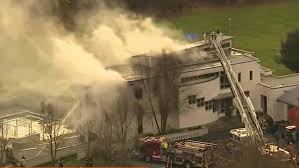
At 5:01 a.m., emergency services received the call about the fire at Paul Caneiro's Ocean Township home. Firefighters found flames consuming parts of the house. In the driveway, they discovered a red gas can. On the ground nearby, a charred glove. There were burn patterns on a vehicle consistent with gasoline being poured.
Paul Caneiro, his wife Susan, and their two adult daughters had escaped. They sat in a Porsche SUV parked nearby. Susan told investigators she had no idea who would want to hurt their family.
Prosecutors allege this fire was a "ruse," designed to make it look like the entire Caneiro family was being targeted by some unknown assailant. The idea, according to former Monmouth County Prosecutor Christopher Gramiccioni, was to create an "illusion" that would divert suspicion away from Paul.
The slow-burn fire in Colts Neck smoldered through the morning. Keith's neighbor, Dr. Boris Volshteyn, a plastic surgeon, was alerted by his landscaper around 12:30 p.m. that smoke was pouring from the Caneiro mansion. Volshteyn rushed to help. He found Keith face down on the lawn and thought about attempting CPR, but it was immediately clear his friend was beyond saving.
Firefighters from departments across Monmouth County responded. The fire, now fully engaged, would burn for hours. When they finally entered the home, they found Jennifer's body on the stairs leading up from the basement. Jesse was on the kitchen floor. Sophia was on the landing of the stairs going to the second floor.
The children's bodies were badly burned. But the autopsy findings were devastating: smoke inhalation was listed as a contributing factor in their deaths. Sophia, according to medical examiner findings cited in a 2019 lawsuit, survived her stab wounds "for an unimaginable period of time but demonstrably long enough to experience breathing difficulty and the onset of high-degree stress."
She was alive while her home burned around her.
Paul Caneiro was arrested the following day, November 21, 2018, on charges of aggravated arson for the fire at his own home. The murder charges came a week later.
When investigators searched Paul's Porsche Cayenne hours after the Ocean Township fire, they found a backpack containing his laptop, his passport, a 9mm barrel from a Sig Sauer pistol, a silencer, and a FLIR night-vision scope designed to attach to a firearm.
A search of his home revealed a gun safe in the garage and what police described as a "vast amount of firearms and a variety of ammunition" in the basement. Among the ammunition: Fiocchi 9mm rounds with the headstamp "GFL 10 9X19," the same type found in shell casings near Keith Caneiro's body.
Three days after the killings, a K-9 unit led detectives to a plastic container in Paul's basement. Inside were blood-stained jeans and a latex glove. DNA testing identified the blood as belonging to 8-year-old Sophia. A knife recovered from the crime scene also contained Sophia's DNA.
Keith Caneiro was the middle child of three brothers, born to Cesar and Sherry Caneiro. He grew up in working-class Brooklyn and Staten Island, but from an early age, he showed a passion for computers that would shape his entire life. As a teenager in the early 1980s, when personal computers were still a novelty, Keith took an unpaid job as a janitor at a small computer store just to be near the machines. His only compensation was the software manuals he asked to take home at night. He worked side jobs at McDonald's and Burger King to support himself.
That hustle paid off. Keith built Jay-Martin Consulting (named for his and Paul's middle names) into Square One, a technology firm that landed contracts with Citibank, J.P. Morgan, and Chase Manhattan. The company installed the computer networks in all 235 of Citibank's branches nationwide. If you've ever used the interactive kiosks at Ellis Island to research your family history, that was Keith's work.
Later in life, Keith went back to school. He earned a bachelor's degree from Columbia University's general studies program in 2014 and a master's degree from Columbia's School of Professional Studies in 2018, just months before his death. He was a voracious reader who could finish three or four books a week, an avid sports fan, and by all accounts, a devoted family man.
Jennifer Karidis Caneiro, 45, was Greek-American, originally from Aegina, Greece. She graduated from the University of Albany and was deeply involved in her children's school, serving as an active member of the Conover Road School PTO. She loved hosting family parties for every holiday, exercising, going to the beach, and traveling with her family to their home in Greece. Her obituary describes her as devoted to health, fitness, and mindful living.
Jesse Alexander Caneiro was 11 years old, a fifth-grader at Conover Road School in Colts Neck. His obituary describes him as a history buff who "excelled in history, especially WWI and WWII, and could have a conversation with anyone about current world events." He loved technology, learning about the latest computers and phones, playing Fortnite, and building structures with Legos. He also loved traveling to Greece with his family.
Sophia Alexis Caneiro was 8 years old, a third-grader. She was described as "vibrant, enthusiastic and precocious," a girl who loved ice skating, gymnastics, and baking cookies with her nanny. She was a New York Yankees fan. A friend wrote in her online tribute: "Sophia my Sophia I will always remember the first time we met you were so cute and funny I will miss your smile."
Hundreds of mourners attended their funeral on December 2, 2018, at Holmdel Funeral Home. The family released a statement asking for privacy: "The passing of these four beautiful people was tragic, sudden and incomprehensible and, like you, we are heartbroken."
Paul Caneiro, now 59, is the oldest of the three Caneiro brothers. He was Keith's first hire when the technology company was just getting started. While Keith ran Square One, Paul eventually took over operations of EcoStar Pest Management, the pest control business they acquired together.
At some point in the years before the murders, Paul was seriously injured in a car accident. He would require multiple surgeries and was left with chronic back pain and a limp. Because he was collecting disability, his $225,000 salary from the businesses was paid to his wife, Susan, instead. They have two adult daughters.
Paul was the best man at Keith's wedding. The brothers grew up together, built businesses together, and lived just eleven miles apart in Monmouth County. Neighbor Boris Volshteyn, who found Keith's body on the lawn, told reporters he never even knew Keith had a brother.
Paul has been held in the Monmouth County Jail without bail since November 21, 2018. For more than seven years, he has maintained his innocence. His attorneys have stated: "There is no confession in this case. No one has heard Mr. Caneiro's story."
In a statement released before trial, his defense team said their client "asserts his innocence, which he has maintained steadfastly for 7 years" and expressed gratitude for "the unwavering support of his close family and friends who continue to stand by him."
His wife Susan and their two daughters appeared in court for a September 2025 hearing, the first time they'd been spotted at proceedings in the case.
A Monmouth County grand jury returned a 16-count indictment against Paul Caneiro on February 25, 2019. Additional insurance fraud charges were added in July 2019. Here's what the State must prove:
What it means: The State alleges that Paul Caneiro purposely or knowingly caused the deaths of Keith Caneiro, Jennifer Caneiro, Jesse Caneiro, and Sophia Caneiro.
What the State must prove: That each victim died, that Paul Caneiro caused each death, and that he acted purposely or knowingly in causing those deaths.
Potential sentence: Life imprisonment without the possibility of parole on each count.
What it means: The State alleges that deaths occurred during the commission of another felony (arson).
What the State must prove: That the victims died during or as a result of the defendant committing aggravated arson.
Potential sentence: Life imprisonment, subject to the No Early Release Act (NERA).
What it means: The State alleges Paul Caneiro intentionally started fires at both the Colts Neck mansion and his own Ocean Township home.
What the State must prove: That he purposely started fires at occupied structures, placing people in danger of death or bodily injury.
Potential sentence: Up to 10 years in state prison on each count, subject to NERA.
What it means: Possession of a firearm and knife for unlawful purposes, plus unlawful possession of both weapons.
Potential sentence: Second-degree offenses carry up to 10 years; fourth-degree offenses carry up to 18 months.
What it means: The State alleges Paul Caneiro stole approximately $75,000 from his brother and sister-in-law and misused funds he was entrusted to manage.
Potential sentence: Up to 10 years on each count.
What it means: The State alleges Paul Caneiro took actions to prevent his own arrest and prosecution, including setting the fire at his own home to create a false narrative.
Potential sentence: Up to 5 years on each count.
What it means: The State alleges fraudulent insurance activity connected to the events of November 20, 2018.
Potential sentence: Up to 10 years.
The burden of proof is entirely on the State. Paul Caneiro does not have to prove anything. He does not have to testify. He does not have to present a defense. He is presumed innocent unless the prosecution proves each element of each charge beyond a reasonable doubt.
Prosecutors Christopher Decker and Nicole Wallace will present what they describe as overwhelming physical evidence connecting Paul Caneiro to the murders:
DNA Evidence: Blood-stained jeans found in Paul's basement contained DNA consistent with Sophia and Jesse Caneiro. A latex glove found with the jeans had Sophia's blood on it. A knife recovered from the crime scene contained Sophia's DNA. The defense challenged the DNA analysis methodology at a lengthy pretrial hearing in 2024, arguing that a software tool called STRmix, used to analyze mixed DNA samples, hadn't been properly validated. Judge Lemieux ruled the DNA evidence admissible.
Ballistics Evidence: Ammunition found in Paul's basement matched shell casings recovered near Keith's body. Both were Fiocchi 9mm rounds with identical headstamps. The 9mm barrel, silencer, and night-vision scope found in Paul's vehicle after the fire are consistent with a planned attack.
Security Footage: Footage from Paul's own security system allegedly shows him approaching the camera at 1:29 a.m., just before the system stopped recording. A neighbor's surveillance camera captured someone leaving Paul's home around 2 a.m. and returning roughly two hours later, during the window when Keith's neighbors reported hearing gunshots.
Financial Motive: Prosecutors will present evidence of the financial disputes between the brothers, including the email Keith sent the night before his death cutting off Paul's salary. They allege Paul stood to lose everything if Keith exposed his theft and ended their business arrangement. They further allege that Jennifer and the children were killed because Paul would not have received any life insurance proceeds if Keith's immediate family survived him.
Former Prosecutor Christopher Gramiccioni called it "one of the most brutal cases that I've seen in my experience here."
Defense attorney Monika Mastellone, who took over as lead counsel in February 2025 after reassignments in the Public Defender's Office, has filed numerous motions challenging the prosecution's evidence. While the defense has not revealed their full strategy, court filings and statements provide some insight:
No Confession: There is no confession in this case. Paul Caneiro has never admitted to any involvement in the murders. He told police he was home sleeping from 6 p.m. the night before until the fire at his home woke him.
Challenge to Evidence Collection: The defense successfully argued that the DVR security system was seized without a warrant, resulting in Judge Lemieux suppressing that evidence in June 2025. However, the New Jersey Supreme Court reversed that ruling on December 4, 2025, meaning the footage will now be presented to the jury.
Overly Broad Search Warrants: Mastellone argued that warrants granting investigators access to Paul's cell phone, iPad, Apple Watch, and laptop were overly broad, giving police unfettered access to years of personal data unrelated to the crimes.
Presumption of Innocence: The defense maintains that Paul Caneiro is innocent and that he has waited more than seven years for the opportunity to present his side of the story to a jury.
The biggest legal fight leading up to this trial centered on a piece of evidence that may seem mundane: a digital video recorder from Paul Caneiro's home security system.
When firefighters and police responded to the Ocean Township fire at 5:01 a.m. on November 20, 2018, they found the DVR in Paul's attached garage. An officer, concerned about evidence being destroyed as the fire continued, seized the device without first obtaining a warrant. Paul later gave consent for police to search the DVR's contents.
The prosecution argued the seizure was justified by "exigent circumstances," a legal exception that allows police to act without a warrant when evidence might be destroyed or when there's an immediate threat. The defense argued the fire in the garage had already been extinguished and the scene was under control, meaning there was no emergency justifying a warrantless search.
In June 2025, Judge Marc Lemieux sided with the defense. In his ruling, he wrote that the DVR "was housed in a structurally intact garage that had already been cleared of active fire." Body camera footage showed officers entering calmly, setting up a ladder, and deliberately removing the device. There was no evidence of an ongoing emergency.
The State appealed to the New Jersey Supreme Court, which heard arguments on November 3, 2025. On December 4, 2025, the high court unanimously reversed Judge Lemieux's decision.
Justice Fasciale, writing for the unanimous court, applied what's known as the "Manning factors," a framework New Jersey courts use to evaluate whether exigent circumstances justify a warrantless search. The court found that the seriousness of the offense (aggravated arson), the ongoing fire in other parts of the house, and the risk that water, extinguishers, or an escalation of the blaze could destroy digital evidence all supported the warrantless seizure.
The ruling means the jury will see the footage that allegedly shows Paul approaching his security system at 1:29 a.m., moments before it stopped recording.
The Fourth Amendment protects citizens from unreasonable searches and seizures. When police take evidence without a warrant, courts must decide whether an exception applies. The "exigent circumstances" exception is powerful because it allows law enforcement to act quickly when evidence might disappear. But it's also easily abused.
My father, Steven M. Askin, spent his career fighting these kinds of battles. He was twice prosecuted by the system he challenged. The first time, in 1994, he refused to testify in federal court because he believed information had been obtained through surveillance that violated the Fourth Amendment. He went to prison for seven months for contempt. The second time, in 2009, he was indicted for helping people from a coffee shop understand their constitutional rights. The prosecutor who opposed his law license reinstatement said she feared he would "disrupt the legal system" by training young lawyers to insist on constitutional protections.
This is exactly the kind of issue my father would have fought over. The question in State v. Caneiro was not whether Paul Caneiro is guilty. It was whether the government followed the rules when it collected evidence against him. Those rules exist for a reason. They exist because evidence obtained illegally is fruit of a poisoned tree. They exist because a conviction built on constitutional violations is not a conviction worth having.
The New Jersey Supreme Court said police acted reasonably here. Maybe they did. But the fact that this question was litigated all the way to the state's highest court, delaying this trial by months, shows how seriously our system takes these protections. Even when the crime is horrific. Even when four people, including two children, are dead.
That's what constitutional rights look like in practice. They protect everyone. Including the accused.
Seven years is a long time to wait for trial. Here's how we got here:

If convicted on the murder charges, Paul Caneiro faces life in prison without the possibility of parole on each count. He is 59 years old. A conviction on any of the first-degree murder charges would mean he would die in prison.
Beyond the criminal trial, a civil lawsuit filed by Vlassis Karidis, Jennifer's father, remains pending. The wrongful death lawsuit accuses Paul of stealing $90,000 from his grandchildren's college funds and seeks unspecified damages. That lawsuit has been stayed for years, awaiting the outcome of this criminal trial.
The estate of Keith and Jennifer Caneiro has been mired in litigation since the murders. Three court-appointed attorneys have billed close to $500,000 working on the case. The civil lawsuit also names Corey Caneiro, the youngest brother, as a defendant. It alleges that after Paul was arrested, Corey "acted in concert" with Paul to install himself as trustee of Keith's family trust, then took "secretive and unilateral control" of the life insurance proceeds and used them to buy a $1.8 million home in Fair Haven, one of New Jersey's wealthiest communities. Corey has denied the allegations.
The 10-acre property where the mansion once stood is now for sale. The house was demolished years ago. A "For Sale" sign swings in the breeze on the quiet hilltop. The fruit trees Keith carefully cultivated have grown a bit wild.
This trial is expected to run through March 20, 2026. Justice Is A Process will provide comprehensive daily coverage, including live broadcasts, analysis, and daily Justice Breakdowns examining what happened in court and what it means for the case.
Here's what I'll be watching for:
The DVR footage: Now that the New Jersey Supreme Court has ruled it admissible, the prosecution will likely make this a centerpiece of their case. What exactly does it show? How clear is the footage? Does it definitively place Paul at the security system moments before it stopped recording?
The DNA evidence: The blood-stained jeans with DNA from Sophia and Jesse are potentially devastating evidence. How will the defense respond? Will they challenge the chain of custody, the testing methodology, or offer an alternative explanation?
The financial motive: The prosecution's theory rests heavily on the idea that Paul killed his brother's entire family to prevent Keith from exposing his theft and cutting off his income. How will they establish this motive? What documents and testimony will they present?
The defense strategy: We know there's no confession. We know Paul claims he was home sleeping. What will the defense present? Will they offer an alternative theory? Will Paul testify?
The timeline: The prosecution's theory requires Paul to have driven to Colts Neck, committed four brutal murders, set a fire, driven home, and then set another fire at his own residence. How will they establish this timeline? Are there gaps the defense can exploit?
The presumption of innocence: Above all, I'll be watching whether the system does what it's supposed to do. The State bears the burden. Paul Caneiro is presumed innocent. Does the prosecution prove its case beyond a reasonable doubt?
Justice Is A Process will provide daily live coverage, analysis, and Justice Breakdowns throughout the trial. Subscribe to our YouTube channel and visit justiceisaprocess.com to follow along as this case unfolds.
Whether Paul Caneiro is guilty or innocent, he is entitled to a fair trial. Let's watch together to make sure he gets one.
A Note on Presumption of Innocence: Paul Caneiro has been charged with terrible crimes. Four people are dead, including two children. The allegations are horrific. But allegations are not proof. Charges are not convictions. In our system, every defendant, no matter how serious the accusation, is presumed innocent until proven guilty beyond a reasonable doubt. That presumption exists to protect all of us. It is the foundation of due process. We honor it here, not because we know Paul Caneiro is innocent, but because that's what justice requires.
Get comprehensive trial coverage, daily analysis, and updates on every major development in this case and others we cover.
Subscribe on YouTubeJoin 111,000+ subscribers watching the system work
Join the Discussion