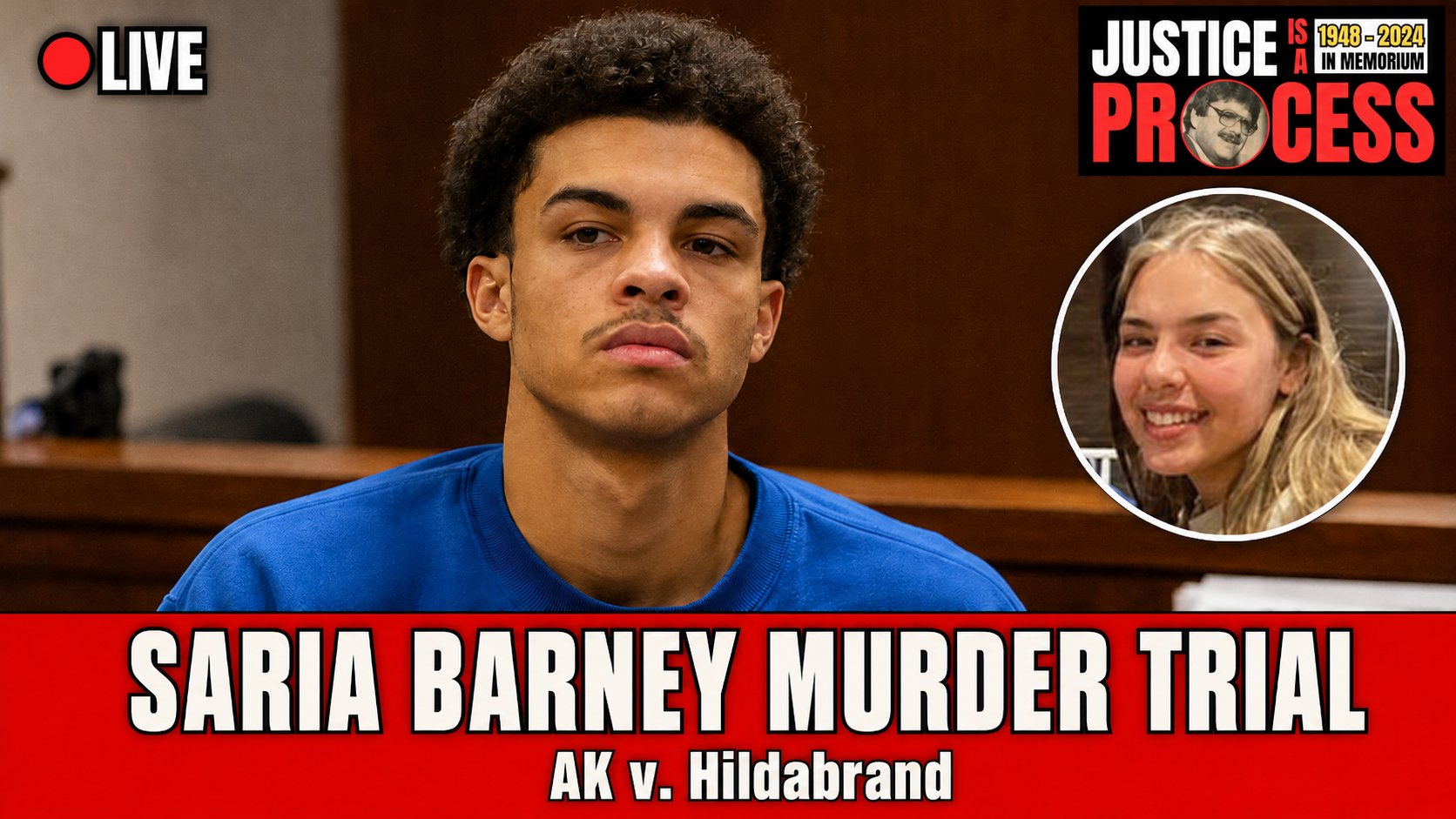
The Military Marriage Murder Trial. A soldier's wife vanished on a Sunday morning walk to work. Five days later, police found her in a storm drain. Her husband is on trial for her murder.
June 2026 | Justice Is A Process
On August 9th, 2023, a missing person flyer started moving through Anchorage social media feeds. A young woman's face. Twenty-one years old. A combat medic in the Alaska Army National Guard. Last seen on a Sunday morning, supposedly walking to her job at a Midtown sandwich shop.
One of the people sharing that flyer, asking the city to help bring her home, was her husband.
Two days later, a police drone hovering over a trail near the couple's apartment spotted something pale inside a storm drain. A pillow. Investigators pulled the lid, moved the pillow, and found Saria Barney Hildabrand. She had a gunshot wound to her left temple.
Prosecutors say her husband knew where she was the entire time. They say he put her there.
Zarrius Hildabrand was a 21-year-old active duty Army soldier stationed at Joint Base Elmendorf-Richardson. Saria was a 21-year-old Guardsman from Utah. They had been married eight months. The night before she disappeared, they were out celebrating his 21st birthday. By the following Friday, he was in the Anchorage Jail charged with her murder.
The state's case is built on what happened after she was last seen alive. Text messages sent from a phone she left at home. A shopping trip for hydrogen peroxide, a mattress cover, and a 96-gallon trash bin on wheels. A missing person report that didn't come for roughly 36 hours. A mattress that, according to the charging documents, was soaked through with human blood. And a husband who, police wrote, kept changing his story.
That is what the state says. Here is what the law says.
Zarrius Hildabrand has pleaded not guilty to every charge. He is presumed innocent. Not as a courtesy. Not as a formality we recite before getting to the good part. The presumption of innocence is the entire foundation of the trial that starts today, and it does not bend just because the allegations are ugly. The state carries the burden of proving every element of every charge beyond a reasonable doubt. He doesn't have to prove a thing.
Starting today, we're in that courtroom. Every witness. Every exhibit. Every objection. We're not here to convict him and we're not here to clear him. We're here to watch whether the system does what it promised to do.
This is Justice Is A Process. Let's begin.
Everything in this section comes from the charging documents, the Anchorage Police Department's public statements, and the reporting built on both. These are allegations. The state now has to prove them in front of twelve jurors.
Saturday night, August 5th, 2023. Zarrius and Saria Hildabrand went out drinking and partying with friends in Anchorage. It was his 21st birthday. According to what Zarrius later told police, they got home around 2 a.m.
Sunday morning is where his account and the evidence start pulling apart, at least the way the state tells it.
Zarrius told investigators that Saria woke up Sunday not feeling well enough to drive, so she decided to walk to her job at Bread & Brew, the Midtown restaurant where she worked. She left around 10 a.m. She left her phone at home. He said that was the last time he saw her.
Her coworkers say she never arrived.
At about 10:45 that morning, roughly 45 minutes after she supposedly walked out the door without her phone, a text went out from that same phone to her coworkers at Bread & Brew. She wasn't coming in. An employee responded that she needed to call the owner directly to report the absence. Another text came back from her phone claiming she didn't have the owner's number.
Investigators checked. The owner's number was saved in her phone. And the owner told police the call never came.
Think about what that means under the state's theory. Whoever sent those texts was holding Saria's phone inside that apartment, pretending to be her, and didn't know what she knew about her own contact list.
Detectives later asked Zarrius about those messages. According to the charging documents, he denied sending them and couldn't explain them.
Then there's the shopping trip. That same Sunday, the day Saria was last seen, investigators say Zarrius made purchases at Fred Meyer and Lowe's. New bedding. A mattress cover. Hydrogen peroxide. And a 96-gallon trash bin on wheels.
The state will tell the jury exactly what it thinks those items were for. The defense will get to answer.
Zarrius told police his concern built slowly. He said he went to pick Saria up from work Sunday evening and learned she had never made it. He said he didn't really start worrying until about 10 p.m., and that he spent the night searching on his own. Driving the neighborhood. Checking with friends. Calling her parents, hospitals, even the jail.
He did not call the police until Monday, August 7th. Roughly 36 hours after the last time anyone claims to have seen her alive. And he was the last person known to have seen her.
When investigators asked about the delay, he told them he held off because he thought he might find her himself and discover the whole thing was a misunderstanding.
Maybe that explanation lands with a jury. Maybe it doesn't. Either way, the state will argue those 36 hours weren't spent searching. They were spent cleaning.
Once the missing person report went in, Anchorage moved. Police searched. Military members searched. Family flew in. On a single day, somewhere between 60 and 70 volunteers walked trails and neighborhoods looking for Saria. Flyers went up in University Lake Park, where she liked to walk her dog.
And Zarrius was publicly part of it. He posted his wife's missing flyer on his own Facebook page and asked people to share it. He posted it the day before his arrest.
Her family says he deceived them throughout the search. Saria's mother, Meredith Barney, has said in court and to reporters that her son-in-law looked her in the eye during those days and lied.
That, again, is the allegation. It is also the emotional core of why this case has drawn national attention. If the state is right, a soldier murdered his wife and then stood shoulder to shoulder with the people searching for her.
If the state is wrong, an innocent 21-year-old widower has spent almost three years in custody waiting to say so.
Both possibilities should make you want to watch this trial closely. That's the point.
After Saria was reported missing, detectives visited the couple's home near Mockingbird Drive in Midtown Anchorage. Something caught their attention immediately. The only bed in the home was stripped down to a bare mattress pad.
They came back with a warrant.
According to the charging documents, when investigators lifted the bedding they found the mattress saturated with human blood. So much blood, the complaint says, that it soaked through the mattress, into the carpet, and into the wooden bed frame beneath it.
Investigators then used a chemical agent that reveals blood after cleanup attempts. They reported finding more. In the bathtub. On the floors.
Remember the Sunday purchases. New bedding. A mattress cover. Hydrogen peroxide. The state is going to hold those receipts up next to that mattress and ask the jury to connect them. The defense will fight that connection at every step, and the jury will decide whose version of those purchases survives cross-examination.
Thursday evening, August 10th. A police drone working the area around the apartment complex spotted something off a nearby trail. A pillow, and something light colored, inside a storm drain about four to five feet deep.
Officers opened the drain. They found blood on the rim. Under the pillow, they found human remains.
The remains were identified as Saria Barney Hildabrand. The charging documents describe a gunshot wound to her left temple.
Reporting on the investigation also describes blood found in a trash can near that trail, and a wheeled bin matching the one purchased that Sunday located during the searches that followed.
Zarrius Hildabrand was taken into custody that Thursday night. By Friday morning, the Anchorage Police Department announced charges: murder in the first degree, murder in the second degree, and tampering with physical evidence. His bail was set at $500,000. Within days, an Anchorage grand jury returned an indictment.
One more detail from the police file, and it matters. Investigators wrote that his story kept changing.
And one detail that is missing, and it matters just as much. The charging documents, as filed, named no motive.
Before she was a case number, Saria was a 21-year-old from Utah who had built a life most people twice her age would respect. She enlisted. She trained as a combat medic. She served as a specialist in the Alaska Army National Guard, the person whose job is to run toward the wounded.
She married Zarrius in December 2022 and the newlyweds moved north to Anchorage that January. She worked at Bread & Brew. She walked her dog at University Lake Park. The flyers her family and friends posted during the search went up on the same trails she walked in life.
Her family described her as a shining light. The Alaska National Guard said the entire organization was deeply saddened by the loss of one of its own. Her funeral was held in Mt. Pleasant, Utah, on August 25th, 2023, less than nine months after her wedding.
Hold on to the combat medic detail as this trial unfolds, because the courtroom is going to reduce her to diagrams and lab results, and she was the opposite of that. A combat medic is the soldier everyone else depends on when things go wrong. The training is brutal, the responsibility is enormous, and the people who choose it tend to be the ones who run toward trouble while everyone else runs away. At 21, Saria had already chosen to be that person twice over: once for her country, once for her state. The state's witnesses will spend weeks describing how she died. We'll keep reminding you how she lived.
Her mother, Meredith Barney, has attended every hearing in this case, sometimes flying from Utah to Anchorage to sit in the courtroom, sometimes appearing by phone. She has said publicly that she shows up so her daughter is represented, so the lawyers and the judge know she isn't going anywhere, and so Saria never becomes just another statistic.
Whatever the verdict, that is a mother doing the hardest work the system asks of a victim's family: showing up, for years, while the process grinds forward.
Zarrius Ray Hildabrand was born August 5th, 2002. The night out that ended his marriage's final weekend was his 21st birthday celebration. He is now 23.
At the time of his arrest, he was an active duty cannon crewmember with the 2nd Infantry Brigade Combat Team (Airborne), 11th Airborne Division, stationed at Joint Base Elmendorf-Richardson in Anchorage. He and Saria were a military couple in a military town, eight months into a marriage that started with a Utah wedding and a move to the Last Frontier.
He reported his wife missing. He shared her flyer. He spoke with detectives, repeatedly and at length, before his arrest. Those statements are now evidence, and you can expect to hear them dissected at trial.
He has pleaded not guilty to all three charges.
Say that part out loud, because everything you just read in the allegations section makes it easy to forget. Zarrius Hildabrand is presumed innocent. He has been presumed innocent every day of the nearly three years he has spent in custody, and he walks into that courtroom today presumed innocent. The state chose to charge him. Now the state has to prove it. That is not a technicality protecting him. That is the rule protecting all of us.
The case is State of Alaska v. Zarrius Ray Hildabrand, case number 3AN-23-05954CR, in Anchorage Superior Court. Judge Peter R. Ramgren presides, in Courtroom 601A of the Nesbett Courthouse in downtown Anchorage.
The prosecution comes from the Anchorage District Attorney's office, which has handled the case through years of pretrial litigation, including a discovery process that ran roughly 200 pages of evidence, autopsy reports, and police files. District Attorney Brittany Dunlop appeared for the state during key pretrial hearings.
The defense comes from the Alaska Public Defender Agency, with attorney Lars Danner appearing for Hildabrand during the pretrial phase. The defense has said almost nothing publicly. When reporters asked, Danner declined to discuss anything beyond what happened in open court. Keep that in mind. It means the defense theory you hear in opening statements today may be the first time anyone outside that defense team has heard it.
Jury selection began Monday, June 8th. Opening statements are expected Wednesday, June 10th. Our live coverage starts the moment that courtroom feed goes hot.
Three counts. Two of them carry up to 99 years each. Here is what each one actually means under Alaska law, because the labels alone don't tell you much.
What it means: The state must prove Zarrius Hildabrand intended to cause Saria's death and caused it. Here's something a lot of viewers get wrong, and it matters in this case: Alaska's first-degree murder statute does not require premeditation. In many states, first degree means a planned killing. In Alaska, it means an intentional one. The state does not have to prove he planned it for days or even minutes. It has to prove that when he acted, he meant to kill her.
What the State must prove: That Saria Hildabrand is dead. That Zarrius Hildabrand caused her death. That he acted with intent to cause death, not by accident, not recklessly, but intending that result.
Potential sentence: 30 to 99 years. The Anchorage Police Department noted at the time of arrest that each murder count carries up to 99 years.
What it means: This is the state's fallback position, and the fact that it's charged tells you something about how prosecutors see their own proof. Second-degree murder in Alaska covers a killing where the defendant intended to cause serious physical injury, or knew his conduct was substantially certain to cause death, or acted with extreme indifference to the value of human life. In plain English: even if the jury isn't convinced he meant to kill her, the state can still win a murder conviction if it proves he meant to hurt her badly or simply didn't care whether she lived, and she died.
What the State must prove: That he caused her death while either intending serious physical injury, knowing death was substantially certain, or acting with extreme indifference to human life.
Potential sentence: 15 to 99 years.
What it means: The state must prove he destroyed, concealed, or removed physical evidence intending to impair its availability in an investigation or official proceeding. The cleaned apartment, the hidden body, the purchases: this count is where all of that lives as its own crime, separate from the killing itself.
What the State must prove: That physical evidence existed, that he concealed or destroyed it, and that he did so specifically intending to interfere with the investigation.
Potential sentence: Up to 5 years as a class C felony.
The burden of proof on every element of every count sits entirely with the State of Alaska. Beyond a reasonable doubt. The defense could rest without calling a single witness and the state would still have to clear that bar.
Three counts means this jury isn't facing a simple guilty-or-not-guilty question. It's facing a menu, and understanding that menu now will make everything you watch over the coming weeks make more sense.
The jury could convict on first-degree murder, finding he intended to kill her. It could reject first-degree and convict on second-degree, finding he killed her but without proof of intent to cause death. And here's the scenario that should be on your radar from day one: the jury could acquit on both murder counts and still convict on tampering with physical evidence.
Sit with that last one. Under Alaska law, hiding a body and destroying evidence are crimes whether or not the person doing it committed the killing. A juror could believe Zarrius Hildabrand concealed his wife's death and remain unconvinced, beyond a reasonable doubt, that he caused it. If that sounds far-fetched, remember that the tampering count carries a five-year maximum while the murder counts carry 99. The distance between those outcomes is the entire stakes of this trial, and it runs straight through the gap in the state's public case: the cover-up is documented, the killing has to be proven.
So when you watch each witness, sort what you're hearing into those buckets. Does this testimony prove tampering? Does it prove a killing? Does it prove intent? The state needs all three buckets full. The defense only needs one of them to come up short.
Why is this case at trial? Strip away the headlines and look at the structure of the evidence, because the structure is the story.
Almost everything the public knows about this case is about what happened after Saria was last seen alive. The texts from her phone. The Sunday shopping list. The 36-hour delay. The stripped bed. The blood. The storm drain. The changing story. It is a thick file of concealment and deception.
What the public file is thin on is the killing itself. No eyewitness has been named. No confession has been reported. The charging documents named no motive. The complaint describes a gunshot wound, but the public record so far doesn't walk through a recovered weapon or a ballistic match. That may come at trial. It may not exist.
So this case is at trial because the state is asking a jury to take overwhelming evidence of a cover-up and conclude, beyond a reasonable doubt, that it proves an intentional murder by this specific man. The defense gets to stand in that gap between concealment and killing, and between killing and intent. That gap is the whole trial.
Expect the prosecution to build a timeline and walk the jury down it hour by hour. The birthday celebration. Home at 2 a.m. The last morning. Then every act they attribute to Zarrius while his wife was supposedly walking to work: the texts from her phone, the purchases, the silence, the late report, the search he joined, the flyer he shared.
The legal engine underneath that timeline is a concept called consciousness of guilt. The law lets a jury infer that a person who lies to police, fabricates evidence, and hides a body is doing it because they know what they did. Layer that on top of the physical evidence in the apartment, the fact that by his own account he was the last person with her, and the absence of any sign she ever left that home alive, and you have the state's theory: nobody else had the access, the opportunity, or the reason to do every single one of these things.
The forensic witnesses will matter enormously here. The medical examiner on the wound. The crime lab on the blood. The digital analysts on the phones and the purchase records. Watch how each one holds up on cross, because circumstantial cases live and die one link at a time.
The defense has kept its theory locked down for almost three years. That's not a weakness. That's discipline, and it means opening statements today carry real suspense.
But the architecture of the case tells you where the defense ground is, because there are only so many places to stand. First, the gap: evidence that someone cleaned up and concealed is not, by itself, proof of who killed her or that the killing was intentional murder. Second, the degree fight: even a jury convinced Zarrius caused her death still has to sort first-degree intent from second-degree recklessness, and the difference is decades. Third, the burden itself: in a case with no named eyewitness, no reported confession, and no stated motive, the defense doesn't have to offer an alternative story. It has to show the state's chain of inferences has a weak link.
And here's a wrinkle regular viewers of this channel will recognize. We just watched a Wisconsin jury wrestle with a defendant who admitted concealing his wife's death while denying he killed her. Concealment-versus-killing is a real defense lane, and juries take it seriously when the state's proof of the death itself is thin. Whether this defense goes anywhere near that lane, we find out today.
The pretrial record in this case played out quietly. Years of discovery hearings and continuances, a 200-page evidence file, and very little public fighting over suppression or admissibility that reporters captured. That silence cuts both ways. It might mean the evidence comes in clean and the trial is a straight fight over inferences. It might mean the battles happened in filings nobody covered. Either way, the first days of testimony will show us which rulings shaped the battlefield, and when they surface, we'll break them down for you in plain English.
Every channel covering this trial will show you the same witnesses. What we do differently is watch the system itself. Four things matter most in this one.
Be honest with yourself about your reaction to the allegations section above. The texts, the trash bin, the blood, the storm drain. Your gut has probably already voted.
That's exactly why this case is worth watching. The presumption of innocence isn't designed for cases where the defendant looks innocent. It's designed for cases like this one, where the public made up its mind in August of 2023. The question this trial answers is not whether the story sounds guilty. It's whether the state can prove each element with admissible evidence, against a defense pushing back at every step. My father spent his career standing next to people whole communities had already convicted. He used to say the Constitution isn't tested when it's easy. It's tested right here.
You will hear the phrase circumstantial evidence used like an insult. It isn't one. Juries convict on circumstantial evidence all the time, lawfully and correctly. But a circumstantial case is a chain, and the jury has to find every link solid. He was the last one with her. The blood was in their bed. The texts came from her phone in their home. The purchases match a cleanup. No single link proves murder. The state's job is to make the jury see one picture. The defense's job is to make at least one link wobble. Watch the links, not the volume.
Zarrius Hildabrand talked to detectives. Before he was arrested, before he had counsel beside him, he gave accounts of that weekend. Police say those accounts shifted. Every one of those statements is now a state's exhibit.
I'm not going to pretend this channel is neutral on the underlying lesson, because it's one my father taught from a coffee shop and was prosecuted for teaching: you have the right to remain silent, and almost nobody uses it. Whatever the jury ultimately decides about Zarrius Hildabrand, his interviews will be a case study in how a person's own voluntary words become the spine of the case against them. Watch how the detectives testify about those conversations. Watch what the defense does on cross to put those statements in context. That's the Fifth Amendment, live, in real time.
Both these young people wore the uniform, and some viewers will wonder why an active duty soldier faces a state jury instead of a court-martial. The short answer: the alleged crime happened off base, against a civilian-jurisdiction victim, inside Anchorage city limits. Alaska charged it, so Alaska tries it. The Army's separate processes can wait. What the military dimension does change is the human texture of this trial. JBER, the Guard, two service families, and a military community that searched for one of its own. Expect that to be present in this courtroom every single day.
Nearly three years separate the search for Saria from the seating of this jury. Here is how the case got here.
You're going to see this question in every comment section, so let's answer it before the trial starts. Saria died in August 2023. Opening statements are happening in June 2026. To a lot of people, that delay looks like the system failing.
It's usually the opposite. The Sixth Amendment gives a defendant the right to a speedy trial, but that right belongs to the defendant, and defendants in serious felony cases waive it constantly. Why? Because the alternative is walking into a 99-year trial unprepared. The state turned over roughly 200 pages of discovery in this case, plus autopsy reports, police files, lab work, and digital evidence. The defense has a constitutional duty to review every page of it, test it, and chase down anything that might help its client. Rushing that process doesn't produce a faster trial. It produces an appeal, a reversal, and a second trial years later, which serves nobody, least of all the victim's family.
The hearings you saw continued and rescheduled across 2023, 2024, and 2025 were the system doing exactly what it's built to do: making sure that when this jury finally renders a verdict, it's a verdict that holds. Meredith Barney sat through every one of those hearings. Three years of patience for one shot at a verdict that sticks. That's the trade, and now we're here.
What should you expect from here? A forensics-heavy state's case: detectives, crime scene technicians, the medical examiner, lab analysts on the blood evidence, and digital witnesses on the phones and purchase records. Expect Saria's family and coworkers to put a human face on the timeline. Expect the defense to do its work on cross-examination long before we learn whether it puts on a case of its own. And keep one question in your pocket for every single witness: does this testimony prove the killing, or only the cover-up?
Live broadcasts every trial day. No Breaks editions within 24 hours. Testimony segments, key moments, and analysis across the entire trial.
Zarrius Hildabrand is presumed innocent until proven guilty beyond a reasonable doubt. That is not a technicality. That is the foundation of everything we do here.
Let's watch the system together.
Subscribe to Justice Is A Process on YouTube for live trial coverage, No Breaks editions, and breaking news as it happens.
🔴 Subscribe on YouTube111,000+ subscribers watching the system with us
Discussion